


100% Pass Guaranteed Free FCSS_EFW_AD-7.4 Exam Dumps Jan 03, 2026
Verified & Latest FCSS_EFW_AD-7.4 Dump Q&As with Correct Answers
NEW QUESTION # 21
View the exhibit, which contains the output of a diagnose command, and then answer the question below.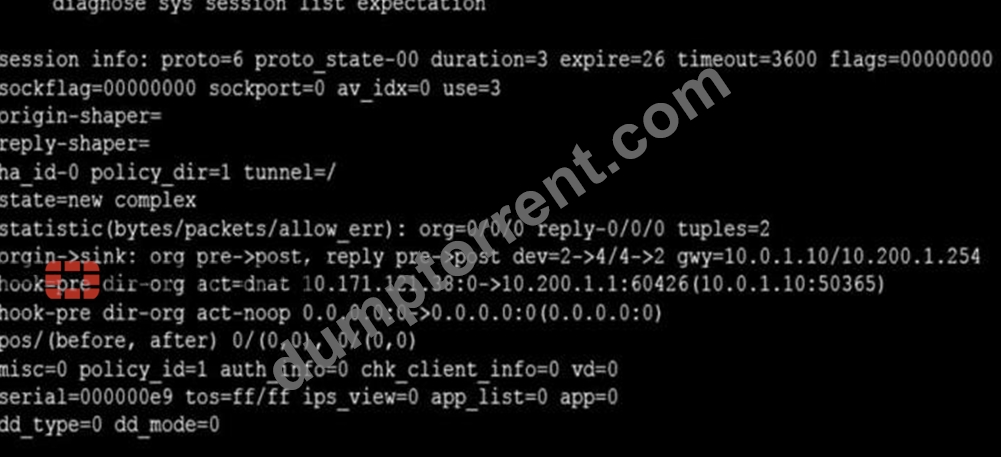
What statements are correct regarding the output? (Choose two.)
- A. Traffic in the original direction (coming from the IP address 10.171.122.38) will be routed to the next- hop IP address 10.200.1.1.
- B. Traffic in the original direction (coming from the IP address 10.171.122.38) will be routed to the next- hop IP address 10.0.1.10
- C. This is an expected session created by an application control profile.
- D. This is an expected session created by a session helper
Answer: A,D
NEW QUESTION # 22
Refer to the exhibit, which shows a hub and spokes deployment.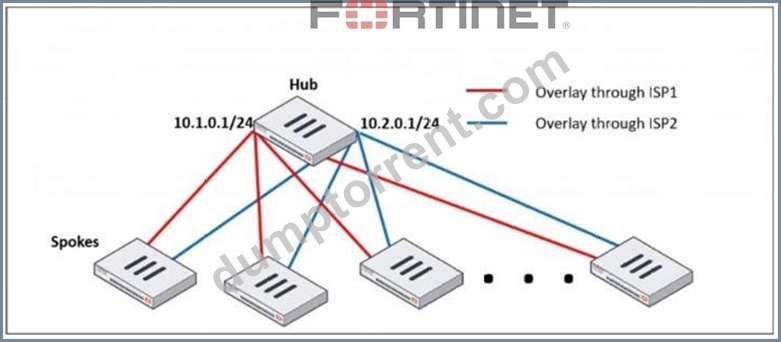
An administrator is deploying several spokes, including the BGP configuration for the spokes to connect to the hub.
Which two commands allow the administrator to minimize the configuration? (Choose two.)
- A. route-reflector-client
- B. neighbor-range
- C. ibgp-enforce-multihop
- D. neighbor-group
Answer: B,D
Explanation:
neighbor-group:
This command is used to group multiple BGP neighbors with the same configuration, reducing redundant configuration.
Instead of defining individual BGP settings for each spoke, the administrator can create a neighbor-group and apply the same policies, reducing manual work.
neighbor-range:
This command allows the configuration of a range of neighbor IPs dynamically, reducing the need to manually define each spoke neighbor.
It automatically adds BGP neighbors that match a given prefix, simplifying deployment.
NEW QUESTION # 23
View the exhibit, which contains the partial output of a diagnose command, and then answer the question below.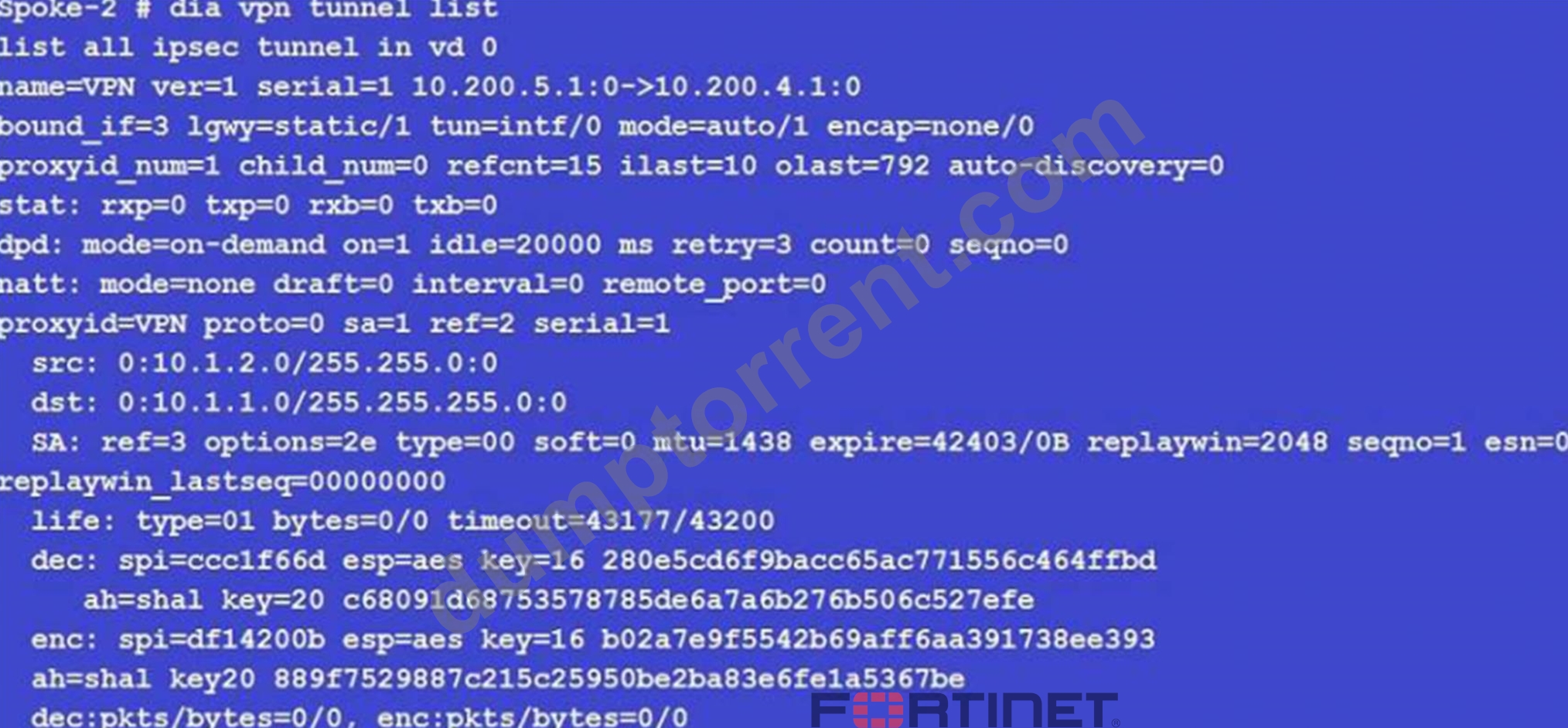
Based on the output, which of the following statements is correct?
- A. Anti-replay is enabled.
- B. Quick mode selectors are disabled.
- C. Remote gateway IP is 10.200.5.1.
- D. DPD is disabled.
Answer: A
NEW QUESTION # 24
An administrator wants to capture ESP traffic between two FortiGates using the built-in sniffer. If the administrator knows that there is no NAT device located between both FortiGates, What command should the administrator execute?
- A. diagnose sniffer packet any 'udp port 500'
- B. diagnose sniffer packet any 'udp port 4500'
- C. diagnose sniffer packet any 'udp port 500 or udp port 4500'
- D. diagnose sniffer packet any 'esp'
Answer: D
NEW QUESTION # 25
View the exhibit, which contains the partial output of an IKE real-time debug, and then answer the question below.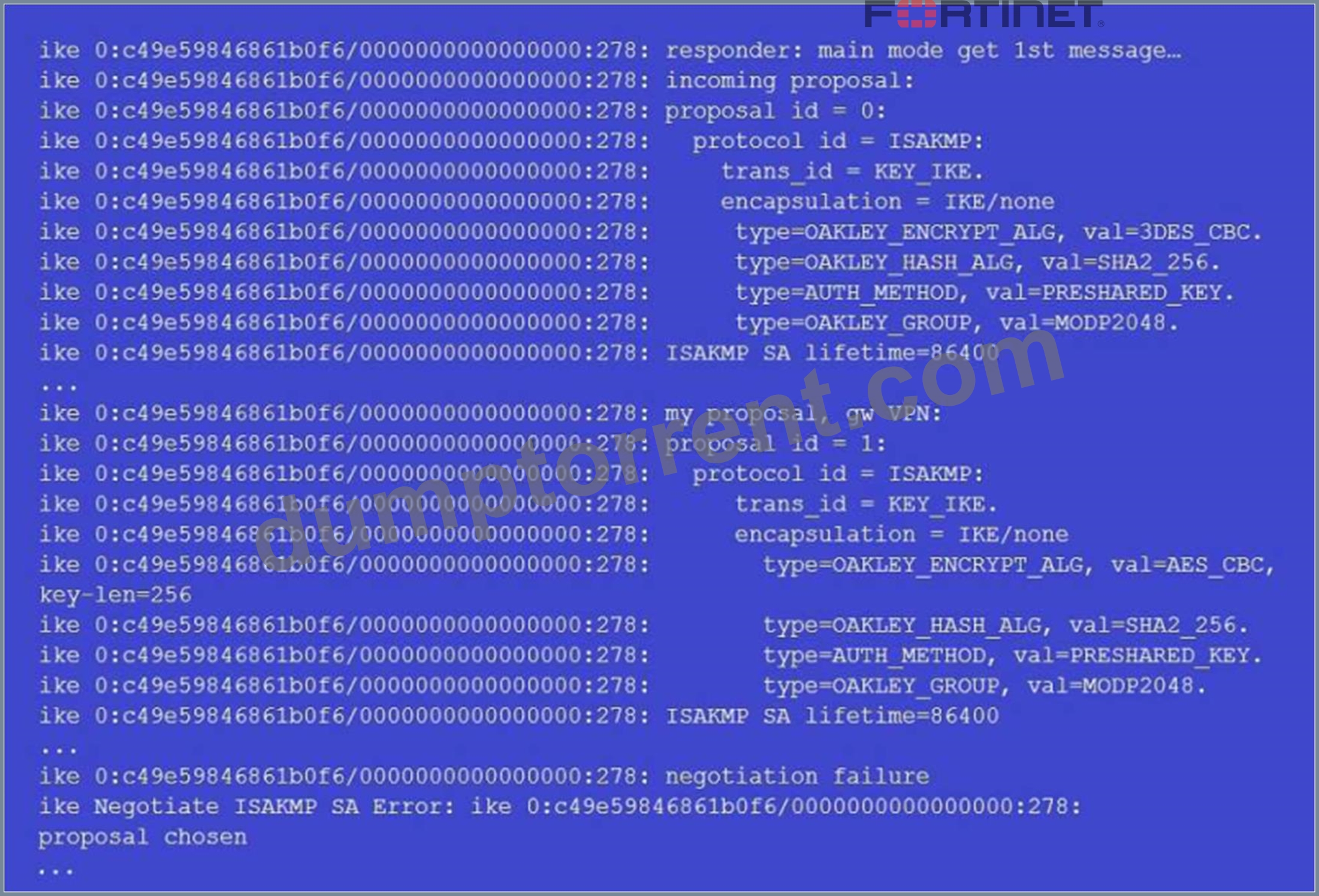
Why didn't the tunnel come up?
- A. The remote gateway is using aggressive mode and the local gateway is configured to use man mode.
- B. The remote gateway's phase 1 configuration does not match the local gateway's phase 1 configuration.
- C. The remote gateway's phase 2 configuration does not match the local gateway's phase 2 configuration.
- D. The pre-shared keys do not match.
Answer: B
NEW QUESTION # 26
Refer to the exhibit, which contains the partial output of an OSPF command.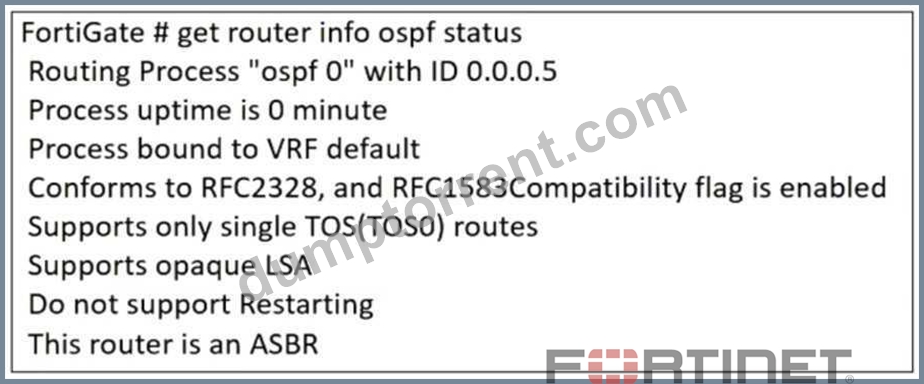
An administrator is checking the OSPF status of a FortiGate device and receives the output shown in the exhibit.
Which statement on this FortiGate device is correct?
- A. The FortiGate device does not support OSPF ECMP.
- B. The FortiGate device is a backup designated router.
- C. The FortiGate device is in the area 0.0.0.5.
- D. The FortiGate device can inject external routing information.
Answer: D
Explanation:
From the OSPF status output, the key information is:
"This router is an ASBR" - This means the FortiGate is acting as an Autonomous System Boundary Router (ASBR).
An ASBR is responsible for injecting external routing information into OSPF from another routing protocol (such as BGP, static routes, or connected networks).
NEW QUESTION # 27
Examine the IPsec configuration shown in the exhibit; then answer the question below.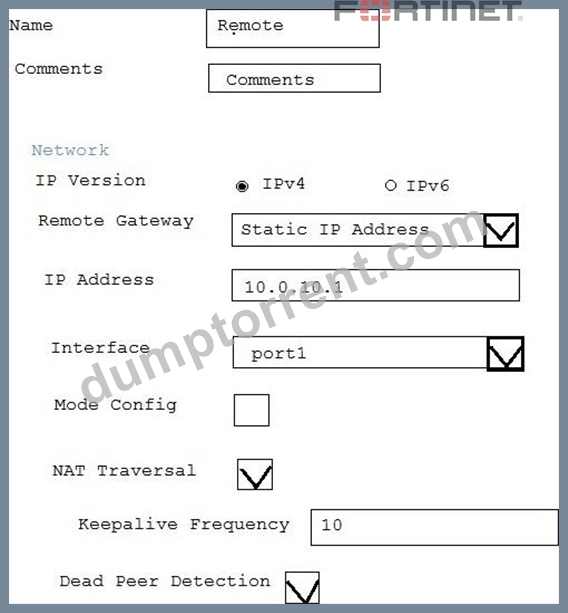
An administrator wants to monitor the VPN by enable the IKE real time debug using these commands:
diagnose vpn ike log-filter src-addr4 10.0.10.1
diagnose debug application ike -1
diagnose debug enable
The VPN is currently up, there is no traffic crossing the tunnel and DPD packets are being interchanged between both Ipsec gateways. However, the IKE rea time debug does NOT show any output.
Why isn't there any output?
- A. The IKE real time debug shows error messages only. If it does not provide any output, it indicates that the tunnel is operating normally.
- B. The log-filter setting is set incorrectly. The VPN's traffic does not match this filter.
- C. The IKF real time debug shows the phase 1 negotiation only. For information after that, the administrator must use the IPsec real time debug instead: diagnose debug application ipsec -1.
- D. The IKE real time debug shows the phases 1 and 2 negotiations only. It does not show any more output once the tunnel is up.
Answer: B
NEW QUESTION # 28
Which two configurations are mandatory for an auto-discovery VPN (ADVPN) implementation on a hub? (Choose two.)
- A. The remote-ip must be on a different IP address from the overlay subnet.
- B. set add-route must be enabled to add routes.
- C. set net-device must be disabled to avoid dynamic interface creation.
- D. An overlay IP address with a mask of /32 must be assigned to the IPsec virtual interface.
Answer: C,D
NEW QUESTION # 29
Refer to the exhibit, which contains a partial command output.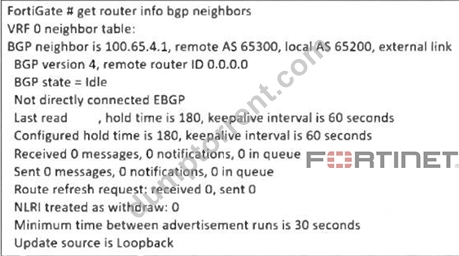
The administrator has configured BGP on FortiGate. The status of this new BGP configuration is shown in the exhibit.
What configuration must the administrator consider next?
- A. Configure the local AS to 65300.
- B. Configure a static route to 100.65.4.1.
- C. Contact the remote peer administrator to enable BGP
- D. Enable ebgp-enforce-multihop.
Answer: D
Explanation:
From theBGP neighbor status output, the key issue is thatBGP is stuck in the "Idle" state, meaning the FortiGate is unable to establish a BGP session with its peer100.65.4.1(Remote AS 65300).
The output also shows:
#"Not directly connected EBGP"# This means the BGP peer is not on the same subnet, requiring multihop BGP.
#"Update source is Loopback"# Since a loopback interface is used, FortiGate must be configured to allow BGP neighbors over multiple hops.
To resolve this issue, the administrator must enableebgp-enforce-multihop, which allows BGP sessions to be established even when the neighbors are not directly connected.
NEW QUESTION # 30
An administrator has configured the following CLI script on FortiManager, which failed to apply any changes to the managed device after being executed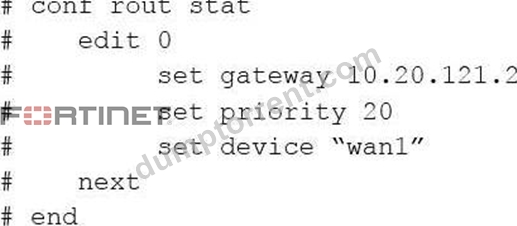
Why didn't the script make any changes to the managed device?
- A. Incomplete commands are ignored in CLI scripts.
- B. Commands that start with the # sign are not executed.
- C. CLI scripts will add objects only if they are referenced by policies.
- D. Static routes can only be added using TCL scripts.
Answer: B
NEW QUESTION # 31
Refer to the exhibit, which shows a command output.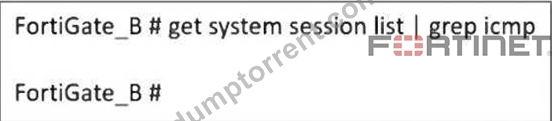
FortiGate_A and FortiGate_B are members of an FGSP cluster in an enterprise network.
While testing the cluster using the ping command, the administrator monitors packet loss and found that the session output on FortiGate_B is as shown in the exhibit.
What could be the cause of this output on FortiGate_B?
- A. session-pickup-connectionless is set to disable on FortiGate_B.
- B. FortiGate_A and FortiGate_B have the same standalone-group-id value.
- C. FortiGate_B is configured in passive mode.
- D. The session synchronization is encrypted.
Answer: A
Explanation:
The Fortinet FGSP (FortiGate Session Life Support Protocol) cluster allows session synchronization between two FortiGate devices to provide seamless failover. However, ICMP (ping) is a connectionless protocol, and by default, FortiGate does not synchronize connectionless sessions unless explicitly enabled.
In the exhibit:
The command get system session list | grep icmp on FortiGate_B returns no output, meaning that ICMP sessions are not being synchronized from FortiGate_A. If session-pickup-connectionless is disabled, FortiGate_B will not receive ICMP sessions, causing packet loss during failover.
NEW QUESTION # 32
Refer to the exhibit, which shows a partial web filter profile configuration.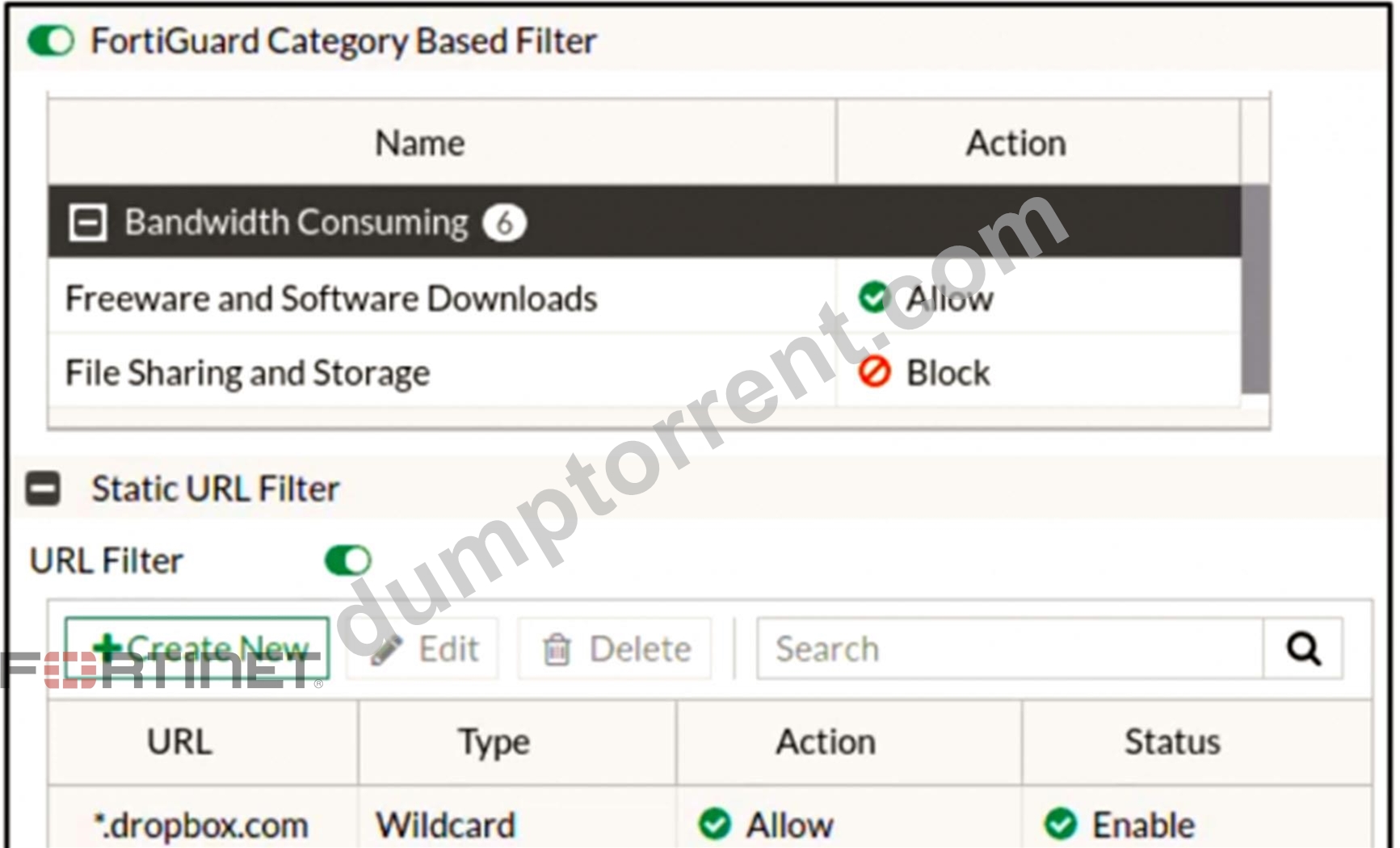
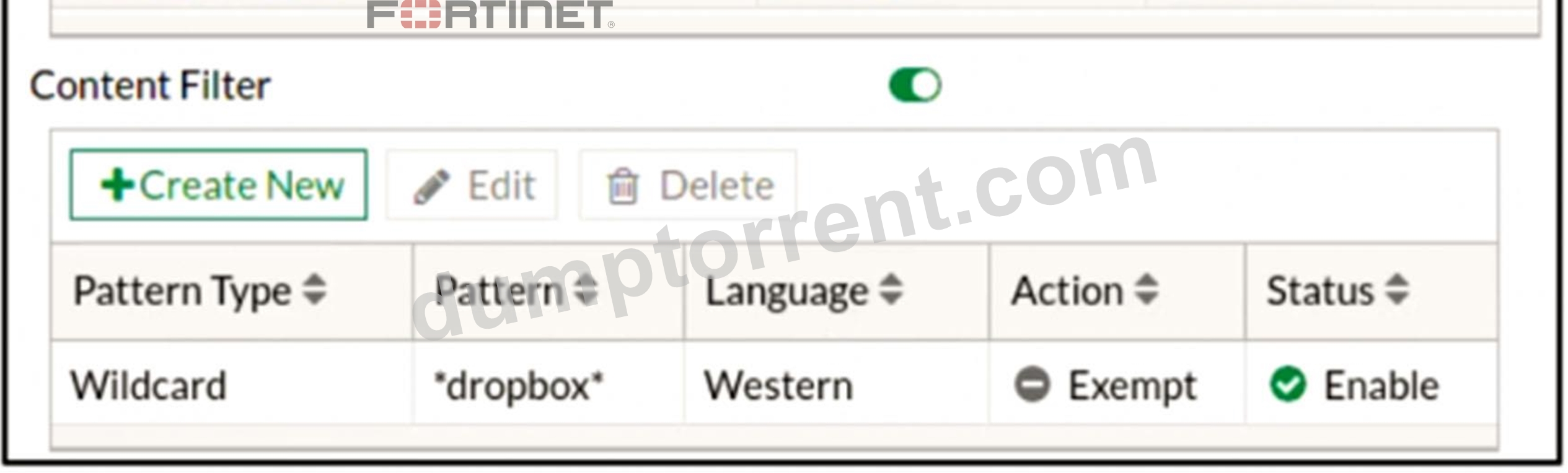
Which action will FortiGate take if a user attempts to access www.dropbox.com, which is categorized as File Sharing and Storage?
- A. FortiGate will block the connection as an invalid URL.
- B. FortiGate will block the connection, based on the FortiGuard category based filter configuration.
- C. FortiGate will allow the connection, based onthe URL Filter configuration.
- D. FortiGate will exempt the connection, based on the Web Content Filter configuration.
Answer: C
NEW QUESTION # 33
Refer to the exhibit, which shows an ADVPN network.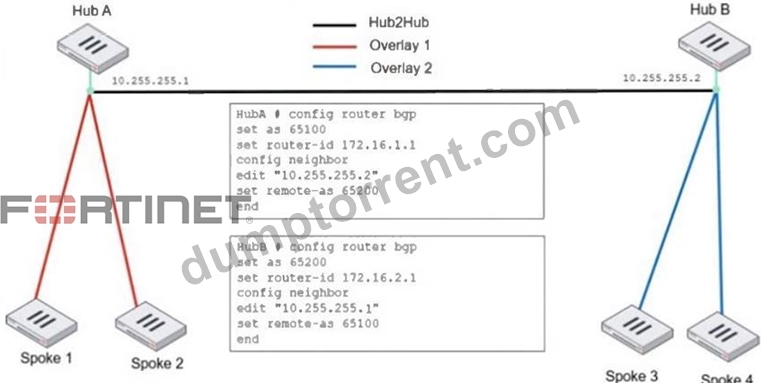
An administrator must configure an ADVPN using IBGP and EBGP to connect overlay network 1 with 2.
What two options must the administrator configure in BGP? (Choose two.)
- A. set ebgp-enforce-multrhop enable
- B. set ibgp-enforce-multihop advpn
- C. set next-hop-self enable
- D. set attribute-unchanged next-hop
Answer: A,C
Explanation:
In this ADVPN (Auto-Discovery VPN) network, there are two hubs (Hub A and Hub B) connected via EBGP, while IBGP is used within each overlay. To ensure proper BGP routing between the overlays, the administrator must configure specific BGP options..
set ebgp-enforce-multihop enable
By default, EBGP requires directly connected neighbors. Since Hub A and Hub B are not directly connected but reach each other over an IPsec tunnel, multihop must be enabled for EBGP sessions to work.
set next-hop-self enable
In IBGP, the next-hop attribute does not change by default. When an IBGP route is advertised from a spoke to another hub or spoke, the next-hop needs to be updated to ensure proper reachability. Enabling next-hop-self forces the BGP speaker to advertise itself as the next-hop, ensuring that all spokes properly reach routes across the overlays.
NEW QUESTION # 34
In which order are firewall policies processed on a FortiGate unit?
- A. Based on best match.
- B. From top to down, according with their policy ID number.
- C. Based on the priority value.
- D. From top to down, according with their sequence number.
Answer: D
NEW QUESTION # 35
Refer to the exhibit, which shows a partial routing table.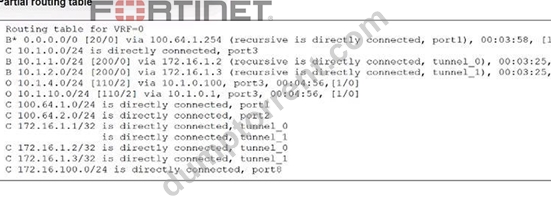
What two conclusions can you draw from the FortiGate output shown in the exhibit? (Choose two.)
- A. FortiGate creates separate virtual interfaces for each VPN client.
- B. FortiGate is not using the destination subnets of the quick mode selectors to populate the routing table.
- C. net-device is disabled in the tunnel IPSec phase 1 configuration.
- D. add-route is enabled in the tunnel IPSec phase 1 configuration.
Answer: B,C
NEW QUESTION # 36
Refer to the exhibit.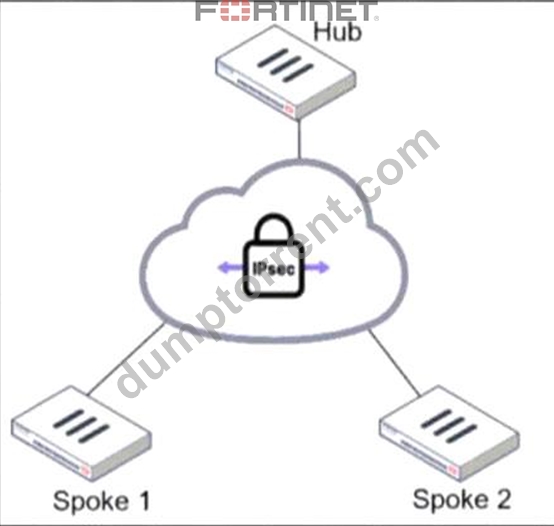
An administrator is deploying a hub and spokes network and using OSPF as dynamic protocol.
Which configuration is mandatory for neighbor adjacency?
- A. Set rfc1583-compatible enable in the router configuration
- B. Set bfd enable in the router configuration
- C. Set network-type point-to-multipoint in the hub interface
- D. Set virtual-link enable in the hub interface
Answer: C
Explanation:
In a hub-and-spoke topology using OSPF over IPsec VPNs, thepoint-to-multipointnetwork type is necessary to establish neighbor adjacencies between the hub and spokes. This network type ensures that OSPF operates correctly without requiring a designated router (DR) and allows dynamic routing updates across the IPsec tunnels.
NEW QUESTION # 37
What does the dirty flag mean in a FortiGate session?
- A. Traffic has been blocked by the antivirus inspection.
- B. Traffic has been identified as from an application that is not allowed.
- C. The next packet must be re-evaluated against the firewall policies.
- D. The session must be removed from the former primary unit after an HA failover.
Answer: C
NEW QUESTION # 38
View the following FortiGate configuration.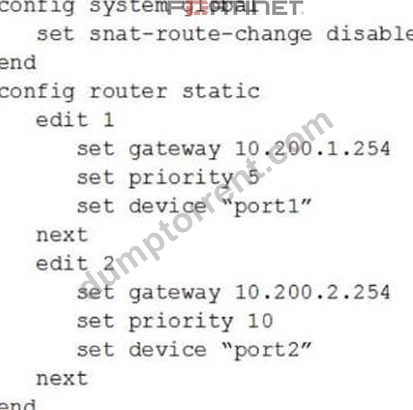
All traffic to the Internet currently egresses from port1.
The exhibit shows partial session information for Internet traffic from a user on the internal network: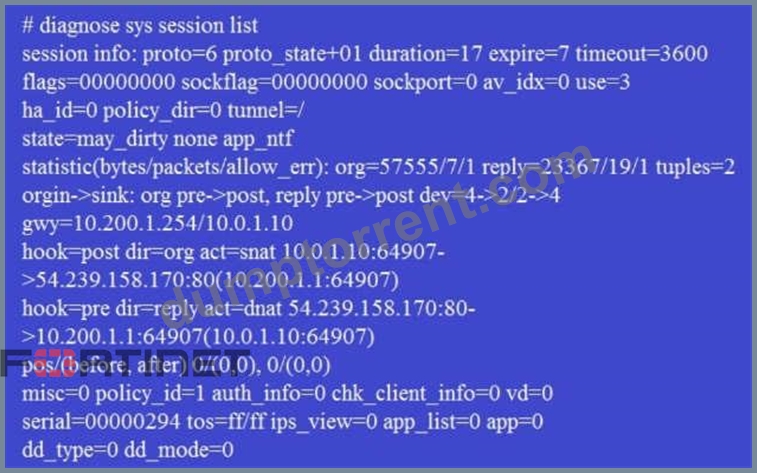
If the priority on route ID 1 were changed from 5 to 20, what would happen to traffic matching that user's session?
- A. The session would remain the session table, and its traffic would start to egress from port2.
- B. The session would remain the session table, but its traffic would now egress from both port 1and port2
- C. The session would be deleted, so the client would need to start a new session.
- D. The session would remain the session table, and its traffic would still egress from port 1.
Answer: D
NEW QUESTION # 39
Refer to the exhibits.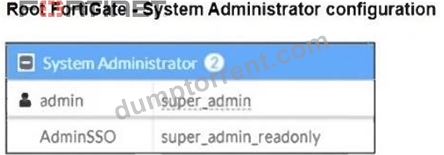
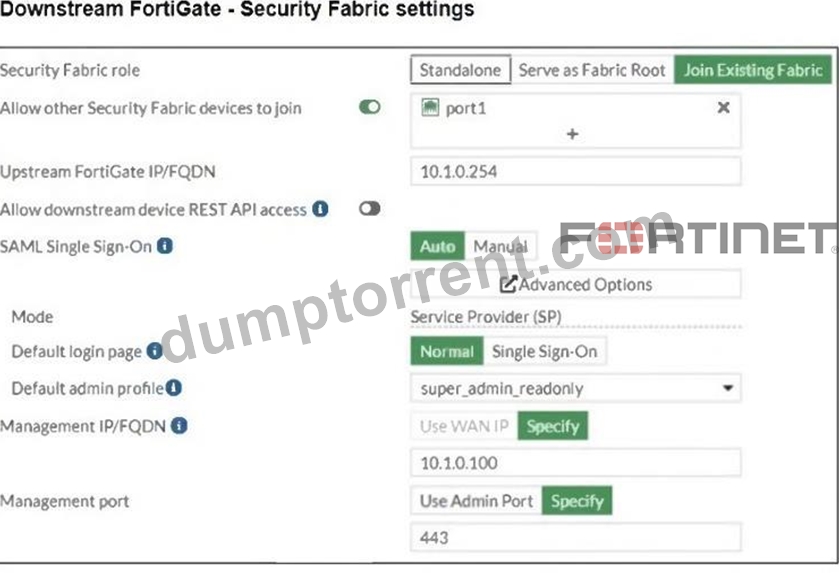
The Administrators section of a root FortiGate device and the Security Fabric Settings section of a downstream FortiGate device are shown.
When prompted to sign in with Security Fabric in the downstream FortiGate device, a user enters the AdminSSO credentials.
What is the next status for the user?
- A. The user receives an authentication failure message.
- B. The user accesses the downstream FortiGate with super_admin privileges.
- C. The user accesses the downstream FortiGate with super_admin_readonly privileges.
- D. The user is prompted to create an SSO administrator account for AdminSSO.
Answer: C
Explanation:
From the Root FortiGate - System Administrator Configuration exhibit:
The AdminSSO account has the super_admin_readonly role.
From the Downstream FortiGate - Security Fabric Settings exhibit:
The Security Fabric role is set to Join Existing Fabric, meaning it will authenticate with the root FortiGate.
SAML Single Sign-On (SSO) is enabled, and the default admin profile is set to super_admin_readonly.
When the AdminSSO user logs into the downstream FortiGate using SSO, the authentication request is sent to the root FortiGate, where AdminSSO has super_admin_readonly permissions.
Since the downstream FortiGate inherits this permission through the Security Fabric configuration, the user will be granted super_admin_readonly access.
NEW QUESTION # 40
An administrator must improve the resiliency of a link by minimizing data loss within the enterprise network that has full path redundancy.
What should the administrator enable on the FortiGate devices that use BGP as dynamic routing protocol between two separate autonomous systems? (Choose two.)
- A. graceful-restart
- B. route-reflector-client
- C. ibgp-multipath
- D. bfd
Answer: A,D
NEW QUESTION # 41
What global configuration setting changes the behavior for content-inspected traffic while FortiGate is in system conserve mode?
- A. av-failopen
- B. ips-failopen
- C. mem-failopen
- D. utm-failopen
Answer: A
NEW QUESTION # 42
An administrator wants to simplify a new hub-and-spoke network deployment with the BGP recommended configuration.
Which two sections on FortiManager must the administrator use? (Choose two.)
- A. Metadata Variables
- B. Automation Stitch
- C. Provisioning Templates
- D. Meta Fields
Answer: A,C
NEW QUESTION # 43
Refer to the exhibits.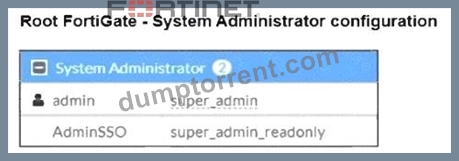
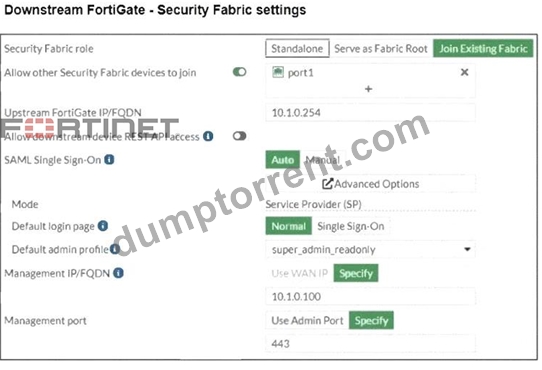
The Administrators section of a root FortiGate device and the Security Fabric Settings section of a downstream FortiGate device are shown.
When prompted to sign in with Security Fabric in the downstream FortiGate device, a user enters the AdminSSO credentials.
What is the next status for the user?
- A. The user receives an authentication failure message.
- B. The user accesses the downstream FortiGate with super_admin privileges.
- C. The user accesses the downstream FortiGate with super_admin_readonly privileges.
- D. The user is prompted to create an SSO administrator account for AdminSSO.
Answer: C
Explanation:
From theRoot FortiGate - System Administrator Configurationexhibit:
# TheAdminSSOaccount has thesuper_admin_readonlyrole.
From theDownstream FortiGate - Security Fabric Settingsexhibit:
# TheSecurity Fabric roleis set toJoin Existing Fabric, meaning it will authenticate with the root FortiGate.
#SAML Single Sign-On (SSO) is enabled, and thedefault admin profileis set tosuper_admin_readonly.
When theAdminSSOuser logs into the downstream FortiGate usingSSO, the authentication request is sent to the root FortiGate, where AdminSSO hassuper_admin_readonlypermissions. Since the downstream FortiGate inherits this permission through the Security Fabric configuration, the user will be granted super_admin_readonlyaccess.
NEW QUESTION # 44
......
Latest FCSS_EFW_AD-7.4 dumps - Instant Download PDF: https://www.dumptorrent.com/FCSS_EFW_AD-7.4-braindumps-torrent.html
Updated Verified FCSS_EFW_AD-7.4 Downloadable Printable Exam Dumps: https://drive.google.com/open?id=1YSmWlSYohStv0QEGRIGwJ0tjfPXGHCUm