


[2021] AZ-120 All-in-One Exam Guide Practice To your AZ-120 Exam!
Preparations of AZ-120 Exam 2021 Microsoft Azure Unlimited 135 Questions
NEW QUESTION 71
What should you use to perform load testing as part of the migration plan?
- A. Azure Application Insights
- B. SAP LoadRunner by Micro Focus
- C. JMeter
- D. Azure Monitor
Answer: B
Explanation:
Scenario: Upgrade and migrate SAP ECC to SAP Business Suite on HANA Enhancement Pack 8.
With the SAP LoadRunner application by Micro Focus, you can accelerate testing and development, reduce slowdowns and expenses, and gain a better understanding of performance issues. Validate software performance, virtualize your network, simulate workloads, benchmark production system performance, and optimize your deployment of SAP HANA software References:
https://www.sap.com/products/loadrunner.html
NEW QUESTION 72
Your on-premises network contains SAP and non-SAP applications.
You have JAVA-based SAP systems that use SPNEGO for single-sign on (SSO) authentication.
Your external portal uses multi-factor authentication (MFA) to authenticate users.
You plan to extend the on-premises authentication features to Azure and to migrate the SAP applications to Azure.
For each of the following statements, select Yes if the statement is true. Otherwise, select No.
NOTE: Each correct selection is worth one point.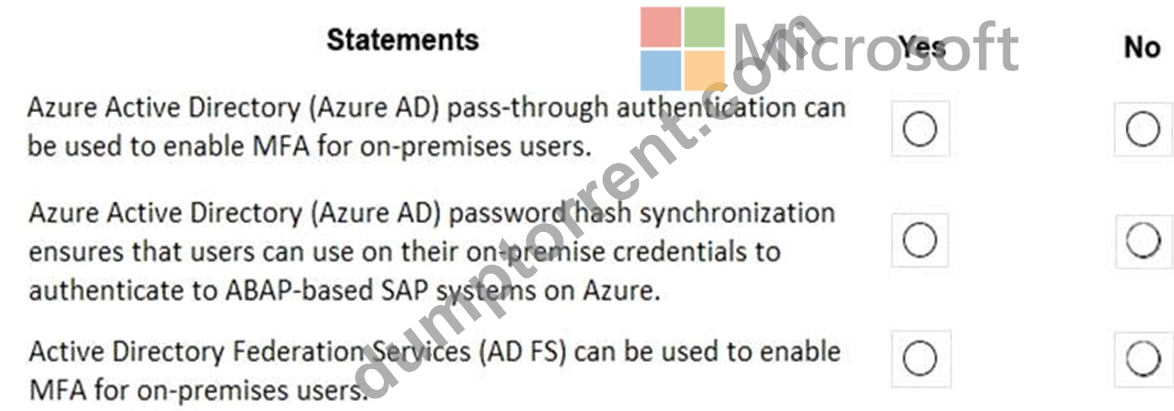
Answer:
Explanation: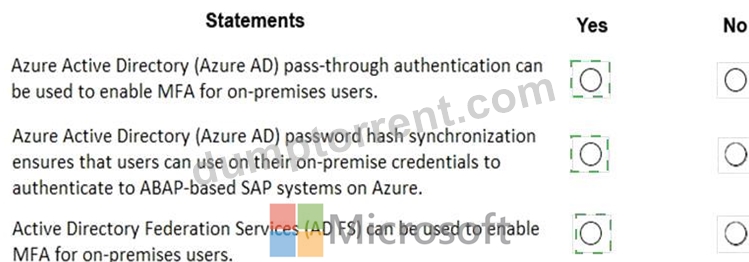
Explanation
Box 1: Yes
Box 2: Yes
Password hash synchronization is one of the sign-in methods used to accomplish hybrid identity. Azure AD Connect synchronizes a hash, of the hash, of a users password from an on-premises Active Directory instance to a cloud-based Azure AD instance.
Password hash synchronization is an extension to the directory synchronization feature implemented by Azure AD Connect sync. You can use this feature to sign in to Azure AD services like Office 365. You sign in to the service by using the same password you use to sign in to your on-premises Active Directory instance.
Box 3: Yes
If your organization is federated with Azure AD, you can use Azure Multi-Factor Authentication to secure AD FS resources, both on-premises and in the cloud. Azure MFA enables you to eliminate passwords and provide a more secure way to authenticate.
References:
https://docs.microsoft.com/en-us/azure/active-directory/hybrid/whatis-phs
https://docs.microsoft.com/en-us/windows-server/identity/ad-fs/operations/configure-ad-fs-and-azure-mfa
https://docs.microsoft.com/en-us/azure/active-directory/hybrid/how-to-connect-pta
NEW QUESTION 73
HOTSPOT
You deploy SAP HANA by using SAP HANA on Azure (Large Instances).
For each of the following statements, select Yes if the statement is true. Otherwise, select No.
NOTE: Each correct selection is worth one point.
Hot Area: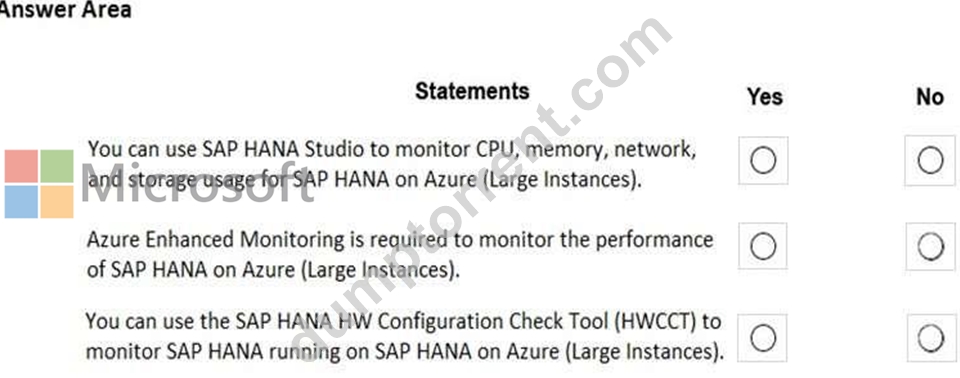
Answer:
Explanation: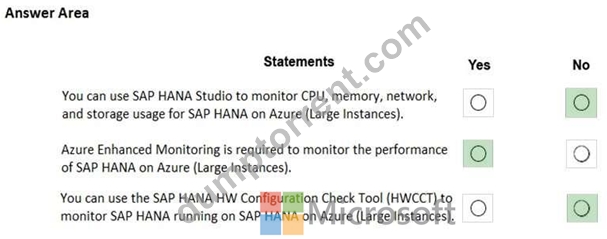
Explanation:
Box 1: No
Box 2: Yes
The SAP Azure Enhanced Monitoring Extension allows for collecting diagnostic data including OS and Application performance counters from Azure VMs running SAP workloads.
Box 3: No
Reference:
http://www.deployazure.com/compute/virtual-machines/sap-azure-enhanced-monitoring-extension/
NEW QUESTION 74
Your on-premises network contains SAP and non-SAP applications. ABAP-based SAP systems are integrated with IDAP and use user name/password-based authentication for logon.
You plan to migrate the SAP applications to Azure.
For each of the following statements, select Yes if the statement is true. Otherwise, select No. NOTE: Each correct selection is worth one point.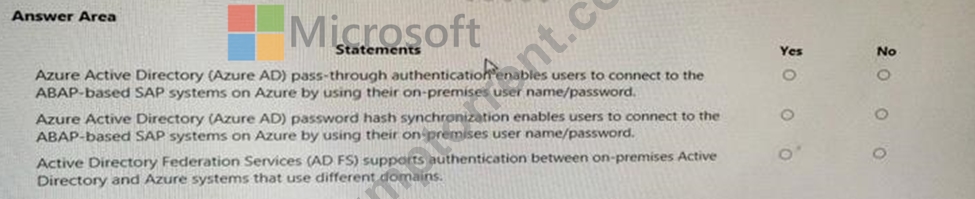
Answer:
Explanation: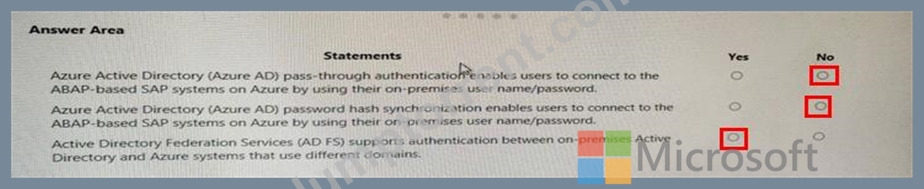
NEW QUESTION 75
For each of the following statements, select Yes if the statement is true. Otherwise, select No.
NOTE: Each correct selection is worth one point.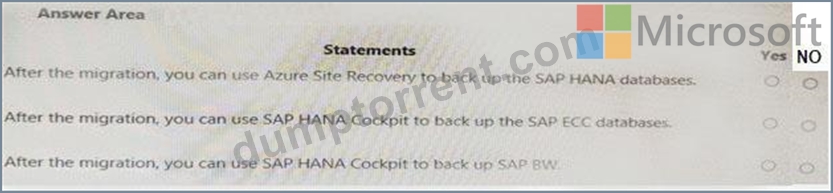
Answer:
Explanation: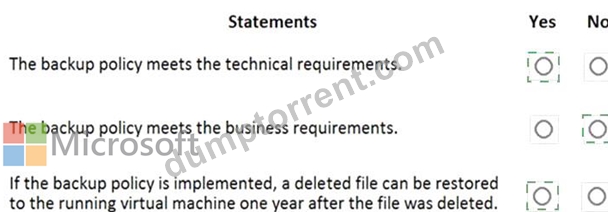
Explanation
YES
YES
NO
NEW QUESTION 76
You plan to migrate an SAP environment to Azure.
You need to design an Azure network infrastructure to meet the following requirements:
* Prevent end users from accessing the database servers.
* Isolate the application servers from the database servers.
* Ensure that end users can access the SAP systems over the internet
Minimize the costs associated to the communications between the application servers and database servers Which two actions should you include in the solution? Each correct answer presents pan of the solution. NOTE: Each correct selection is worth one point.
- A. Create a site-to-site VPN between the on premises network and Azure.
- B. Configure an infernal Azure Standard Load Balancer for incoming connections.
- C. Configure Azure Traffic Manager to route incoming connections.
- D. Segregate the SAP application servers and database servers by using different Azure virtual networks.
- E. In the same Azure virtual network, segregate the SAP application service and database servers by using different subnets and network security groups.
Answer: C
NEW QUESTION 77
You have an on- premises SAP environment hosted on VMware VSphere that in Microsoft SQL Server as the database platform. You plan to migrate the environment to Azure. The database platform will remain the same. You need gather information to size the target Azure Environment for the migration. What should you use?
What should you use?
- A. Azure Advisor
- B. Azure Monitor
- C. the SAP EarlyWatch Alert report
- D. the SAP NANA sizing report
Answer: C
Explanation:
https://azure.microsoft.com/nl-nl/blog/sap-on-azure-architecture-designing-for-performance-and-scalability/
"For existing on-premises systems, you should reference system configuration and resource utilization data. The system utilization information is collected by the SAP OS Collector and can be reported via SAP transaction OS07N as well as the EarlyWatch Alert. "
NEW QUESTION 78
You have an Azure subscription.
You deploy Active Directory domain controllers to Azure virtual machines.
You plan to deploy Azure for SAP workloads.
You plan to segregate the domain controllers from the SAP systems by using different virtual networks.
You need to recommend a solution to connect the virtual networks. The solution must minimize costs.
What should you recommend?
- A. virtual network peering
- B. a site-to-site VPN
- C. ExpressRoute
- D. user-defined routing
Answer: A
Explanation:
Explanation
https://github.com/MicrosoftDocs/azure-docs/issues/32537
https://azure.microsoft.com/en-us/blog/vnet-peering-and-vpn-gateways/
NEW QUESTION 79
You are validating an SAP HANA on Azure (Large Instances) deployment.
You need to ensure that sapconf is installed and the kernel parameters are set appropriately for the active profile.
How should you complete the commands? To answer, drag the appropriate values to the correct targets. Each value may be used once, more than once, or not at all. You may need to drag the split bar between panes or scroll to view content.
NOTE: Each correct selection is worth one point.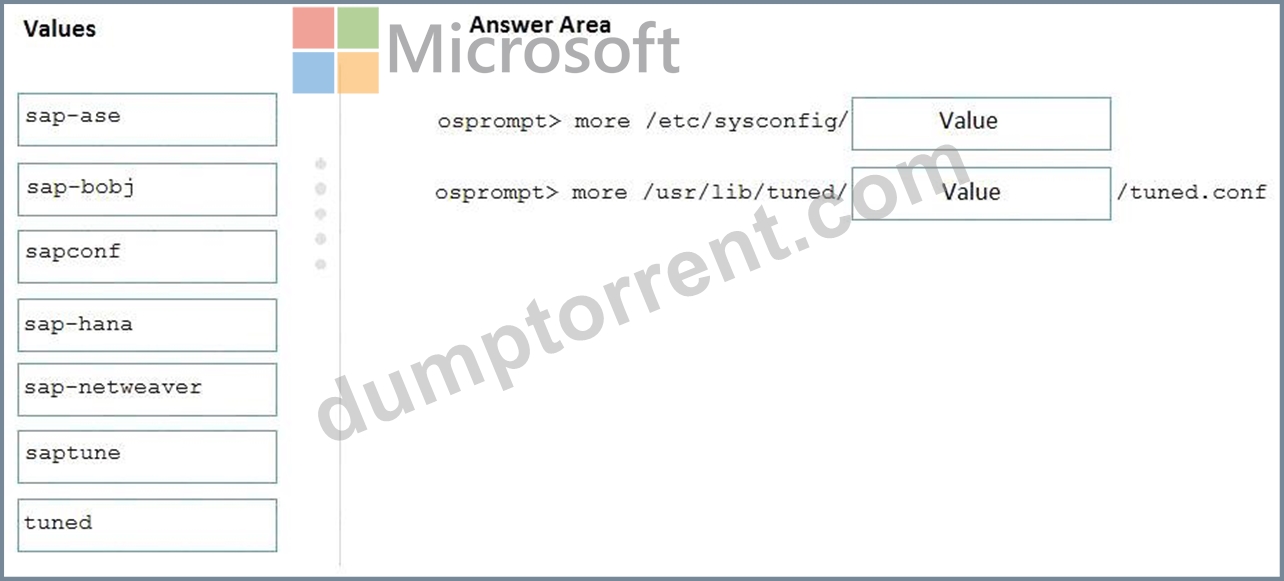
Answer:
Explanation: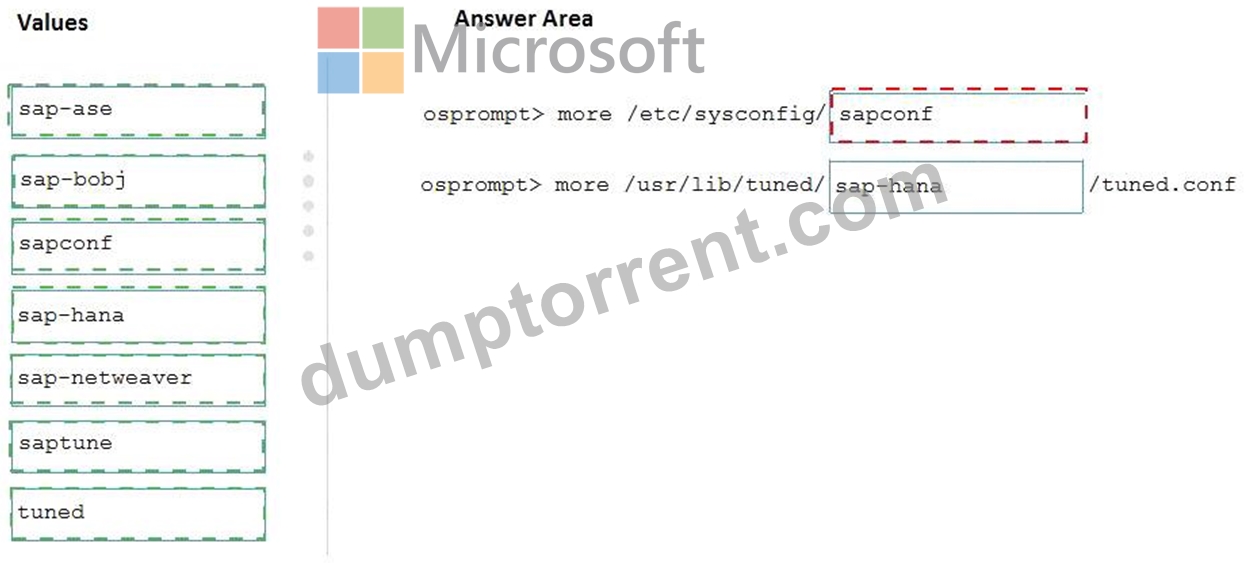
Explanation
Box 1: sapconf
The configuration is split into two parts:
/etc/sysconfig/sapconf
/usr/lib/tuned//tuned.conf
Box 2: sap-hana
References:
https://blogs.sap.com/2017/12/22/prepare-your-linux-for-your-sap-solution-with-saptune/
NEW QUESTION 80
Note: This question is part of a series of questions that present the same scenario. Each question in the series contains a unique solution that might meet the stated goals. Some question sets might have more than one correct solution, while others might not have a correct solution.
After you answer a question in this section, you will NOT be able to return to it. As a result, these questions will not appear in the review screen.
You deploy SAP HANA on Azure (Large Instances).
You need to back up the SAP HANA database to Azure.
Solution: You configure DB13 to back up directly to a local disk.
Does this meet the goal?
- A. No
- B. Yes
Answer: A
Explanation:
Explanation
You need to back up the SAP HANA database to Azure, not to a local disk.
References:
https://docs.microsoft.com/en-us/azure/backup/sap-hana-db-about
https://docs.microsoft.com/en-us/azure/backup/backup-azure-sap-hana-database#configure-backup
NEW QUESTION 81
HOTSPOT
You have SAP ERP on Azure.
For SAP high availability, you plan to deploy ASCS/ERS instances across Azure Availability Zones and to use failover clusters.
For each of the following statements, select Yes if the statement is true. Otherwise, select No.
NOTE: Each correct selection is worth one point.
Hot Area: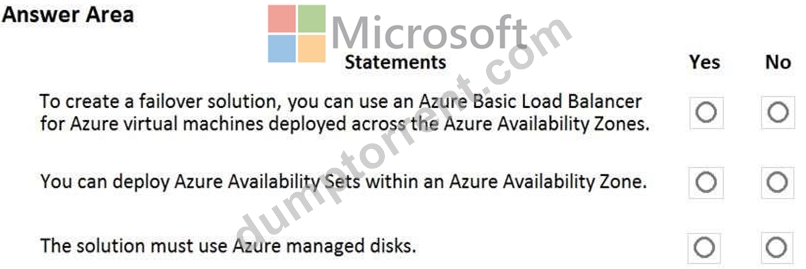
Answer:
Explanation: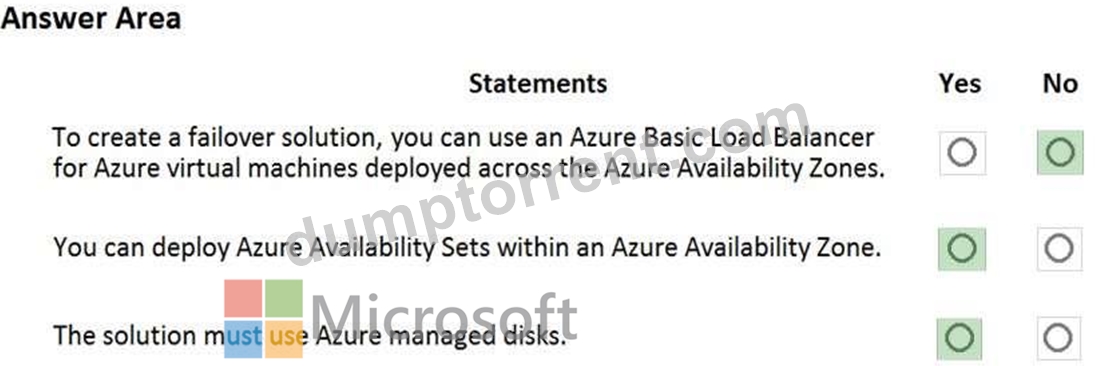
Explanation:
Box 1: No
You can't use an Azure Basic Load Balancer to create failover cluster solutions based on Windows Server Failover Clustering or Linux Pacemaker. Instead, you need to use the Azure Standard Load Balancer SKU.
Box 2: Yes
Azure Availability Zones is one of the high-availability features that Azure provides. Using Availability Zones improves the overall availability of SAP workloads on Azure.
The SAP application layer is deployed across one Azure availability set. For high availability of SAP Central Services, you can deploy two VMs in a separate availability set.
Box 3: Yes
You must use Azure Managed Disks when you deploy to Azure Availability Zones.
Reference:
https://docs.microsoft.com/en-us/azure/virtual-machines/workloads/sap/sap-ha-availability-zones
NEW QUESTION 82
You are deploying SAP Fiori lo an SAP environment on Azure.
You are configuring SAML 2.0 for an SAP Fiori instance named FPP that uses client 100 to authenticate to an Azure Active Directory (Azure AD) tenant.
Which provider name should you use to ensure that the Azure AD tenant recognizes the SAP fiori instance?
- A. https://FPP100
- B. httpsV/FPP
- C. ldap://FPP-100
- D. ldap://FPP
Answer: D
NEW QUESTION 83
For each of the following statements, select Yes if the statement is true. Otherwise, select No.
NOTE: Each correct selection is worth one point.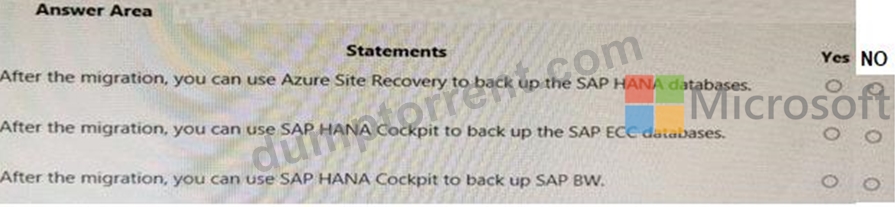
Answer:
Explanation: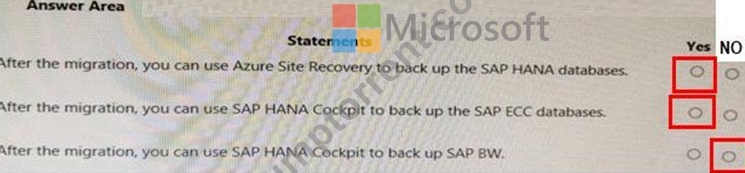
NEW QUESTION 84
You have an SAP development landscape on Azure.
For each of the following statements, select Yes if the statement is true. Otherwise, select No.
NOTE: Each correct selection is worth one point.
Answer:
Explanation:
NEW QUESTION 85
Note: This question is part of a series of questions that present the same scenario. Each question in the series contains a unique solution that might meet the stated goals. Some question sets might have more than one correct solution, while others might not have a correct solution.
After you answer a question in this section, you will NOT be able to return to it. As a result, these questions will not appear in the review screen.
You have a complex SAP environment that has both ABAP- and Java-based systems. The current on-premises landscapes are based on SAP NetWeaver 7.0 (Unicode and Non-Unicode) running on Windows Server and Microsoft SQL Server.
You need to migrate the SAP environment to a HANA-certified Azure environment.
Solution: You upgrade to SAP NetWeaver 7.4, and then you migrate SAP to Azure by using Azure Site Recovery.
Does this meet the goal?
- A. No
- B. Yes
Answer: B
Explanation:
Explanation
We need upgrade to SAP NetWeaver 7.4 before the migration. Then Azure Site Recovery is used for the migration to Azure.
Reference:
https://docs.microsoft.com/en-us/azure/site-recovery/vmware-azure-architecture
NEW QUESTION 86
A customer that has a large enterprise SAP environment plans to migrate to Azure. The environment uses servers that run Windows Server 2016 and Microsoft SQL Server.
The environment is critical and requires a comprehensive business continuity and disaster recovery (BCDR) strategy that minimizes the recovery point objective (RPO) and the recovery time objective (RTO).
The customer wants a resilient environment that has a secondary site that is at least 250 kilometers away.
You need to recommend a solution for the customer.
Which two solutions should you recommend? Each correct answer presents part of the solution.
NOTE: Each correct selection is worth one point.
- A. Azure Traffic Manager to route incoming traffic
- B. warm standby virtual machines in an Azure Availability Set that uses geo-redundant storage (GRS)
- C. warm standby virtual machines in Azure Availability Zones
- D. warm standby virtual machines in paired regions
- E. an internal load balancer to route Internet traffic
Answer: B,D
Explanation:
A: An Azure Region Pair is a relationship between two Azure Regions within the same geographic region for disaster recovery purposes. If one of the regions were to experience a disaster or failure, then the services in that region will automatically failover to that regions secondary region in the pair.
C: For increased availability, you can deploy two VMs with two HANA instances within an Azure availability set that uses HANA system replication for availability.
References:
https://docs.microsoft.com/en-us/azure/virtual-machines/workloads/sap/sap-hana-availability-one-region
NEW QUESTION 87
You have an Azure Active Directory (Azure AD) tenant and an SAP Cloud Platform tenant.
You need to ensure that users sign in automatically by using their Azure AD accounts when they connect to SAP Cloud Platform.
Which four actions should you perform in sequence? To answer, move all actions from the list of actions to the answer area and arrange them in the correct order.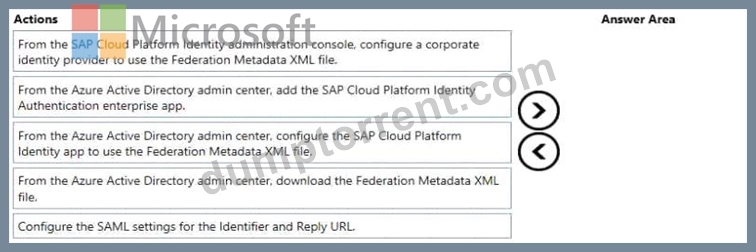
Answer:
Explanation: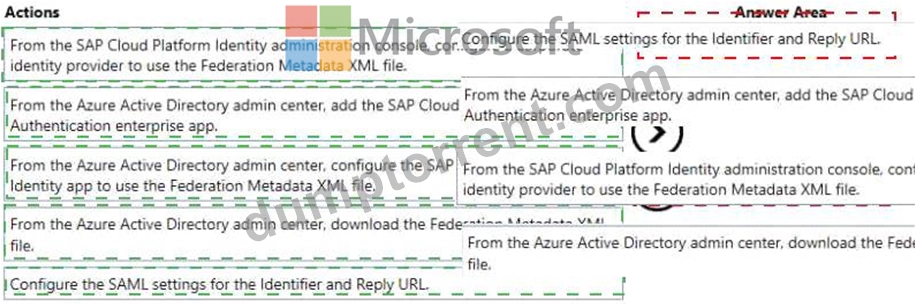
NEW QUESTION 88
You are deploying an SAP environment on Azure that will use an SAP HANA database server.
You provision an Azure virtual machine for SAP HANA by using the M64s virtual machine SKU.
You need to set the swap space by using the Microsoft Azure Linux Agent (waagent) configuration file.
Which two settings should you configure? Each correct answer presents part of the solution.
NOTE: Each correct selection is worth one point.
- A. ResourceDisk.EnableSwap=y
- B. ResourceDisk.SwapSizeMB=229376
- C. ResourceDisk.EnableSwapEncryption=n
- D. AutoUpdate.Enabled=n
Answer: A,B
Explanation:
To create a swap file in the directory that's defined by the ResourceDisk.MountPoint parameter, you can update the /etc/waagent.conf file by setting the following three parameters:
ResourceDisk.Format=y
ResourceDisk.EnableSwap=y
ResourceDisk.SwapSizeMB=xx
References:
https://support.microsoft.com/en-us/help/4010058/how-to-add-a-swap-file-in-linux-azure-virtual-machines
NEW QUESTION 89
You plan to deploy an SAP environment on Azure.
During a bandwidth assessment, you identify that connectivity between Azure and an on-premises datacenter requires up to 5 Gbps.
You need to identify which connectivity method you must implement to meet the bandwidth requirement. The solution must minimize costs.
Which connectivity method should you identify?
- A. Global VNet peering
- B. an Azure site-to-site VPN that is route-based
- C. an Azure site-to-site VPN that is policy-based
- D. an ExpressRoute connection
Answer: B
Explanation:
Azure site-to-site VPN is cheaper.
References:
https://docs.microsoft.com/en-us/azure/architecture/reference-architectures/hybrid-networking/vpn
NEW QUESTION 90
......
Focus on AZ-120 All-in-One Exam Guide For Quick Preparation: https://www.dumptorrent.com/AZ-120-braindumps-torrent.html
Practice To AZ-120 - DumpTorrent Remarkable Practice On your Planning and Administering Microsoft Azure for SAP Workloads Exam: https://drive.google.com/open?id=1_qQwt2wTzgNJBYmWpP52hAtfThpxoPTL