


C_ABAPD_2507 Sample Practice Exam Questions 2025 Updated Verified
Exam Study Guide Free Practice Test LAST UPDATED C_ABAPD_2507
NEW QUESTION # 12
Given the following code which defines an SAP HANA database table in SAP S/4HANA Cloud, public edition: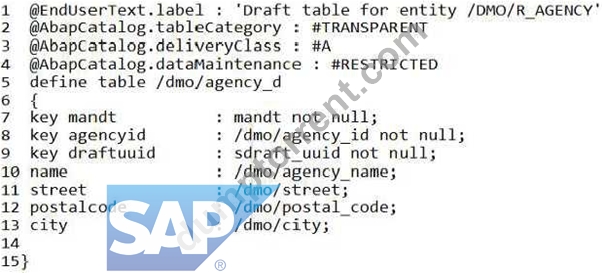
You are a consultant and the client wants you to extend this SAP database table with a new field called "zz_countrycode" on line. Which of the following is the correct response?
- A. The database table cannot be extended since it has not been extensibility enabled by SAP.
- B. The database table can be extended whether extensibility enabled or not if it is assigned to a software component of type "ABAP Cloud".
- C. The database table can be extended once it has been extensibility enabled by the customer.
- D. The database table can be extended whether extensibility enabled or not if it is assigned to a software component of type "Standard ABAP".
Answer: B
NEW QUESTION # 13
For the assignment, gv_target = gv_source.
which of the following data declarations will always work without truncation or rounding? Note: There are 2 correct answers to this question.
- A. DATA gv_source TYPE p LENGTH 8 DECIMALS 3. to DATA gv_target TYPE p LENGTH 16 DECIMALS 2.
- B. DATA gv_source TYPE string, to DATA gv_target TYPE c.
- C. DATA gv_source TYPE d. to DATA gv_target TYPE string.
- D. DATA gv_source TYPE c. to DATA gv_target TYPE string.
Answer: C,D
Explanation:
The data declarations that will always work without truncation or rounding for the assignment gv_target = gv_source are B and C. This is because the target data type string is a variable-length character type that can hold any character string, including those of data types c (fixed-length character) and d (date). The assignment of a character or date value to a string variable will not cause any loss of information or precision, as the string variable will adjust its length to match the source value12.
You cannot do any of the following:
A . DATA gv_source TYPE string, to DATA gv_target TYPE c.: This data declaration may cause truncation for the assignment gv_target = gv_source. This is because the target data type c is a fixed-length character type that has a predefined length. If the source value of type string is longer than the target length of type c, the source value will be truncated on the right to fit the target length12.
D . DATA gv_source TYPE p LENGTH 8 DECIMALS 3. to DATA gv_target TYPE p LENGTH 16 DECIMALS 2.: This data declaration may cause rounding for the assignment gv_target = gv_source. This is because the target data type p is a packed decimal type that has a predefined length and number of decimal places. If the source value of type p has more decimal places than the target type p, the source value will be rounded to the target number of decimal places12.
NEW QUESTION # 14
Which of the following are features of Core Data Services (CDS)?
(Select 3 correct answers)
- A. Structured Query Language (SQL)
- B. Inheritance
- C. Delegation
- D. Annotations
- E. Associations
Answer: A,D,E
Explanation:
Comprehensive and Detailed Explanation from Exact Extract:
* Associations # # Supported in CDS to define relationships between entities without materializing joins.
* SQL (Structured Query Language) # # CDS is built on SQL semantics and supports declarative data modeling with SQL-based syntax.
* Annotations # # Used to enrich CDS artifacts with metadata for UI, OData exposure, and behavior.
* Delegation # # Not a CDS feature; belongs to OO or API design patterns.
* Inheritance # # Not supported in CDS entities; CDS focuses on associations and compositions.
Study Guide Reference: ABAP CDS User Guide - CDS View Features and Annotations.
NEW QUESTION # 15
Which of the following ON conditions must you insert in place of "???"?
- A. ON Sprojection. Carrier Source2.carrier
- B. ON Sprojection.carrier_id=Z_Source2.carrier_id
- C. ON Sprojection Camer=Source2 carrier_id
- D. ON Z_Sourcel.camer_id = 7_Source2 carrier_id
Answer: B
Explanation:
The correct ON condition that must be inserted in place of "???" is:
ON Sprojection.carrier_id=Z_Source2.carrier_id
This ON condition specifies the join condition between the CDS view Sprojection and the database table Z_Source2. The join condition is based on the field carrier_id, which is the primary key of both the CDS view and the database table. The ON condition ensures that only the records that have the same value for the carrier_id field are joined together1.
The other options are not valid ON conditions, because:
A . ON Z_Sourcel.camer_id = 7_Source2 carrier_id is not valid because Z_Sourcel and 7_Source2 are not valid data sources in the given code. There is no CDS view or database table named Z_Sourcel or 7_Source2. The correct names are Z_Source1 and Z_Source2. Moreover, the field camer_id is not a valid field in the given code. There is no field named camer_id in any of the data sources. The correct name is carrier_id.
B . ON Sprojection Camer=Source2 carrier_id is not valid because Sprojection and Source2 are not valid data sources in the given code. There is no CDS view or database table named Sprojection or Source2. The correct names are Sprojection and Z_Source2. Moreover, the field Camer is not a valid field in the given code. There is no field named Camer in any of the data sources. The correct name is carrier_id. Furthermore, the ON condition is missing the dot (.) operator between the data source name and the field name, which is required to access the fields of the data source1.
C . ON Sprojection. Carrier Source2.carrier is not valid because Carrier and carrier are not valid fields in the given code. There is no field named Carrier or carrier in any of the data sources. The correct name is carrier_id. Moreover, the ON condition is missing the dot (.) operator between the data source name and the field name, which is required to access the fields of the data source1.
NEW QUESTION # 16
Given the following Core Data Service View Entity Data Definition:
1 @AccessControl.authorizationCheck: #NOT_REQUIRED
2 DEFINE VIEW ENTITY demo_flight_info_join
3 AS SELECT
4 FROM scarr AS a
5 LEFT OUTER JOIN scounter AS c
6 LEFT OUTER JOIN sairport AS p
7 ON p.id = c.airport
8 ON a.carrid = c.carrid
9 {
10 a.carrid AS carrier_id,
11 p.id AS airport_id,
12 c.countnum AS counter_number
13 }
In what order will the join statements be executed?
- A. scarr will be joined with sairport first and the result will be joined with scounter.
- B. sairport will be joined to scounter first and the result will be joined with scarr.
- C. scounter will be joined to sairport first and the result will be joined with scarr.
- D. scarr will be joined with scounter first and the result will be joined with sairport.
Answer: D
Explanation:
The order in which the join statements will be executed is:
scarr will be joined with scounter first and the result will be joined with sairport.
This is because the join statements are nested from left to right, meaning that the leftmost data source is joined with the next data source, and the result is joined with the next data source, and so on. The join condition for each pair of data sources is specified by the ON clause that follows the data source name. The join type for each pair of data sources is specified by the join operator that precedes the data source name. In this case, the join operator is LEFT OUTER JOIN, which means that all the rows from the left data source are included in the result, and only the matching rows from the right data source are included. If there is no matching row from the right data source, the corresponding fields are filled with initial values1.
Therefore, the join statements will be executed as follows:
First, scarr AS a will be joined with scounter AS c using the join condition a.carrid = c.carrid. This means that all the rows from scarr will be included in the result, and only the rows from scounter that have the same value for the carrid field will be included. If there is no matching row from scounter, the countnum field will be filled with an initial value.
Second, the result of the first join will be joined with sairport AS p using the join condition p.id = c.airport. This means that all the rows from the first join will be included in the result, and only the rows from sairport that have the same value for the id field as the airport field from the first join will be included. If there is no matching row from sairport, the id field will be filled with an initial value.
NEW QUESTION # 17
Exhibit:
With Icl_super being superclass for Icl_subl and Icl_sub2 and with methods subl_methl and sub2_methl being subclass-specific methods of Id_subl or Icl_sub2, respectivel. What will happen when executing these casts? Note:
There are 2 correct answers to this question
- A. go_sub2 = CAST # go super), will work. go_subl CAST #go_super), will work
- B. go_subl->subl_meth !(...)* w'll work.
- C. go_sub2 = CAST #(go_super). will not work. ] go sub2->sub2 meth 1(...). will work
- D. go subl = CAST # go super), will not work
Answer: B,D
Explanation:
The following are the explanations for each statement:
A: This statement is correct. go_subl = CAST #(go_super) will not work. This is because go_subl is a data object of type REF TO cl_subl, which is a reference to the subclass cl_subl. go_super is a data object of type REF TO cl_super, which is a reference to the superclass cl_super. The CAST operator is used to perform a downcast or an upcast of a reference variable to another reference variable of a compatible type. A downcast is a conversion from a more general type to a more specific type, while an upcast is a conversion from a more specific type to a more general type. In this case, the CAST operator is trying to perform a downcast from go_super to go_subl, but this is not possible, as go_super is not pointing to an instance of cl_subl, but to an instance of cl_super. Therefore, the CAST operator will raise an exception CX_SY_MOVE_CAST_ERROR at runtime12 B: This statement is incorrect. go_sub2 = CAST #(go_super) will work. go_subl = CAST #(go_super) will not work. This is because go_sub2 is a data object of type REF TO cl_sub2, which is a reference to the subclass cl_sub2. go_super is a data object of type REF TO cl_super, which is a reference to the superclass cl_super. The CAST operator is used to perform a downcast or an upcast of a reference variable to another reference variable of a compatible type. A downcast is a conversion from a more general type to a more specific type, while an upcast is a conversion from a more specific type to a more general type. In this case, the CAST operator is trying to perform a downcast from go_super to go_sub2, and this is possible, as go_super is pointing to an instance of cl_sub2, which is a subclass of cl_super. Therefore, the CAST operator will assign the reference of go_super to go_sub2 without raising an exception. However, the CAST operator will not work for go_subl, as explained in statement A12 C: This statement is incorrect. go_sub2 = CAST #(go_super) will work. go_sub2->sub2_meth1(...) will not work. This is because go_sub2 is a data object of type REF TO cl_sub2, which is a reference to the subclass cl_sub2. go_super is a data object of type REF TO cl_super, which is a reference to the superclass cl_super. The CAST operator is used to perform a downcast or an upcast of a reference variable to another reference variable of a compatible type. A downcast is a conversion from a more general type to a more specific type, while an upcast is a conversion from a more specific type to a more general type. In this case, the CAST operator is trying to perform a downcast from go_super to go_sub2, and this is possible, as go_super is pointing to an instance of cl_sub2, which is a subclass of cl_super. Therefore, the CAST operator will assign the reference of go_super to go_sub2 without raising an exception. However, the method call go_sub2->sub2_meth1(...) will not work, as sub2_meth1 is a subclass-specific method of cl_sub2, which is not inherited by cl_super. Therefore, the method call will raise an exception CX_SY_DYN_CALL_ILLEGAL_METHOD at runtime123 D: This statement is correct. go_subl->subl_meth1(...) will work. This is because go_subl is a data object of type REF TO cl_subl, which is a reference to the subclass cl_subl. subl_meth1 is a subclass-specific method of cl_subl, which is not inherited by cl_super. Therefore, the method call go_subl->subl_meth1(...) will work, as go_subl is pointing to an instance of cl_subl, which has the method subl_meth1123
NEW QUESTION # 18
What is a class defined as part of an ABAP program called?
- A. Global class
- B. Global variable
- C. Local class
- D. Local variable
Answer: C
NEW QUESTION # 19
Given the following code,
DATA gv_text1 TYPE string. "#EC_NEEDED
DATA gv_text2 TYPE string ##NEEDED.
What are valid statements? Note: There are 2 correct answers to this question.
- A. The pseudo-comment is checked by the syntax checker.
- B. #EC_NEEDED is not checke d by the syntax checker.
- C. ##NEEDED is checked by the syntax checker.
- D. The pragma is not checked by the syntax checker.
Answer: B,C
NEW QUESTION # 20
How can you control data access of a business user?
(Select 3 correct answers)
- A. To control the "Create, Update, and Delete access" via explicit check using AUTHORITY-CHECK.
- B. To control the "Create, Update, and Delete access" implicitly via an Access Control object (define role).
- C. To control the "Read access" via explicit check using AUTHORITY-CHECK.
- D. To control the "Read access" implicitly via an Access Control object (define role).
- E. To control the general access implicitly via an Access Control object (define role).
Answer: A,B,D
Explanation:
Comprehensive and Detailed Explanation from Exact Extract:
In ABAP Cloud / RAP, authorization control follows a structured approach:
* Read access # can be controlled implicitly via an Access Control object (D).
* Create, Update, Delete access # can be controlled both:
* Explicitly with AUTHORITY-CHECK (B),
* Or implicitly through Access Control object definitions (C).
* General implicit control via Access Control (A) or explicit checks for Read (E) are not correct because the system differentiates access levels precisely.
This ensures that business users can only access the data they are authorized for, following RAP's security- by-default principle.
Verified Study Guide Reference: RAP Security & Access Control Documentation - Authorization in RAP BOs.
NEW QUESTION # 21
What is the sequence priority when evaluating a logical expression?
A) NOT 1
B) OR 3
C) AND 2
- A. B A C
- B. A B C
- C. CAB
- D. A C B
Answer: D
Explanation:
The sequence priority when evaluating a logical expression is C. A C B, which means NOT, AND, OR. This is the order of precedence of the Boolean operators in ABAP, which determines how the system implicitly parenthesizes all logical expressions that are not closed by explicit parentheses. The operator with the highest priority is evaluated first, and the operator with the lowest priority is evaluated last. The order of precedence of the Boolean operators in ABAP is as follows12:
NOT: The NOT operator is a unary operator that negates the logical expression that follows it. It has the highest priority and is evaluated before any other operator. For example, in the expression NOT a AND b, the NOT operator is applied to a first, and then the AND operator is applied to the result and b.
AND: The AND operator is a binary operator that returns true if both logical expressions on its left and right are true, and false otherwise. It has the second highest priority and is evaluated before the OR and EQUIV operators. For example, in the expression a AND b OR c, the AND operator is applied to a and b first, and then the OR operator is applied to the result and c.
OR: The OR operator is a binary operator that returns true if either or both logical expressions on its left and right are true, and false otherwise. It has the third highest priority and is evaluated after the NOT and AND operators, but before the EQUIV operator. For example, in the expression a OR b EQUIV c, the OR operator is applied to a and b first, and then the EQUIV operator is applied to the result and c.
EQUIV: The EQUIV operator is a binary operator that returns true if both logical expressions on its left and right have the same truth value, and false otherwise. It has the lowest priority and is evaluated after all other operators. For example, in the expression a AND b EQUIV c OR d, the EQUIV operator is applied to a AND b and c last, after the AND and OR operators are applied.
NEW QUESTION # 22
When you work with a test class you can set up some prerequisites before the actual testing.
In which sequence will the following fixtures be called by the test environment?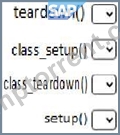
- A. teardown()
- B. class_teardown()
- C. class_setup()
- D. setup()
Answer: A,B,C,D
NEW QUESTION # 23
What can you do in SAP S/4HANA Cloud, public edition?
Note: There are 2 correct answers to this question.
- A. Use Web Dynpros
- B. Use ABAP Development Tools in Eclipse (ADT)
- C. Use SAP-released extension points
- D. Modify SAP objects
Answer: B,C
NEW QUESTION # 24
In class ZCL_CLASS_A, you use the statement DATA var TYPE ***
What may stand in place of ***?
Note: There are 2 correct answers to this question.
- A. The name of a type defined privately in class ZCL_CLASS_A
- B. The name of a type defined privately in another class
- C. The name of a domain from the ABAP Dictionary
- D. The name of a data element from the ABAP Dictionary
Answer: A,D
NEW QUESTION # 25
In a subclass subl you want to redefine a component of a superclass superl. How do you achieve this? Note: There are 2 correct answers to this question.
- A. You implement the redefined component in subl.
- B. You add the clause REDEFINITION to the component in subl.
- C. You add the clause REDEFINITION to the component in superl.
- D. You implement the redefined component for a second time in superl.
Answer: A,B
Explanation:
To redefine a component of a superclass in a subclass, you need to do the following12:
You add the clause REDEFINITION to the component declaration in the subclass. This indicates that the component is inherited from the superclass and needs to be reimplemented in the subclass. The redefinition must happen in the same visibility section as the component declaration in the superclass. For example, if the superclass has a public method m1, the subclass must also declare the redefined method m1 as public with the REDEFINITION clause.
You implement the redefined component in the subclass. This means that you provide the new logic or behavior for the component that is specific to the subclass. The redefined component in the subclass will override the original component in the superclass when the subclass object is used. For example, if the superclass has a method m1 that returns 'Hello', the subclass can redefine the method m1 to return 'Hi' instead.
You cannot do any of the following:
You implement the redefined component for a second time in the superclass. This is not possible, because the superclass already has an implementation for the component that is inherited by the subclass. The subclass is responsible for providing the new implementation for the redefined component, not the superclass.
You add the clause REDEFINITION to the component in the superclass. This is not necessary, because the superclass does not need to indicate that the component can be redefined by the subclass. The subclass is the one that needs to indicate that the component is redefined by adding the REDEFINITION clause to the component declaration in the subclass.
NEW QUESTION # 26
In a subclass sub1, you want to redefine a component of a superclass super1.
How do you achieve this?
Note: There are 2 correct answers to this question.
- A. You add the clause REDEFINITION to the component in super1.
- B. You implement the redefined component in sub1.
- C. You implement the redefined component for a second time in super1.
- D. You add the clause REDEFINITION to the component in sub1.
Answer: B,D
Explanation:
Comprehensive and Detailed Explanation From Exact Extract:
To redefine a component in a subclass:
* The component (method) in the superclass must be defined with the FOR REDEFINITION addition.
* In the subclass, you use the REDEFINITION clause in the method declaration and implement the method in the subclass to override the superclass behavior.
Thus:
* Option A is correct because the method declaration in sub1 must include the REDEFINITION addition.
* Option D is correct because the actual redefined method implementation must be provided in the subclass sub1.
* Option B is incorrect because the component is not re-implemented in the superclass.
* Option C is incorrect because REDEFINITION is not added in the superclass, but FOR REDEFINITION is.
Reference: SAP Help 2, section on object-oriented ABAP programming with class-based components and redefinitions in inheritance structures.
NEW QUESTION # 27
Given the following code in an SAP S/4HANA Cloud private edition tenant: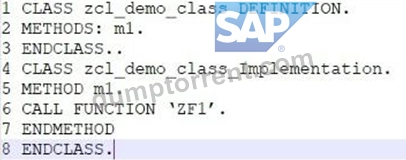
The class zcl_demo_class is in a software component with the language version set to "ABAP Cloud". The function module ZF1' is in a different software component with the language version set to "Standard ABAP". Both the class and function module are customer created.
Regarding line #6, which of the following are valid statements? Note: There are 2 correct answers to this question.
- A. "ZF1" can be called whether it is released or not for cloud development
- B. ZF1" can be called if a wrapper is created for it but the wrapper itself is not released for cloud development.
- C. ZF1' can be called only if it is released for cloud development.
- D. 'ZF1' can be called if a wrapper is created for it and the wrapper itself is released for cloud development.
Answer: C,D
Explanation:
The ABAP Cloud Development Model requires that only public SAP APIs and extension points are used to access SAP functionality and data. These APIs and extension points are released by SAP and documented in the SAP API Business Hub1. Customer-created function modules are not part of the public SAP APIs and are not released for cloud development. Therefore, calling a function module directly from an ABAP Cloud class is not allowed and will result in a syntax error. However, there are two possible ways to call a function module indirectly from an ABAP Cloud class:
Create a wrapper class or interface for the function module and release it for cloud development. A wrapper is a class or interface that encapsulates the function module and exposes its functionality through public methods or attributes. The wrapper must be created in a software component with the language version set to "Standard ABAP" and must be marked as released for cloud development using the annotation @EndUserText.label. The wrapper can then be called from an ABAP Cloud class using the public methods or attributes2.
Use the ABAP Cloud Connector to call the function module as a remote function call (RFC) from an ABAP Cloud class. The ABAP Cloud Connector is a service that enables the secure and reliable communication between SAP BTP, ABAP environment and on-premise systems. The function module must be exposed as an RFC-enabled function module in the on-premise system and must be registered in the ABAP Cloud Connector. The ABAP Cloud class can then use the class cl_rfc_destination_service to get the destination name and the class cl_abap_system to create a proxy object for the function module. The proxy object can then be used to call the function module3.
NEW QUESTION # 28
What RESTful Application Programming feature is used to ensure the uniqueness of a semantic key?
- A. None of the above
- B. Action
- C. Validation
- D. Determination
Answer: C
Explanation:
Comprehensive and Detailed Explanation From Exact Extract:
In the ABAP RESTful Application Programming Model (RAP), validations are used to ensure that business rules and constraints are fulfilled, including the uniqueness of semantic keys.
A semantic key represents a natural identifier (e.g., employee number, product ID) and not a technical surrogate key. Validations can be:
* Field-level validations - used to validate input for single fields.
* Entity-level validations - used to validate logical conditions like uniqueness of a key combination.
The uniqueness check is typically enforced using a custom validation implementation in the behavior pool.
* Action (Option A) is used for operations triggered by the user or system but not for enforcing uniqueness.
* Determination (Option C) is used for automatically computing or adjusting field values, not for enforcing uniqueness.
Reference: SAP Help 1, page 7 - RAP Runtime and behavior definition section explains how validations are responsible for enforcing semantic consistency and uniqueness constraints.
NEW QUESTION # 29
In ABAP SQL, which of the following can be assigned an alias? Note: There are 2 correct answers to this question.
- A. field (from field list)
- B. order criterion (from order by clause)
- C. database table
- D. group criterion (from group by clause)
Answer: A,C
Explanation:
In ABAP SQL, an alias is a temporary name that can be assigned to a field or a database table in a query. An alias can be used to make the query more readable, to avoid name conflicts, or to access fields or tables with long names. An alias is created with the AS keyword and is only valid for the duration of the query1.
The following are examples of how to assign an alias to a field or a database table in ABAP SQL:
B . field (from field list): A field is a column of a table or a view that contains data of a certain type. A field can be assigned an alias in the field list of a SELECT statement, which specifies the fields that are selected from the data source. For example, the following query assigns the alias name to the field carrname of the table scarr:
SELECT carrid, carrname AS name FROM scarr.
The alias name can be used instead of carrname in other clauses of the query, such as WHERE, GROUP BY, ORDER BY, and so on2.
C . database table: A database table is a collection of data that is organized in rows and columns. A database table can be assigned an alias in the FROM clause of a SELECT statement, which specifies the data source that is selected from. For example, the following query assigns the alias c to the table scarr:
SELECT c.carrid, c.carrname FROM scarr AS c.
The alias c can be used instead of scarr in other clauses of the query, such as WHERE, JOIN, GROUP BY, ORDER BY, and so on3.
The following are not valid for assigning an alias in ABAP SQL:
A . order criterion (from order by clause): An order criterion is a field or an expression that is used to sort the result set of a query in ascending or descending order. An order criterion cannot be assigned an alias in the ORDER BY clause of a SELECT statement, because the alias is not visible in this clause. The alias can only be used in the clauses that follow the clause where it is defined1.
D . group criterion (from group by clause): A group criterion is a field or an expression that is used to group the result set of a query into subsets that share the same values. A group criterion cannot be assigned an alias in the GROUP BY clause of a SELECT statement, because the alias is not visible in this clause. The alias can only be used in the clauses that follow the clause where it is defined1.
NEW QUESTION # 30
You want to document a global class with ABAP Doc. What do you need to consider?
(Select 3 correct answers)
- A. The documentation can be translated.
- B. The documentation can contain links to other repository object's documentation.
- C. The documentation may contain tags like <strong> </strong>.
- D. The documentation has to be positioned directly after the declarative statement.
- E. The documentation starts with !.
Answer: A,D,E
Explanation:
Comprehensive and Detailed Explanation from Exact Extract:
ABAP Doc is the integrated documentation system for classes, interfaces, and methods. Rules:
* Position # Must be placed directly after the declarative statement (B).
* Translatable # ABAP Doc content can be translated (D).
* Syntax # Each line must start with ! (E).
* HTML tags (A) and repository links (C) are not supported.
Verified Study Guide Reference: ABAP Development Tools (ADT) Documentation - ABAP Doc Annotations and Rules.
NEW QUESTION # 31
Which of the following is a technique for defining access controls?
- A. Inheritance
- B. Casting
- C. Singleton
- D. Redefiniton
Answer: B
NEW QUESTION # 32
Given the following code which defines an SAP HANA database table in SAP S/4HANA Cloud, public edition:
@EndUserText.label : 'Draft table for entity /DMO/R_AGENCY'
@AbapCatalog.tableCategory : #TRANSPARENT
@AbapCatalog.deliveryClass : #A
@AbapCatalog.dataMaintenance : #RESTRICTED
define table /dmo/agency_d {
key mandt : mandt not null;
key agencyid : /dmo/agency_id not null;
key draftuuid : sdraft_uuid not null;
name : /dmo/agency_name;
street : /dmo/street;
postalcode : /dmo/postal_code;
city : /dmo/city;
}
You are a consultant and the client wants you to extend this SAP database table with a new field called zz_countrycode on line #14.
Which of the following is the correct response?
- A. The database table can be extended once it has extensibility been enabled by the customer.
- B. The database table can be extended whether extensibility enabled or not if it is assigned to a software component of type "ABAP Cloud".
- C. The database table cannot be extended since it has not been extensibility enabled by SAP.
- D. The database table can be extended whether extensibility enabled or not if it is assigned to a software component of type "Standard ABAP".
Answer: C
Explanation:
Comprehensive and Detailed Explanation From Exact Extract:
In SAP S/4HANA Cloud, public edition, database tables are only extendable if SAP has explicitly enabled extensibility for them via metadata. This is a strict limitation in the ABAP Cloud model to ensure upgrade- stability and isolation of extensions from SAP-owned objects.
Key facts:
* The annotation @AbapCatalog.dataMaintenance : #RESTRICTED implies that this table is not editable or extensible by default.
* The table resides in a delivered component and unless SAP marks it as extensible, customers cannot add fields like zz_countrycode.
* Even if the table is in an ABAP Cloud-compliant software component, extensibility must be explicitly enabled by SAP.
* Therefore, Option B is the only correct and valid answer.
Incorrect options:
* Option A and D are wrong because extensibility is not determined by the software component type alone.
* Option C is wrong because customers cannot enable extensibility for SAP-delivered tables; it must be pre-approved by SAP.
Reference: ABAP Extension Guidelines for SAP S/4HANA Cloud (ABAP Extension.pdf, section 2.3 - Extensibility Enablement and Restrictions in Tier 1)
NEW QUESTION # 33
......
The New C_ABAPD_2507 2025 Updated Verified Study Guides & Best Courses: https://www.dumptorrent.com/C_ABAPD_2507-braindumps-torrent.html
Authentic C_ABAPD_2507 Exam Dumps PDF - 2025 Updated: https://drive.google.com/open?id=1iNxH8X8JnWA33hqKqWYExXkWNa8LaLVN