


[Dec 25, 2025] Pass Fortinet Certified Solution Specialist FCSS_SASE_AD-24 Exam With 56 Questions
Ultimate Guide to Prepare Free Fortinet FCSS_SASE_AD-24 Exam Questions and Answer
NEW QUESTION # 30
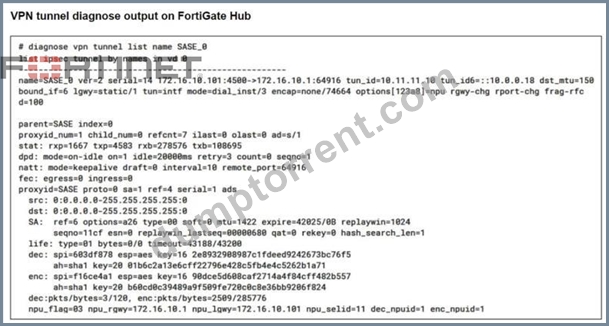
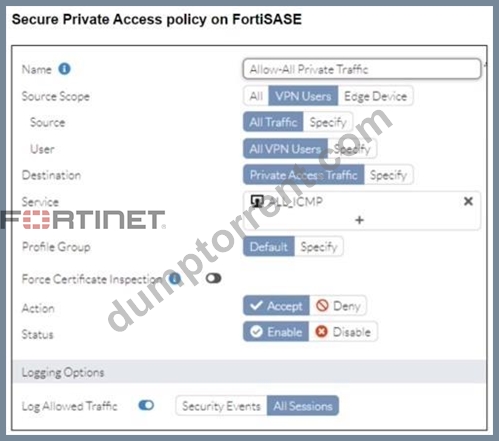
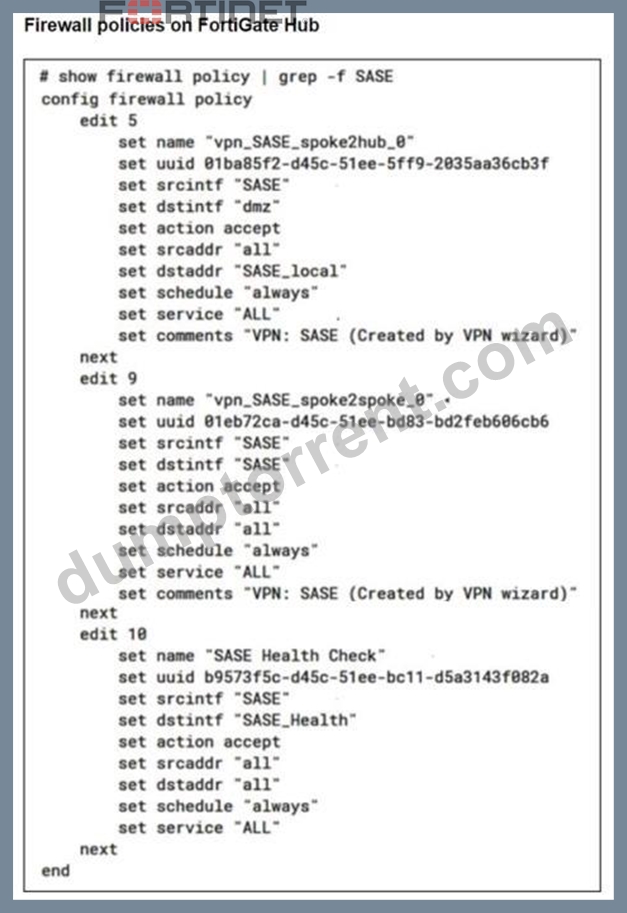
Refer to the exhibits. A FortiSASE administrator is trying to configure FortiSASE as a spoke to a FortiGate hub. The tunnel is up to the FortiGate hub. However, the administrator is not able to ping the Webserver hosted behind the FortiGate hub.
Based on the output, what is the reason for the ping failures?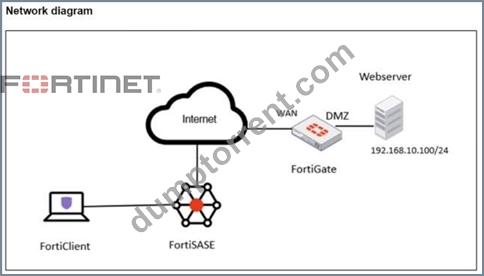
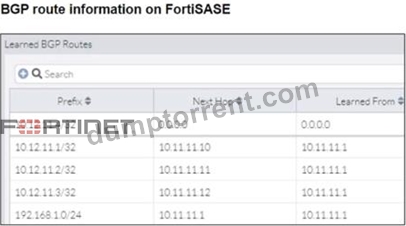
- A. The BGP route is not received.
- B. The Secure Private Access (SPA) policy needs to allow PING service.
- C. Network address translation (NAT) is not enabled on the spoke-to-hub policy.
- D. Quick mode selectors are restricting the subnet.
Answer: A
NEW QUESTION # 31
You are designing a new network for Company X and one of the new cybersecurity policy requirements is that all remote user endpoints must always be connected and protected Which FortiSASE component facilitates this always-on security measure?
- A. unified FortiClient
- B. inline-CASB
- C. thin-branch SASE extension
- D. site-based deployment
Answer: A
Explanation:
The unified FortiClient component of FortiSASE facilitates the always-on security measure required for ensuring that all remote user endpoints are always connected and protected.
* Unified FortiClient:
* FortiClient is a comprehensive endpoint security solution that integrates with FortiSASE to provide continuous protection for remote user endpoints.
* It ensures that endpoints are always connected to the FortiSASE infrastructure, even when users are off the corporate network.
* Always-On Security:
* The unified FortiClient maintains a persistent connection to FortiSASE, enforcing security policies and protecting endpoints against threats at all times.
* This ensures compliance with the cybersecurity policy requiring constant connectivity and protection for remote users.
References:
FortiOS 7.2 Administration Guide: Provides information on configuring and managing FortiClient for endpoint security.
FortiSASE 23.2 Documentation: Explains how FortiClient integrates with FortiSASE to deliver always-on security for remote endpoints.
NEW QUESTION # 32
How does ZTNA enhance security when accessing cloud applications?
Response:
- A. By ensuring physical security of data centers
- B. By limiting access based on user roles
- C. By encrypting end-to-end communications
- D. By providing a dedicated hardware path
Answer: B
NEW QUESTION # 33
Which FortiSASE feature ensures least-privileged user access to corporate applications that are protected by an on-premises FortiGate?
- A. Privileged access management (PAM)
- B. Identity & access management (IAM)
- C. zero trust network access (ZTNA)
- D. role-based access control (RBAC)
Answer: C
Explanation:
The correct answer is D. zero trust network access (ZTNA).
Explanation:
Zero Trust Network Access (ZTNA) is the FortiSASE feature specifically designed to provide secure, least-privileged access to applications. It operates on the core principle of "never trust, always verify." Instead of granting broad network access like a traditional VPN, ZTNA grants access to specific applications on a per-session basis, only after verifying the user's identity and the security posture of their device. This ensures a user can only access the corporate applications they are explicitly authorized for, and nothing else on the network, perfectly embodying the principle of least-privileged access.
The FortiSASE solution achieves this by creating a secure, encrypted tunnel from the remote user directly to the application protected by the on-premises FortiGate, which acts as a ZTNA access proxy.
NEW QUESTION # 34
Which secure internet access (SIA) use case minimizes individual endpoint configuration?
- A. SIA using ZTNA
- B. Site-based remote user internet access
- C. Agentless remote user internet access
- D. SIA for SSL VPN remote users
Answer: C
NEW QUESTION # 35
Which security profiles can be applied within FortiSASE for content inspection?
(Select all that apply)
Response:
- A. Load balancing profiles
- B. Data Loss Prevention (DLP) profiles
- C. Antivirus profiles
- D. Web filtering profiles
Answer: B,C,D
NEW QUESTION # 36
Which element is essential for configuring security profiles in FortiSASE for content inspection?
Response:
- A. Encryption type
- B. User group
- C. Data type
- D. Application type
Answer: C
NEW QUESTION # 37
Refer to the exhibits.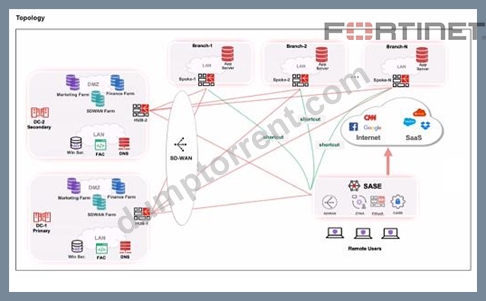
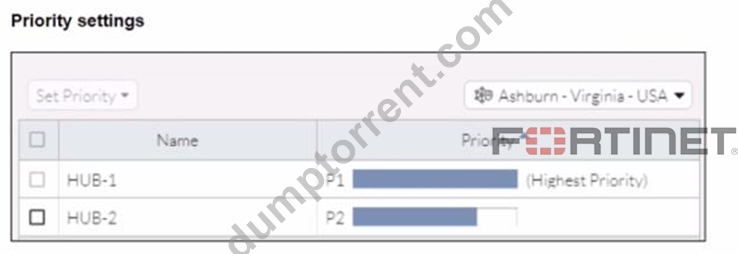
When remote users connected to FortiSASE require access to internal resources on Branch-2. how will traffic be routed?
- A. FortiSASE will use the AD VPN protocol and determine that traffic will be directed to Branch-2 directly, using a static route
- B. FortiSASE will use the SD-WAN capability and determine that traffic will be directed to HUB-2. which will then route traffic to Branch-2.
- C. FortiSASE will use the AD VPN protocol and determine that traffic will be directed to Branch-2 directly, using a dynamic route
- D. FortiSASE will use the SD-WAN capability and determine that traffic will be directed to HUB-1, which will then route traffic to Branch-2.
Answer: C
NEW QUESTION # 38
What features make Zero Trust Network Access (ZTNA) within FortiSASE different from traditional access methods?
(Select all that apply)
Response:
- A. Network-level encryption
- B. Application-level access controls
- C. Device posture checks
- D. Persistent connectivity
Answer: B,C
NEW QUESTION # 39
A customer needs to implement device posture checks for their remote endpoints while accessing the protected server. They also want the TCP traffic between the remote endpoints and the protected servers to be processed by FortiGate.
In this scenario, which three setups will achieve the above requirements? (Choose three.)
- A. Sync ZTNA tags from FortiSASE to FortiGate.
- B. Configure ZTNA servers and ZTNA policies on FortiGate.
- C. Configure private access policies on FortiSASE with ZTNA.
- D. Configure ZTNA tags on FortiGate.
- E. Configure FortiGate as a zero trust network access (ZTNA) access proxy.
Answer: A,B,E
Explanation:
References:
Fortinet FCSS FortiSASE Documentation - Zero Trust Network Access (ZTNA) Deployment FortiGate Administration Guide - ZTNA Configuration
NEW QUESTION # 40
Which VDOM type needs to be configured on the FortiGate Secure Edge to establish a layer 2 network between itself and FortiSASE?
Response:
- A. LAN-Extension
- B. Transparent
- C. Traffic
- D. Admin
Answer: A
NEW QUESTION # 41
Which FortiOS command is used to view the log settings configured in FortiSASE?
Response:
- A. config log settings view
- B. get log settings
- C. get system log settings
- D. diagnose debug log
Answer: C
NEW QUESTION # 42
Which two components are part of onboarding a secure web gateway (SWG) endpoint? (Choose two)
- A. FortiSASE CA certificate
- B. proxy auto-configuration (PAC) file
- C. FortiClient installer
- D. FortiSASE invitation code
Answer: A,B
Explanation:
Onboarding a Secure Web Gateway (SWG) endpoint involves several components to ensure secure and effective integration with FortiSASE. Two key components are the FortiSASE CA certificate and the proxy auto-configuration (PAC) file.
* FortiSASE CA Certificate:
* The FortiSASE CA certificate is essential for establishing trust between the endpoint and the FortiSASE infrastructure.
* It ensures that the endpoint can securely communicate with FortiSASE services and inspect SSL
/TLS traffic.
* Proxy Auto-Configuration (PAC) File:
* The PAC file is used to configure the endpoint to direct web traffic through the FortiSASE proxy.
* It provides instructions on how to route traffic, ensuring that all web requests are properly inspected and filtered by FortiSASE.
References:
FortiOS 7.2 Administration Guide: Details on onboarding endpoints and configuring SWG.
FortiSASE 23.2 Documentation: Explains the components required for integrating endpoints with FortiSASE and the process for deploying the CA certificate and PAC file.
NEW QUESTION # 43
Which role does FortiSASE play in supporting zero trust network access (ZTNA) principles9
- A. It can identify attributes on the endpoint for security posture check.
- B. It integrates with software-defined network (SDN) solutions.
- C. It offers hardware-based firewalls for network segmentation.
- D. It enables VPN connections for remote employees.
Answer: A
Explanation:
FortiSASE supports zero trust network access (ZTNA) principles by identifying attributes on the endpoint for security posture checks. ZTNA principles require continuous verification of user and device credentials, as well as their security posture, before granting access to network resources.
* Security Posture Check:
* FortiSASE can evaluate the security posture of endpoints by checking for compliance with security policies, such as antivirus status, patch levels, and configuration settings.
* This ensures that only compliant and secure devices are granted access to the network.
* Zero Trust Network Access (ZTNA):
* ZTNA is based on the principle of "never trust, always verify," which requires continuous assessment of user and device trustworthiness.
* FortiSASE plays a crucial role in implementing ZTNA by performing these security posture checks and enforcing access control policies.
References:
FortiOS 7.2 Administration Guide: Provides information on ZTNA and endpoint security posture checks.
FortiSASE 23.2 Documentation: Details on how FortiSASE implements ZTNA principles.
NEW QUESTION # 44
What role does FortiSASE play in proactive threat detection?
Response:
- A. It reduces hardware requirements
- B. It tracks physical locations of devices
- C. It increases network speed
- D. It provides real-time analytics to detect unusual patterns
Answer: D
NEW QUESTION # 45
Which actions enhance compliance in FortiSASE deployments?
(Select all that apply)
Response:
- A. Allowing unregulated file sharing
- B. Disabling user activity logs
- C. Regular updates of compliance rules
- D. Implementing data encryption
Answer: C,D
NEW QUESTION # 46
Your organization is currently using FortiSASE for its cybersecurity. They have recently hired a contractor who will work from the HQ office and who needs temporary internet access in order to set up a web-based point of sale (POS) system.
What is the recommended way to provide internet access to the contractor?
- A. Use zero trust network access (ZTNA) and tag the client as an unmanaged endpoint.
- B. Configure a VPN policy on FortiSASE to provide access to the internet.
- C. Use FortiClient on the endpoint to manage internet access.
- D. Use a proxy auto-configuration (PAC) file and provide secure web gateway (SWG) service as an explicit web proxy.
Answer: A
Explanation:
The recommended way to provide temporary internet access to the contractor is to use Zero Trust Network Access (ZTNA) and tag the client as an unmanaged endpoint . ZTNA ensures that only authorized users and devices can access specific resources, while treating all endpoints as untrusted by default. By tagging the contractor's device as an unmanaged endpoint, you can apply strict access controls and ensure that the contractor has limited access to only the necessary resources (e.g., the web-based POS system) without exposing the internal network to unnecessary risks.
Here's why the other options are less suitable:
A . Use FortiClient on the endpoint to manage internet access: While FortiClient provides endpoint security and management, it requires installation and configuration on the contractor's device. This may not be feasible for temporary contractors or unmanaged devices.
B . Use a proxy auto-configuration (PAC) file and provide secure web gateway (SWG) service as an explicit web proxy: While this approach can control web traffic, it does not provide the granular access control and security posture validation offered by ZTNA. Additionally, managing PAC files can be cumbersome and less secure compared to ZTNA.
D . Configure a VPN policy on FortiSASE to provide access to the internet: Using a VPN policy would grant broader access to the network, which is not ideal for a temporary contractor. It increases the risk of unauthorized access to internal resources and does not align with the principle of least privilege.
Reference:
Fortinet FCSS FortiSASE Documentation - Zero Trust Network Access (ZTNA) Use Cases FortiSASE Administration Guide - Managing Unmanaged Endpoints
NEW QUESTION # 47
In constructing FortiSASE deployment cases, which factor is crucial for optimizing performance in a hybrid network?
Response:
- A. Type of encryption used
- B. Total number of users
- C. Placement of physical appliances
- D. Location of cloud data centers
Answer: D
NEW QUESTION # 48
When viewing the daily summary report generated by FortiSASE, the administrator notices that the report contains very little data.
What is a possible explanation for this almost empty report?
- A. There are no security profile groups applied to all policies.
- B. The web filter security profile is not set to Monitor.
- C. Log allowed traffic is set to Security Events for all policies.
- D. Digital experience monitoring is not configured.
Answer: C
Explanation:
The issue of an almost empty daily summary report in FortiSASE can often be traced back to how logging is configured within the system. Specifically, if "Log Allowed Traffic" is set to "Security Events" for all policies, it means that only security-related events (such as threats or anomalies) are being logged, while normal, allowed traffic is not being recorded. Since most traffic in a typical network environment is allowed, this configuration would result in very little data being captured and subsequently reported in the daily summary.
Here's a breakdown of why the other options are less likely to be the cause:
* B. There are no security profile groups applied to all policies:While applying security profiles is important for comprehensive protection, their absence does not directly affect the volume of data in reports unless specific logging settings are also misconfigured.
* C. The web filter security profile is not set to Monitor:This option pertains specifically to web filtering activities. Even if web filtering is not set to monitor mode, other types of traffic and logs should still populate the report.
* D. Digital experience monitoring is not configured:Digital Experience Monitoring (DEM) focuses on user experience metrics rather than general traffic logging. Its absence would not lead to an almost empty report.
To resolve this issue, administrators should review the logging settings across all policies and ensure that
"Log Allowed Traffic" is appropriately configured to capture the necessary data for reporting purposes.
References:
Fortinet FCSS FortiSASE Documentation - Reporting and Logging Best Practices FortiSASE Administration Guide - Configuring Logging Settings
NEW QUESTION # 49
When configuring logging settings in FortiSASE, what is essential to capture for effective security analysis?
Response:
- A. Error and event logs related to security incidents
- B. Logs of all printed documents
- C. Debug level logs for everyday operations
- D. Continuous video logs of server rooms
Answer: A
NEW QUESTION # 50
Which policy type is used to control traffic between the FortiClient endpoint to FortiSASE for secure internet access?
- A. thin edge policy
- B. VPN policy
- C. secure web gateway (SWG) policy
- D. private access policy
Answer: B
NEW QUESTION # 51
Which event log subtype captures FortiSASE SSL VPN user creation?
- A. Endpoint Events
- B. Administrator Events
- C. VPN Events
- D. User Events
Answer: D
Explanation:
Theevent log subtypethat captures FortiSASE SSL VPN user creation isUser Events. This subtype is specifically designed to log activities related to user management, such as creating, modifying, or deleting user accounts. When an SSL VPN user is created, it falls under this category because it involves adding a new user to the system.
Here's why the other options are incorrect:
* A. Endpoint Events:These logs pertain to activities related to endpoint devices, such as device registration, compliance checks, or security posture assessments. SSL VPN user creation is unrelated to endpoint events.
* B. VPN Events:These logs capture activities related to VPN connections, such as session establishment, termination, or errors. While SSL VPN usage generates VPN events, the creation of a user account itself is not logged under this subtype.
* D. Administrator Events:These logs track actions performed by administrators, such as configuration changes or policy updates. While an administrator might create the SSL VPN user, the specific event of user creation is categorized under User Events, not Administrator Events.
References:
Fortinet FCSS FortiSASE Documentation - Event Logging and Subtypes
FortiSASE Administration Guide - Monitoring and Logging
NEW QUESTION # 52
......
Fortinet FCSS_SASE_AD-24 Exam Syllabus Topics:
| Topic | Details |
|---|---|
| Topic 1 |
|
| Topic 2 |
|
| Topic 3 |
|
| Topic 4 |
|
FCSS - FortiSASE 24 Administrator Practice Tests 2025 | Pass FCSS_SASE_AD-24 with confidence!: https://drive.google.com/open?id=14geFHCnyYy15hRj7mRD67WhNPxn6Fx4y
Pass FCSS_SASE_AD-24 Tests Engine pdf - All Free Dumps: https://www.dumptorrent.com/FCSS_SASE_AD-24-braindumps-torrent.html