


Dec 31, 2025 Detailed New CPRE-FL_Syll_3.0 Exam Questions for Concept Clearance
CPRE-FL_Syll_3.0 Exam Preparation Material with New CPRE-FL_Syll_3.0 Dumps Questions.
NEW QUESTION # 71
Which of the following are considered to be obstacles of shared understanding of requirements?
- A. Outsourcing
- B. Reference system known by people involved
- C. Informed mutual trust
- D. Regulatory constraints
- E. Domain-specific standards
Answer: A,D
NEW QUESTION # 72
A number of factors influence how the RE process should be configured. Which of the following sentences are NOT true?
- A. When schedules and budgets are constrained, a lightweight RE process is often adopted.
- B. The less experienced the Requirements Engineers are, the less sophisticated the RE process should be.
- C. When there is a high degree of trust between the customer and the supplier, more formal specifications should be used.
- D. The more complex the system to be implemented is, the more formal and rigorous the RE process should be.
- E. The stronger the shared understanding, the more complex and rigorous the RE process should be.
Answer: C,E
NEW QUESTION # 73
Select the two typically highest abstraction levels among the following options.
- A. System
- B. Component
- C. Stakeholder
- D. Subsystem
- E. Business
Answer: C,E
Explanation:
Comprehensive and Detailed Explanation From Exact Extract:
The abstraction hierarchy described in CPRE starts with business requirements, then stakeholder requirements, and proceeds to system, subsystem and component levels. Business requirements capture organizational goals and strategic intentions. Stakeholder requirements express what different stakeholder groups want in order to fulfill those goals. These are higher-level and less detailed than system/subsystem
/component requirements, which are closer to implementation. Therefore Business and Stakeholder represent the highest abstraction levels among the options, while System, Subsystem and Component are progressively more detailed.
NEW QUESTION # 74
According to the Kano model, there is a particular category of system attributes that has an almost linear relationship between satisfaction and degree of compliance.
For which category is this so? (1 Point)
- A. Needs
- B. Excitement attributes
- C. Basic attributes
- D. Performance attributes
- E. Goals
Answer: D
NEW QUESTION # 75
Which of the following best fits the phrase template of a user story?
- A. As a user, I want to reset my password so that I can regain access to my account if I forget it.
- B. As a system, I shall respond to user inputs within 2 seconds.
- C. The system shall process up to 1,000 transactions per minute without performance degradation.
- D. The system shall support data exchange with external databases via a RESTful API.
Answer: A
Explanation:
Comprehensive and Detailed Explanation From Exact Extract:
User stories in agile follow the canonical template: "As a <role>, I want <capability> so that <benefit>".
Option A matches this exactly: role ("user"), capability ("reset my password") and benefit ("regain access if I forget it"). Options B and C are classic system requirements expressed with "shall", not user stories. Option D misuses the template by treating "system" as the role and mixing story language with "shall", which is reserved for formal system requirements. Hence A is the correct user-story example.
NEW QUESTION # 76
Which of the following elements are elements of a state diagram and which are not? Please indicate true or false. (1 Point)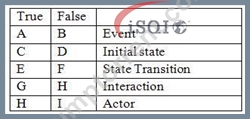
Answer:
Explanation:
A, C, E, H, J
NEW QUESTION # 77
The implementation of traceability offers many benefits for RE. Which of the following benefits would be the LEAST applicable?
- A. It helps to analyze the impacts of change in requirements.
- B. It helps to produce verifiable requirements.
- C. It helps to produce unambiguous requirements.
- D. It helps when trying to find where a requirement came from.
Answer: B,C
NEW QUESTION # 78
You are assigned to carry out and document a system and context delimitation for a software system that is to be developed. What diagram is least suited for the representation of the delimitation? (1 Point)
- A. Use case diagram
- B. Statediagram
- C. Class diagram
- D. Context diagram with data flows
Answer: B
NEW QUESTION # 79
Choose the right sentence regarding the types of views:
- A. All the other options are wrong.
- B. A selective view presents a subset of the available data (attributes) for the requirements.
- C. An aggregating view presents summaries, totals, or averages derived from a group of requirements.
- D. Projective views provide information on a carefully chosen subset of requirements.
Answer: C
NEW QUESTION # 80
Which of the following options are considered evidences of a good application of RE in a project?
- A. Stakeholders have a shared understanding of requirements.
- B. There is no such thing as the assumption that requirements are self-evident.
- C. Early system implementation.
- D. People writing requirements are well educated in RE.
Answer: A,B,D
NEW QUESTION # 81
Choose the right options regarding tools to support Requirements Engineering.
- A. After acquiring a new tool, it is a good practice to initially use it redundantly alongside an existing project.
- B. When choosing a tool, the most important thing is to evaluate if the tool can be adapted to the existing RE process and working method.
- C. The RE process can be changed due to the tool selected.
- D. It is perfectly fine to use basic office tools to manage requirements.
Answer: A,C
NEW QUESTION # 82
Choose the right sentence regarding requirements documents.
- A. All the other options are wrong.
- B. The product backlog is an explicit requirements document.
- C. A requirements document must also contain additional information and explanations.
- D. There is a universal structure that all requirements documents should follow.
Answer: A
Explanation:
Comprehensive and Detailed Explanation From Exact Extract:
There is no single universal template for requirements documents; structures must be tailored to domain, process model and contractual needs, contradicting A.
In agile, a product backlog is a prioritized list of work items, not a traditional explicit requirements specification, though it does contain requirement-like entries, so B is inaccurate. While many specs include additional project and explanatory information, this is not mandatory, so C overstates. Consequently, the only generally correct answer is that the other statements are wrong.
NEW QUESTION # 83
Choose the right sentences.
- A. Product owners may act as a requirements engineer.
- B. Requirements engineers should work in defining/improving the RE processes within their organization.
- C. Having RE knowledge is not useful for professionals that don't act as requirements engineers.
- D. Requirements engineer is typically not a role to be played, but a job title.
Answer: A,B
NEW QUESTION # 84
Requirements documentation can either be natural language or model-based. Which two statements are most applicable? (2 Points)
- A. If documentation is model-based, natural language documentation can be dispensed with.
- B. In requirements engineering models are more suitable than textual descriptions to reduce the complexity of the entity being considered.
- C. As models are more formal, they offer a higher degree of uniqueness compared to natural language.
- D. When deciding between model-based and natural language documentation, model-based is preferable.
Answer: A,C
NEW QUESTION # 85
Which of the following are NOT major types of prototypes?
- A. Evolutionary prototype
- B. Experimental prototype
- C. Simulational prototype
- D. Test prototype
Answer: C,D
NEW QUESTION # 86
As input for the system development, the Board of Directors of an automotive manufacturer has specified the following goals:
1. The infotainment system should be easy to operate.
2. The user must be able to operate the system without becoming distracted from the road traffic.
3. The system should function without an additional power source.
4. The system should be configurable for various models of car.
With which two approaches can these goals be detailed and refined best? (2 Points)
- A. Documentation of the goals in a sequence diagram.
- B. Clear specification of the goals with the help of use casesand the associated activity diagrams.
- C. Decomposition of the goals with the help of goaltrees, in order to obtain more concrete goals.
- D. Formulation of other goals, since the given goals are not feasible.
Answer: A,B
NEW QUESTION # 87
You are given the requirement: "The option to change font color should be displayd by the system Alfa in its main menu." What is the most severe issue?
- A. The requirement is written in the passive voice.
- B. The requirement has incomplete conditions.
- C. Nominalizations have been used.
- D. Universal quantifiers have been used.
Answer: A
Explanation:
Comprehensive and Detailed Explanation From Exact Extract:
Natural-language guidelines advise using active voice and a clear subject. The requirement currently focuses on the "option to change font color" being "displayed" rather than on what the system shall do, and includes spelling errors. Rewriting it as "The system Alfa shall display an option to change font color in its main menu" uses active voice, clarifies responsibility and fits recommended phrase templates. No universal quantifiers like "always" or "all" are present, no specific condition is needed, and there are no problematic nominalizations. Thus the primary defect is the passive, object-centred phrasing.
NEW QUESTION # 88
Which of the following perspectives is the most important when selecting a tool to support the RE process?
- A. All the other options are wrong
- B. Project perspective
- C. User perspective
- D. Process perspective
Answer: A
NEW QUESTION # 89
......
CPRE-FL_Syll_3.0 2025 Training With 178 QA's: https://www.dumptorrent.com/CPRE-FL_Syll_3.0-braindumps-torrent.html
ISQI CPRE-FL_Syll_3.0 Certification Exam Questions: https://drive.google.com/open?id=162KstTr8TxTSupf6oTY5jb9SO3xD6al8