


Pass Fortinet FCP_ZCS_AD-7.4 exam questions - convert Test Engine to PDF
Pass Your FCP_ZCS_AD-7.4 Exam Easily - Real FCP_ZCS_AD-7.4 Practice Dump Updated Jul 11, 2025
NEW QUESTION # 32
Refer to the exhibits.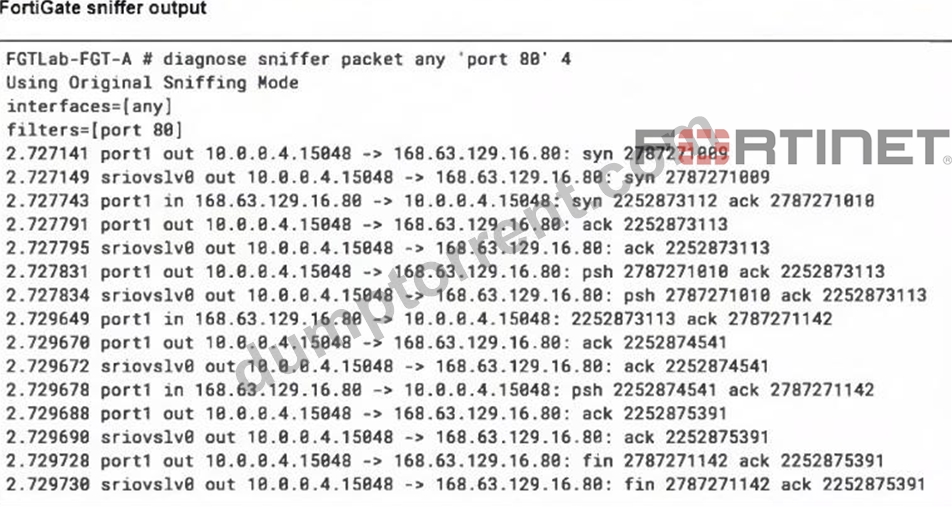
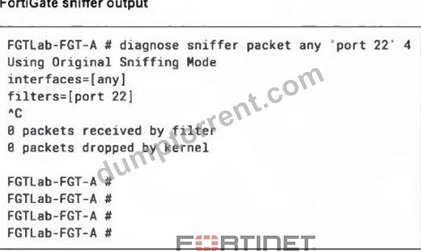
A high availability (HA) active-active FortiGate with Elastic Load Balancing (ELB) and Internal Load Balancing (ILB) was deployed with a default setup to filter traffic to a Linux server running Apache server.
Ports 80 and 22 are open on the Linux server, and on FortiGate a VIP and firewall policy are configured to allow traffic through ports 80 and 22. Traffic on port 80 is successful, but traffic on port 22 is not detected by FortiGate.
What configuration changes could you perform to allow SSH traffic?
- A. Add a new Inbound NAT rule
- B. Configure a customized port under the Frontend IP configuration
- C. Include the Linux server in the back-end pool options
- D. Add a new Azure load balancing rule
Answer: A
Explanation:
Since port 80 traffic is reaching the FortiGate (as shown in the sniffer output) but port 22 traffic is not, the issue lies before the FortiGate, at the Azure Load Balancer level. Azure Load Balancers require an Inbound NAT rule to forward specific ports (like SSH on port 22) to a specific backend VM. Creating a new Inbound NAT rule for port 22 will allow SSH traffic to be properly routed to the FortiGate VM.
NEW QUESTION # 33
A Linux server was deployed in a protected subnet with a dynamic IP address. A FortiGate VM in the internal subnet provides traffic filtering to it. and you must implement a firewall policy using the IP address of the Linux server.
Which feature could help integrate FortiGate using Linux server tags?
- A. Targets Management
- B. Microsoft Entra ID
- C. Software-defined network (SDN) connector
- D. Service Fabric Cluster
Answer: C
Explanation:
The Software-defined network (SDN) connector allows FortiGate to dynamically pull metadata such as tags, IP addresses, and resource groups from Azure resources. This enables automatic policy updates based on dynamic IP changes, such as those of a Linux server in a protected subnet.
NEW QUESTION # 34
Why would an organization use Azure Route Server in a hybrid cloud scenario?
Response:
- A. To provide faster access to cloud resources
- B. To enhance the security of on-premises devices
- C. To ensure data compliance across borders
- D. To manage routing between Azure and on-premises environments
Answer: D
NEW QUESTION # 35
What does Azure Sentinel primarily manage within the scope of Azure security services?
Response:
- A. Digital key protection
- B. VPN configurations
- C. Device management
- D. Threat intelligence and analytics
Answer: D
NEW QUESTION # 36
Why would you use a user-defined route in Azure?
- A. To allow communication between FortiGate VMs on two subnets in the same VNET
- B. To have the traffic from the other VMs inspected by FortiGate
- C. To allow inbound management access to FortiGate VMs
- D. To manage user authentication and access control
Answer: B
Explanation:
A user-defined route (UDR) in Azure is used to redirect traffic from other VMs through a FortiGate VM for inspection. By modifying the routing table, you ensure that outbound or inter-subnet traffic is sent to the FortiGate as the next hop, enabling traffic filtering, logging, and security enforcement.
NEW QUESTION # 37
What is a limitation of the Network Security Groups (NSGs) in Azure?
- A. NSGs are applied only to vNICs.
- B. NSGs allow the filtering of inbound traffic only.
- C. NSGs cannot be applied to individual virtual machines.
- D. NSGs operate at the application layer, limiting their effectiveness in the network layer.
Answer: A
Explanation:
A limitation of NSGs is that they are applied only at the subnet level or to network interfaces (vNICs), not directly to other resources like load balancers or application gateways. This means granular application-layer filtering is not supported, and NSGs primarily operate at Layers 3 and 4.
NEW QUESTION # 38
Which Azure service is directly involved in building, testing, deploying, and managing applications and services through Microsoft-managed data centers?
Response:
- A. Azure ExpressRoute
- B. Azure Active Directory
- C. Azure Cosmos DB
- D. Azure DevOps
Answer: D
NEW QUESTION # 39
What critical step is involved when integrating FortiGate with Azure SDN?
Response:
- A. Configuring VLAN attachments
- B. Setting up direct peering
- C. Implementing a VPN gateway
- D. Configuring security policies
Answer: D
NEW QUESTION # 40
Which type of network virtual appliances (NVAs) are supported by Azure route servers?
Response:
- A. Any network appliance that supports Azure firewall manager.
- B. Any network appliance that supports Azure virtual WAN.
- C. Any network appliance that supports BGP routing protocol.
- D. Any network appliance that supports IPsec VPN protocol.
Answer: C
NEW QUESTION # 41
After integrating a FortiGate VM with Azure Route Server, you detect that routes are not propagating successfully.
What initial step could you perform to diagnose the root cause?
- A. Verify the BGP peering status on both the FortiGate VM and Azure Route Server
- B. Monitor the network latency between the FortiGate VM and Azure Route Server to identify potential communication delays affecting route propagation
- C. Verify that the FortiGate VM is running the latest firmware version
- D. Examine the Azure Microsoft Entra ID permissions associated with the FortiGate VM to ensure that correct authentication is being used for BGP peering
Answer: A
Explanation:
The first and most direct diagnostic step is to verify the BGP peering status on both the FortiGate VM and Azure Route Server. If BGP peering is not established or is in an idle or down state, route propagation will fail. This check confirms whether the two systems are communicating and exchanging routes as expected.
NEW QUESTION # 42
Your organization must provide secure communication to various resources like VMs, databases, and applications. Additionally, there is a need to implement network segmentation. Which Azure feature offers a dedicated and isolated environment for connecting these cloud resources?
Response:
- A. Azure Virtual Network
- B. Azure Logic Apps
- C. Azure App Service Environment
- D. Azure Firewall Premium
Answer: A
NEW QUESTION # 43
What is the primary benefit of configuring HA with FortiGate in an Azure environment?
Response:
- A. Failover protection
- B. Enhanced data encryption
- C. Reduced data storage costs
- D. Increased application performance
Answer: A
NEW QUESTION # 44
What component of Azure is primarily used to enhance data security and privacy through encrypted storage solutions?
Response:
- A. Azure Disk Storage
- B. Azure Security Center
- C. Azure Key Vault
- D. Azure Blob Storage
Answer: C
NEW QUESTION # 45
Refer to the exhibits.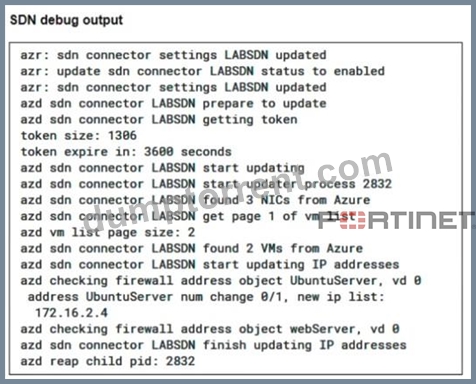
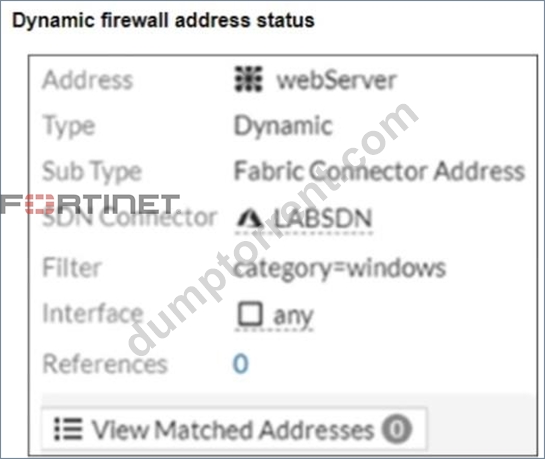
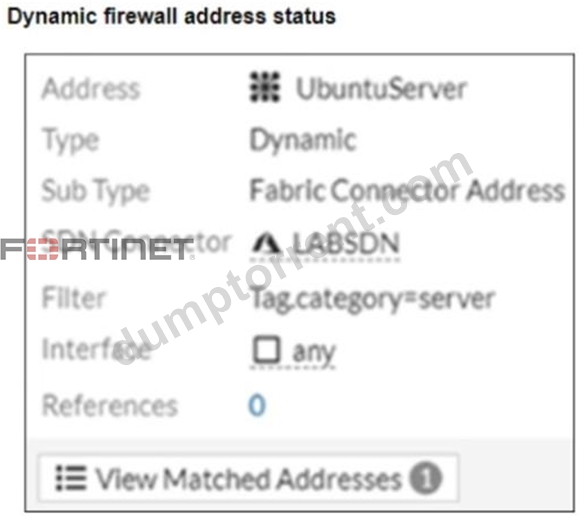
Two new dynamic firewall addresses have been configured on the FortiGate VM using the external connector to Integrate within the same Azure environment.
The debug output shows that one IP address can be resolved successfully, but the second is empty.
Which steps could you perform to correct the misconfiguration? (Choose all that apply.)
- A. Check for a mistyped Microsof Entra ID subscription
- B. Verify the NSG for the target VM
- C. Verify the filter used for the dynamic firewall address
- D. Verify the tags on the target VM
- E. Verify the Microsoft Entra ID role assignment access rights
Answer: C,D
Explanation:
The debug output shows that the UbuntuServer address object successfully resolved an IP, while the webServer did not. The most likely cause is a mismatch in the dynamic address filter or missing tags on the target VM.
Verify the filter used for the dynamic firewall address - The filter category=windows may not match any VM metadata, resulting in no matched addresses.
Verify the tags on the target VM - Ensure that the VM has the correct tags (e.g., category=windows) that match the dynamic address filter to enable resolution.
NEW QUESTION # 46
What is the main purpose of FortiWeb in the context of web applications in Azure?
Response:
- A. To offer web application firewall (WAF) capabilities for protection against web application attacks
- B. To automatically optimize network latency within Azure virtual networks
- C. To provide a secure content delivery network (CDN) for web applications.
- D. To encrypt data at rest within Azure storage
Answer: A
NEW QUESTION # 47
Which role does the local network gateway play in FortiGate to Azure VPN connectivity?
- A. It is responsible for load balancing traffic between FortiGate and Azure
- B. It represents the Azure VPN Gateway in the FortiGate configuration
- C. It manages the encryption keys for the VPN connection
- D. It defines the IP addresses of the on-premises network
Answer: D
Explanation:
The local network gateway in Azure represents the on-premises VPN device (such as FortiGate) and defines the on-premises public IP address and the address prefixes of the on-premises network. This is essential for configuring site-to-site VPN connections from Azure to FortiGate.
NEW QUESTION # 48
......
FCP_ZCS_AD-7.4 Real Exam Questions and Answers FREE: https://www.dumptorrent.com/FCP_ZCS_AD-7.4-braindumps-torrent.html
2025 Realistic Verified Free Fortinet FCP_ZCS_AD-7.4 Exam Questions: https://drive.google.com/open?id=1pLnNoJ9DmtKRQ5VccXJL-eZDeuvXCVMr