


Sample Questions of 212-82 Dumps With 100% Exam Passing Guarantee
Pass Key features of 212-82 Course with Updated 168 Questions
ECCouncil 212-82 Exam is a comprehensive exam that covers various cybersecurity topics. 212-82 exam is designed to test the skills of candidates in identifying, analyzing, and responding to various cybersecurity threats. 212-82 exam also tests the candidates' ability to implement security measures to protect networks and systems from cyber-attacks. 212-82 exam consists of multiple-choice questions and practical simulations that test the candidates' ability to apply their knowledge in real-world scenarios.
ECCouncil 212-82 certification is a stepping stone for individuals who want to pursue advanced certifications in cybersecurity. Certified Cybersecurity Technician certification provides a solid foundation in cybersecurity concepts and principles, which can be further developed through advanced certifications such as the Certified Ethical Hacker (CEH) and the Certified Information Systems Security Professional (CISSP). Having the ECCouncil 212-82 certification can also increase your chances of getting hired by top companies in the cybersecurity industry.
ECCouncil 212-82 certification exam consists of 100 multiple-choice questions that must be completed within a 3-hour timeframe. 212-82 exam is computer-based and can be taken at a Pearson VUE testing center or remotely from home or office. 212-82 exam fee includes one attempt at the exam, and candidates must achieve a passing score of 70% or higher to earn the certification.
NEW QUESTION # 66
Ruben, a crime investigator, wants to retrieve all the deleted files and folders in the suspected media without affecting the original files. For this purpose, he uses a method that involves the creation of a cloned copy of the entire media and prevents the contamination of the original media. Identify the method utilized by Ruben in the above scenario.
- A. Bit-stream imaging
- B. Logical acquisition
- C. Drive decryption
- D. Sparse acquisition
Answer: A
Explanation:
Bit-stream imaging is the method utilized by Ruben in the above scenario. Bit-stream imaging is a method that involves creating a cloned copy of the entire media and prevents the contamination of the original media. Bit-stream imaging copies all the data on the media, including deleted files and folders, hidden partitions, slack space, etc., at a bit level. Bit-stream imaging preserves the integrity and authenticity of the digital evidence and allows further analysis without affecting the original media. Sparse acquisition is a method that involves creating a partial copy of the media by skipping empty sectors or blocks. Drive decryption is a method that involves decrypting an encrypted drive or partition using a password or a key. Logical acquisition is a method that involves creating a copy of the logical files and folders on the media using file system commands.
NEW QUESTION # 67
Matias, a network security administrator at an organization, was tasked with the implementation of secure wireless network encryption for their network. For this purpose, Matias employed a security solution that uses
256-bit Galois/Counter Mode Protocol (GCMP-256) to maintain the authenticity and confidentiality of data.
Identify the type of wireless encryption used by the security solution employed by Matias in the above scenario.
- A. WEP encryption
- B. WPA3 encryption
- C. WPA2 encryption
- D. WPA encryption
Answer: B
Explanation:
WPA3 encryption is the type of wireless encryption used by the security solution employed by Matias in the above scenario. WPA3 encryption is the latest and most secure version of Wi-FiProtected Access, a protocol that provides authentication and encryption for wireless networks. WPA3 encryption uses 256-bit Galois/Counter Mode Protocol (GCMP-256) to maintain the authenticity and confidentiality of data. WPA3 encryption also provides enhanced protection against offline dictionary attacks, forward secrecy, and secure public Wi-Fi access . WPA2 encryption is the previous version of Wi-Fi Protected Access, which uses Advanced Encryption Standard (AES) or Temporal Key Integrity Protocol (TKIP) for data encryption. WEP encryption is an outdated and insecure version of Wi-Fi security, which uses RC4 stream cipher for data encryption. WPA encryption is an intermediate version of Wi-Fi security, which uses TKIP for data encryption.
NEW QUESTION # 68
Hotel Grande offers luxury accommodations and emphasizes top-notch service for its guests. One such service is secure, high-speed Wi-FI access In every room. The hotel wishes to deploy an authentication method that would give individual guests a seamless experience without compromising security. This method should ideally provide a balance between convenience and strong security. Which of the following should Hotel Grande use?
- A. Open Authentication
- B. EAP-TLS (Extensible Authentication Protocol-Transport Layer Security)
- C. PSK (Pre-Shared Key)
- D. MAC address filtering
Answer: B
Explanation:
* Strong Security:
* EAP-TLS provides strong security by using certificate-based authentication. This ensures that both the client and server are authenticated before a connection is established.
NEW QUESTION # 69
A renowned research institute with a high-security wireless network recently encountered an advanced cyber attack. The attack was not detected by traditional security measures andresulted in significant data exfiltration.
The wireless network was equipped with WPA3 encryption, MAC address filtering, and had disabled SSID broadcasting. Intriguingly. the attack occurred without any noticeable disruption or changes in network performance. After an exhaustive forensic analysis, the cybersecurity team pinpointed the attack method.
Which of the following wireless network-specific attacks was most likely used?
- A. Evil Twin Attack, where a rogue access point mimics a legitimate one to capture network traffic
- B. Jamming Attack, disrupting network communications with interference signals
- C. Bluesnarfing. exploiting Bluetooth connections to access network data
- D. KRACK (Key Reinstallation Attack), exploiting vulnerabilities in the WPA2 protocol
Answer: A
Explanation:
* Definition of Evil Twin Attack:
* An Evil Twin Attack involves setting up a rogue access point that mimics a legitimate Wi-Fi network. Unsuspecting users connect to this rogue AP, allowing the attacker to intercept and capture network traffic.
NEW QUESTION # 70
Desmond, a forensic officer, was investigating a compromised machine involved in various online attacks. For this purpose. Desmond employed a forensic tool to extract and analyze computer-based evidence to retrieve information related to websites accessed from the victim machine. Identify the computer-created evidence retrieved by Desmond in this scenario.
- A. Compressed files
- B. Cookies
- C. Documents
- D. Address books
Answer: B
Explanation:
Cookies are the computer-created evidence retrieved by Desmond in this scenario. Cookies are small files that are stored on a user's computer by a web browser when the user visits a website. Cookies can contain information such as user preferences, login details, browsing history, or tracking data. Cookies can be used to extract and analyze computer-based evidence to retrieve information related to websites accessed from the victim machine2. Reference: Cookies
NEW QUESTION # 71
Finley, a security professional at an organization, was tasked with monitoring the organizational network behavior through the SIEM dashboard. While monitoring, Finley noticed suspicious activities in the network; thus, he captured and analyzed a single network packet to determine whether the signature included malicious patterns. Identify the attack signature analysis technique employed by Finley in this scenario.
- A. Context-based signature analysis
- B. Composite signature-based analysis
- C. Atomic-signature-based analysis
- D. Content-based signature analysis
Answer: D
Explanation:
Content-based signature analysis is the attack signature analysis technique employed by Finley in this scenario. Content-based signature analysis is a technique that captures and analyzes a single network packet to determine whether the signature included malicious patterns. Content- based signature analysis can be used to detect known attacks, such as buffer overflows, SQL injections, or cross-site scripting.
NEW QUESTION # 72
Hayes, a security professional, was tasked with the implementation of security controls for an industrial network at the Purdue level 3.5 (IDMZ). Hayes verified all the possible attack vectors on the IDMZ level and deployed a security control that fortifies the IDMZ against cyber-attacks.
Identify the security control implemented by Hayes in the above scenario.
- A. Use of authorized RTU and PLC commands
- B. MAC authentication
- C. Anti-DoS solution
- D. Point-to-point communication
Answer: A
NEW QUESTION # 73
You are the Lead Cybersecurity Specialist at GlobalTech, a multinational tech conglomerate renowned for its avant-garde technological solutions in the aerospace and defense sector. The organization's reputation stands on the innovative technologies it pioneers, many of which are nation's top secrets.
Late on a Sunday night, you are alerted about suspicious activities on a server holding the schematics and project details for a groundbreaking missile defense system. The indicators suggest a complex, multi-stage cyberattack that managed to bypass traditional security measures. Preliminary investigations reveal that the cybercrlmlnals might have used an Insider's credentials, further complicating the breach. Given the extremely sensitive nature of the data involved, a leak could have severe national security implications and irreparably tarnish the company's reputation. Considering the potential gravity and intricacies of this security incident, what immediate action should you undertake to handle this situation effectively, safeguard crucial data, and minimize potential fallout?
- A. Engage with an external specialized cybersecurity firm to conduct a parallel investigation, leveraging its expertise to identify the culprits and understand the breach's modus operandi.
- B. Initiate the incident response protocol, focusing on immediate containment by isolating the impacted server. Concurrently, assess the breadth and depth of the breach by examining network logs and affected systems.
- C. Notify federal agencies about the potential breach of national security. Work in tandem with them to ensure all necessary measures are taken to prevent further data exfiltration and protect national interests.
- D. Inform the top executive board and legal team about the breach. Prepare a public statement to ensure shareholders and clients are kept in the loop about the incident and the measures being undertaken.
Answer: B
Explanation:
In the event of a cyberattack involving highly sensitive data, such as a missile defense system, the immediate focus should be on containing the breach and understanding its scope. Here's a step-by-step approach:
* Incident Response Protocol:
* Containment: Isolate the impacted server to prevent further unauthorized access or data exfiltration. This helps to limit the damage and secure sensitive information.
* Assessment: Examine network logs, affected systems, and user activities to determine the extent of the breach. This includes identifying how the attackers gained access and what data might have been compromised.
* Minimize Fallout:
* Preservation of Evidence: Ensure that all logs and forensic data are preserved for a detailed investigation.
* Internal Coordination: Inform key stakeholders within the organization, including the executive board and legal team, about the breach and ongoing response efforts.
* Collaboration:
* Federal Agencies: Depending on the severity and national security implications, notifying federal agencies might be necessary after initial containment and assessment.
* External Experts: If required, engage external cybersecurity firms to assist with the investigation and provide additional expertise.
References:
* NIST Computer Security Incident Handling Guide:NIST SP 800-61r2
* SANS Institute Incident Handling Handbook: SANS Reading Room
NEW QUESTION # 74
A web application www.movieabc.com was found to be prone to SQL injection attack. You are given a task to exploit the web application and fetch the user credentials. Select the UID which is mapped to user john in the database table.
Note:
Username: sam
Pass: test
- A. 0
- B. 1
- C. 2
- D. 3
Answer: D
NEW QUESTION # 75
Desmond, a forensic officer, was investigating a compromised machine involved in various online attacks. For this purpose. Desmond employed a forensic tool to extract and analyze computer- based evidence to retrieve information related to websites accessed from the victim machine.
Identify the computer-created evidence retrieved by Desmond in this scenario.
- A. Compressed files
- B. Cookies
- C. Documents
- D. Address books
Answer: B
Explanation:
Cookies are the computer-created evidence retrieved by Desmond in this scenario. Cookies are small files that are stored on a user's computer by a web browser when the user visits a website.
Cookies can contain information such as user preferences, login details, browsing history, or tracking data. Cookies can be used to extract and analyze computer-based evidence to retrieve information related to websites accessed from the victim machine.
NEW QUESTION # 76
Shawn, a forensic officer, was appointed to investigate a crime scene that had occurred at a coffee shop. As a part of investigation, Shawn collected the mobile device from the victim, which may contain potential evidence to identify the culprits.
Which of the following points must Shawn follow while preserving the digital evidence? (Choose three.)
- A. Never record the screen display of the device
- B. Turn the device ON if it is OFF
- C. Do not leave the device as it is if it is ON
- D. Make sure that the device is charged
Answer: B,C,D
Explanation:
Turn the device ON if it is OFF, do not leave the device as it is if it is ON, and make sure that the device is charged are some of the points that Shawn must follow while preserving the digital evidence in the above scenario. Digital evidence is any information or data stored or transmitted in digital form that can be used in a legal proceeding or investigation. Digital evidence can be found on various devices, such as computers, mobile phones, tablets, etc. Preserving digital evidence is a crucial step in forensic investigation that involves protecting and maintaining the integrity and authenticity of digital evidence from any alteration or damage. Some of the points that Shawn must follow while preserving digital evidence are:
Turn the device ON if it is OFF: If the device is OFF, Shawn must turn it ON to prevent any data loss or encryption that may occur when the device is powered off. Shawn must also document any password or PIN required to unlock or access the device.
Do not leave the device as it is if it is ON: If the device is ON, Shawn must not leave it as it is or use it for any purpose other than preserving digital evidence. Shawn must also disable any network connections or communication features on the device, such as Wi-Fi, Bluetooth, cellular data, etc., to prevent any remote access or deletion of data by unauthorized parties.
Make sure that the device is charged: Shawn must ensure that the device has enough battery power to prevent any data loss or corruption that may occur due to sudden shutdown or low battery. Shawn must also use a write blocker or a Faraday bag to isolate the device from any external interference or signals.
Never record the screen display of the device is not a point that Shawn must follow while preserving digital evidence. On contrary, Shawn should record or photograph the screen display of the device to capture any relevant information or messages that may appear on the screen. Recording or photographing the screen display of the device can also help document any changes or actions performed on the device during preservation.
NEW QUESTION # 77
Cairo, an incident responder. was handling an incident observed in an organizational network. After performing all IH&R steps, Cairo initiated post-incident activities. He determined all types of losses caused by the incident by identifying And evaluating all affected devices, networks, applications, and software. Identify the post-incident activity performed by Cairo in this scenario.
- A. Incident impact assessment
- B. Close the investigation
- C. Review and revise policies
- D. Incident disclosure
Answer: A
Explanation:
Incident impact assessment is the post-incident activity performed by Cairo in this scenario. Incident impact assessment is a post-incident activity that involves determining all types of losses caused by the incident by identifying and evaluating all affected devices, networks, applications, and software. Incident impact assessment can include measuring financial losses, reputational damages, operational disruptions, legal liabilities, or regulatory penalties1. References: Incident Impact Assessment
NEW QUESTION # 78
Andre, a security professional, was tasked with segregating the employees' names, phone numbers, and credit card numbers before sharing the database with clients. For this purpose, he implemented a deidentification technique that can replace the critical information in database fields with special characters such as asterisks (*) and hashes (#).
Which of the following techniques was employed by Andre in the above scenario?
- A. Bucketing
- B. Masking
- C. Tokenization
- D. Hashing
Answer: B
Explanation:
Masking is the technique that Andre employed in the above scenario. Masking is a deidentification technique that can replace the critical information in database fields with special characters such as asterisks (*) and hashes (#). Masking can help protect sensitive data from unauthorized access or disclosure, while preserving the format and structure of the original data . Tokenization is a deidentification technique that can replace the critical information in database fields with random tokens that have no meaning or relation to the original data. Hashing is a deidentification technique that can transform the critical information in database fields into fixed-length strings using a mathematical function. Bucketing is a deidentification technique that can group the critical information in database fields into ranges or categories based on certain criteria.
NEW QUESTION # 79
Elliott, a security professional, was tasked with implementing and deploying firewalls in the corporate network of an organization. After planning and deploying firewalls in the network, Elliott monitored the firewall logs to detect evolving threats And attacks; this helped in ensuring firewall security and addressing network issues beforehand.
in which of the following phases of firewall implementation and deployment did Elliott monitor the firewall logs?
- A. Testing
- B. Deploying
- C. Configuring
- D. Managing and maintaining
Answer: D
Explanation:
Managing and maintaining is the phase of firewall implementation and deployment in which Elliott monitored the firewall logs in the above scenario. A firewall is a system or device that controls and filters the incoming and outgoing traffic between different networks or systems based on predefined rules or policies. A firewall can be used to protect a network or system from unauthorized access, use, disclosure, modification, or destruction . Firewall implementation and deployment is a process that involves planning, installing, configuring, testing, managing, and maintaining firewalls in a network or system . Managing and maintaining is the phase of firewall implementation and deployment that involves monitoring and reviewing the performance and effectiveness of firewalls over time . Managing and maintaining can include tasks such as updating firewall rules or policies, analyzing firewall logs , detecting evolving threats or attacks , ensuring firewall security , addressing network issues , etc. In the scenario, Elliott was tasked with implementing and deploying firewalls in the corporate network of an organization. After planning and deploying firewalls in the network, Elliott monitored the firewall logs to detect evolving threats and attacks; this helped in ensuring firewall security and addressing network issues beforehand. This means that he performed managing and maintaining phase for this purpose. Deploying is the phase of firewall implementation and deployment that involves installing and activating firewalls in the network or system according to the plan. Testing is the phase of firewall implementation and deployment that involves verifying and validating the functionality and security of firewalls before putting them into operation. Configuring is the phase of firewall implementation and deployment that involves setting up and customizing firewalls according to the requirements and specifications.
NEW QUESTION # 80
Cassius, a security professional, works for the risk management team in an organization. The team is responsible for performing various activities involved in the risk management process. In this process, Cassius was instructed to select and implement appropriate controls on the identified risks in order to address the risks based on their severity level. Which of the following risk management phases was Cassius instructed to perform in the above scenario?
- A. Risk analysis
- B. Risk identification
- C. Risk prioritization
- D. Risk treatment
Answer: D
Explanation:
Risk treatment is the risk management phase that Cassius was instructed to perform in the above scenario. Risk management is a process that involves identifying, analyzing, evaluating, treating, monitoring, and reviewing risks that can affect an organization's objectives, assets, or operations.
Risk management phases can be summarized as follows: risk identification, risk analysis, risk prioritization, risk treatment, and risk monitoring.Risk identification is the risk management phase that involves identifying and documenting potential sources, causes, events, and impacts of risks.
Risk analysis is the risk management phase that involves assessing and quantifying the likelihood and consequences of risks. Risk prioritization is the risk management phase that involves ranking risks based on their severity level and determining which risks need immediate attention or action. Risk treatment is the risk management phase that involves selecting and implementing appropriate controls or strategies to address risks based on their severity level.Risk treatment can include avoiding, transferring, reducing, or accepting risks. Risk monitoring is the risk management phase that involves tracking and reviewing the performance and effectiveness of risk controls or strategies over time.
NEW QUESTION # 81
A web application, www.moviescope.com. hosted on your tarqet web server is vulnerable to SQL injection attacks. Exploit the web application and extract the user credentials from the moviescope database. Identify the UID (user ID) of a user, John, in the database. Note: Vou have an account on the web application, and your credentials are samAest.
(Practical Question)
- A. 0
- B. 1
- C. 2
- D. 3
Answer: D
Explanation:
4 is the UID (user ID) of a user, John, in the database in the above scenario. A web application is a software application that runs on a web server and can be accessed by users through a web browser. A web application can be vulnerable to SQL injection attacks, which are a type of web application attack that exploit a vulnerability in a web application that allows an attacker to inject malicious SQL statements into an input field, such as a username or password field, and execute them on the database server. SQL injection can be used to bypass authentication, access or modify sensitive data, execute commands, etc. To exploit the web application and extract the user credentials from the moviescope database, one has to follow these steps:
* Open a web browser and type www.moviescope.com
* Press Enter key to access the web application.
* Enter sam as username and test as password.
* Click on Login button.
* Observe that a welcome message with username sam is displayed.
* Click on Logout button.
* Enter sam' or '1'='1 as username and test as password.
* Click on Login button.
* Observe that a welcome message with username admin is displayed, indicating that SQL injection was successful.
* Click on Logout button.
* Enter sam'; SELECT * FROM users; - as username and test as password.
* Click on Login button.
* Observe that an error message with user credentials from users table is displayed.
The user credentials from users table are: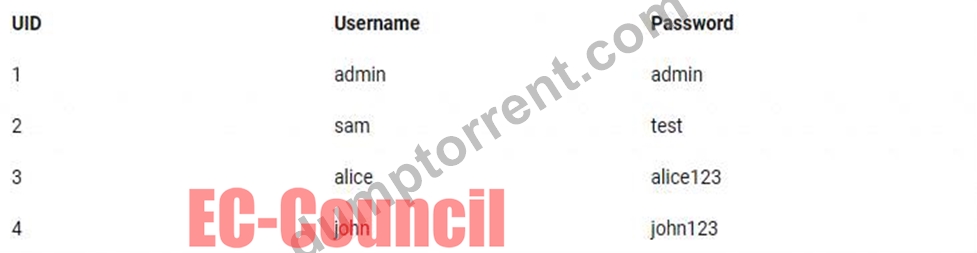
The UID that is mapped to user john is 4
NEW QUESTION # 82
As the director of cybersecurity for a prominent financial Institution, you oversee the security protocols for a vast array of digital operations. The institution recently transitioned to a new core banking platform that integrates an artificial intelligence (Al)-based fraud detection system. This system monitors real-time transactions, leveraging pattern recognition and behavioral analytics.
A week post-transition, you are alerted to abnormal behavior patterns in the Al system. On closer examination, the system is mistakenly flagging genuine transactions as fraudulent, causing a surge in false positives. This not only disrupts the customers' banking experience but also strains the manual review team. Preliminary investigations suggest subtle data poisoning attacks aiming to compromise the Al's training data, skewing its decision-making ability. To safeguard the Al-based fraud detection system and maintain the integrity of your financial data, which of the following steps should be your primary focus?
- A. Engage in extensive customer outreach programs, urging them to report any discrepancies in their transaction records, and manually verifying flagged transactions.
- B. Liaise with third-party cybersecurity firms to conduct an exhaustive penetration test on the entire core banking platform, focusing on potential data breach points.
- C. Migrate back to the legacy banking platform until the new system is thoroughly vetted and all potential vulnerabilities are addressed.
- D. Collaborate with the Al development team to retrain the model using only verified transaction data and implement real time monitoring to detect data poisoning attempts.
Answer: D
Explanation:
To address the issue of the AI-based fraud detection system flagging genuine transactions as fraudulent due to data poisoning, the primary focus should be on:
* Retraining the AI Model:
* Verified Data: Use only verified, clean transaction data to retrain the model. This helps to eliminate any compromised data that might be skewing the AI's decision-making process.
* Model Integrity: Ensure the integrity of the training data to prevent future data poisoning attempts.
* Real-Time Monitoring:
* Detection Systems: Implement real-time monitoring to detect any attempts at data poisoning as they happen. This involves setting up alerts for abnormal patterns that could indicate malicious
* activity.
* Continuous Learning: Integrate continuous learning systems that can adapt and respond to new threats in real-time, ensuring the AI system remains robust against evolving attack vectors.
References:
* NIST guidelines on AI and data integrity:NIST AI
* Research on data poisoning and mitigation techniques:IEEE Xplore
NEW QUESTION # 83
The SOC department in a multinational organization has collected logs of a security event as
"Windows.events.evtx". Study the Audit Failure logs in the event log file located in the Documents folder of the
-Attacker Maehine-1" and determine the IP address of the attacker. (Note: The event ID of Audit failure logs is
4625.)
(Practical Question)
- A. 10.10.1.16
- B. 10.10.1.10
- C. 10.10.1.19
- D. 10.10.1.12
Answer: A
Explanation:
The IP address of the attacker is 10.10.1.16. This can be verified by analyzing the Windows.events.evtx file using a tool such as Event Viewer or Log Parser. The file contains several Audit Failure logs with event ID 4625, which indicate failed logon attempts to the system. The logs show that the source network address of the failed logon attempts is 10.10.1.16, which is the IP address of the attacker3. The screenshot below shows an example of viewing one of the logs using Event Viewer4: Reference: Audit Failure Log, [Windows.events.evtx], [Screenshot of Event Viewer showing Audit Failure log]
NEW QUESTION # 84
An organization's risk management team identified the risk of natural disasters in the organization's current location. Because natural disasters cannot be prevented using security controls, the team suggested to build a new office in another location to eliminate the identified risk. Identify the risk treatment option suggested by the risk management team in this scenario.
- A. Risk avoidance
- B. Risk sharing
- C. Risk retention
- D. Risk modification
Answer: A
Explanation:
Risk avoidance is the risk treatment option suggested by the risk management team in this scenario. Risk avoidance is a risk treatment option that involves eliminating the identified risk by changing the scope, requirements, or objectives of the project or activity. Risk avoidance can be used when the risk cannot be prevented using security controls or when the risk outweighs the benefits.
NEW QUESTION # 85
As a cybersecurity technician, you were assigned to analyze the file system of a Linux image captured from a device that has been attacked recently. Study the forensic image
'Evidenced.img" in the Documents folder of the "Attacker Machine-1" and identify a user from the image file. (Practical Question)
- A. john
- B. roger
- C. smith
- D. attacker
Answer: D
Explanation:
The attacker is a user from the image file in the above scenario. A file system is a method or structure that organizes and stores files and data on a storage device, such as a hard disk, a flash drive, etc. A file system can have different types based on its format or features, such as FAT, NTFS, ext4, etc. A file system can be analyzed to extract various information, such as file names, sizes, dates, contents, etc. A Linux image is an image file that contains a copy or a snapshot of a Linux-based file system.A Linux image can be analyzed to extract various information about a Linux-based system or device.To analyze the file system of a Linux image captured from a device that has been attacked recently and identify a user from the image file, one has to follow these steps:
Navigate to Documents folder of Attacker Machine-1.
Right-click on Evidenced.img file and select Mount option. Wait for the image file to be mounted and assigned a drive letter.
Open File Explorer and navigate to the mounted drive.
Open etc folder and open passwd file with a text editor.
Observe the user accounts listed in the file.
The user accounts listed in the file are:
root:x:0:0:root:/root:/bin/bash daemon:x:1:1:daemon:/usr/sbin:/usr/sbin/nologin bin:x:2:2:bin:/bin:/usr/sbin/nologin sys:x:3:3:sys:/dev:/usr/sbin/nologin sync:x:4:65534:sync:/bin:/bin/sync games:x:5:60:games:/usr/games:/usr/sbin/nologin man:x:6:12:man:/var/cache/man:/usr/sbin/nologin lp:x:7:7:lp:/var/spool/lpd:/usr/sbin/nologin mail:x:8:8:mail:/var/mail:/usr/sbin/nologin news:x:9:9:news:/var/spool/news:/usr/sbin/nologin uucp:x:10:10:uucp:/var/spool/uucp:/usr/sbin/nologin proxy:x:13:13:proxy:/bin:/usr/sbin/nologin www-data:x:33:33:www-data:/var/www:/usr/sbin/nologin backup:x:34:34:backup:/var/backups:/usr/sbin/nologin list:x:38:38:Mailing List Manager:/var/list:/usr/sbin/nologin irc:x:39:39:ircd:/var/run/ircd:/usr/sbin/nologin gnats:x:41:41:Gnats Bug-Reporting System (admin):/var/lib/gnats:/usr/sbin/nologin nobody:x:65534:65534:nobody:/nonexistent:/usr/sbin/nologin systemd-timesync:x:100: systemd- network:x: systemd-resolve:x: systemd-bus-proxy:x: syslog:x: _apt:x: messagebus:x: uuidd:x:
lightdm:x: whoopsie:x: avahi-autoipd:x: avahi:x: dnsmasq:x: colord:x: speech-dispatcher:x:
hplip:x:
kernoops:x: saned:x: nm-openvpn:x: nm-openconnect:x: pulse:x: rtkit:x: sshd:x: attacker::1000 The user account that is not a system or service account is attacker, which is a user from the image file.
NEW QUESTION # 86
Nancy, a security specialist, was instructed to identify issues related to unexpected shutdown and restarts on a Linux machine. To identify the incident cause, Nancy navigated to a directory on the Linux system and accessed a log file to troubleshoot problems related to improper shutdowns and unplanned restarts.
Identify the Linux log file accessed by Nancy in the above scenario.
- A. /var/log/boot.log
- B. /var/log/lighttpd/
- C. /var/log/kern.log
- D. /var/log/secure
Answer: A
Explanation:
/var/log/boot.log is the Linux log file accessed by Nancy in the above scenario. Linux is an open-source operating system that logs various events and activities on the system or network. Linux log files are stored in the /var/log directory, which contains different types of log files for different purposes. /var/log/boot.log is the type of log file that records events related to the booting process of the Linux system, such as loading drivers, services, modules, etc. /var/log/boot.log can help identify issues related to unexpected shutdowns and restarts on a Linux machine . /var/log/secure is the type of log file that records events related to security and authentication, such as logins, logouts, password changes, sudo commands, etc. /var/log/kern.log is the type of log file that records events related to the kernel, such as kernel messages, errors, warnings, etc. /var/log/lighttpd/ is the directory that contains log files related to the lighttpd web server, such as access logs, error logs, etc.
NEW QUESTION # 87
As a Virtualization Software Engineer/Analyst, you are employed on a Project with Alpha Inc.
Company, the OS Virtualization is used for isolation of Physical/Base OS with the Hypervisor OS.
What is the security benefit of OS virtualization in terms of isolation?
- A. A compromised virtual machine can easily infect the physical host and other VMs.
- B. Virtual machines are isolated from each other, preventing a security breach in one from impacting others.
- C. Virtual machines can freely access the resources of other VMs on the same host.
- D. OS virtualization offers no security benefits in isolation.
Answer: B
NEW QUESTION # 88
......
212-82 Sample Practice Exam Questions 2026 Updated Verified: https://www.dumptorrent.com/212-82-braindumps-torrent.html
Exam Study Guide Free Practice Test LAST UPDATED : https://drive.google.com/open?id=1IxmuAfJUIfwfhdjt2h3qCCJg_RC31Bk0