


VMware 3V0-21.25 Study Guide Archives Updated on Jul 01, 2026
Download 3V0-21.25 Mock Test Study Material
NEW QUESTION # 24
A development team submits the following requirements to the VMware Cloud Foundation (VCF) Automation administrator:
* Three-tier inventory system (web, application, and database).
* All components deployed as virtual machines (VMs).
* Static IP addresses required.
* NAT and load balancing for external access.
* Network segmentation between DMZ and internal tiers.
* The team requests to use the platform's managed PostgreSQL database service instead of maintaining their own database virtual machines.
Which organization type should the administrator configure to meet these requirements with minimal complexity?
- A. Provider Organization
- B. Kubernetes Apps Organization
- C. AllApps Organization
- D. VMApps Organization
Answer: C
Explanation:
To satisfy the requirement for a mix of traditional Virtual Machines and modern managed services like a managed PostgreSQL database, the AllApps Organization is the ideal choice in VCF 9.0. While a VMApps Organization excels at basic VM lifecycle management, it lacks the native integration for "higher- level" managed services provided by the vSphere Supervisor. The AllApps model is designed specifically to bridge the gap between IaaS and PaaS. It allows the administrator to provision NSX VPCs, which natively handle complex networking requirements such as NAT, load balancing, and multi-tier segmentation (DMZ vs.
Internal) with significantly less manual configuration than traditional NSX segments. Furthermore, the AllApps organization provides direct access to Supervisor Services, which include managed data services like PostgreSQL. This allows the development team to consume a database as a service (DBaaS) while still deploying their web and application logic as standard VMs within the same governed environment and VPC, fulfilling all technical requirements within a single, unified consumption interface.
NEW QUESTION # 25
A customer needs to deploy Kubernetes-based workloads in a newly created VMware Cloud Foundation (VCF) workload domain.
Which two prerequisites must be met before creating an AllApps Organization in VMware Cloud Foundation (VCF) Automation? (Choose two.)
- A. Supervisor must be activated within the VCF workload domain.
- B. Supervisor must be activated within the VCF Management domain and workload domain.
- C. The VMware Kubernetes Service (VKS) must be activated within the VCF Management domain.
- D. A Region must be configured within the VCF Automation Provider Management Portal.
- E. The VCF workload domain must be configured for VMware NSX Federation.
Answer: A,D
Explanation:
To support an AllApps Organization, which is inherently designed for both Kubernetes and VM workloads, the underlying infrastructure must be "modernized" via the vSphere Supervisor. Activating the Supervisor within the specific Workload Domain is the primary prerequisite, as it transforms the standard vSphere clusters into a Kubernetes-native control plane. Once the hardware/vSphere layer is ready, the next mandatory step takes place within the VCF Automation Provider Management Portal, where the administrator must define a Region. The Region acts as the "bridge" between the physical workload domain and the logical Organization; it discovers the Supervisor clusters and makes their compute, memory, and storage classes available for tenant assignment. Without a defined Region, the AllApps Organization has no source of resources to consume, and without an active Supervisor, the AllApps networking (VPC) and container services (VKS) cannot function.
NEW QUESTION # 26
A design requirement for a new VCF 9.0 deployment specifies that all tenant network traffic must be inspected by a centralized firewall appliance located in a "Security" VPC before reaching the internet.
Which NSX VPC feature should be used to support this "Service Chaining" requirement?
- A. Static Routes with Next-Hop to an Interface IP
- B. Distributed Firewall (DFW) Exclusion List
- C. VPC Ingress Profiles
- D. Default Outbound NAT
Answer: A
Explanation:
To support centralized security inspection or "Service Chaining" in VCF 9.0, administrators leverage the routing flexibility of the NSX VPC. By configuring Static Routes within the tenant VPC, the administrator can override the default system-generated path to the internet. Specifically, the "0.0.0.0/0" (Default Route) can be pointed to the Interface IP of a security appliance or a load balancer residing within a shared or dedicated Security VPC. This forces all egress traffic from the application VPC to transit through the security layer for deep packet inspection or logging before the Transit Gateway forwards it to the external network.
While the Distributed Firewall (Option C) provides micro-segmentation, it does not redirect traffic to external appliances; only custom routing logic-managed through the VPC's routing table-can satisfy the requirement for centralized service insertion in a multi-VPC regional design.
NEW QUESTION # 27
What are two prerequisites to enable provisioning VMs via kubectl against tenant resources? (Choose two.)
- A. Generate an API token from the VCF Automation UI.
- B. Ask the Provider to generate a token via the system APIs.
- C. Create a new extensibility Action.
- D. Create a context via VCF CLI.
- E. Create a context via kubectl.
Answer: A,D
NEW QUESTION # 28
Match the VMware Cloud Foundation (VCF) Operations orchestrator component with its description by dragging and dropping the correct item from the Component list on the left and place them onto the Description list on the right.
Answer:
Explanation: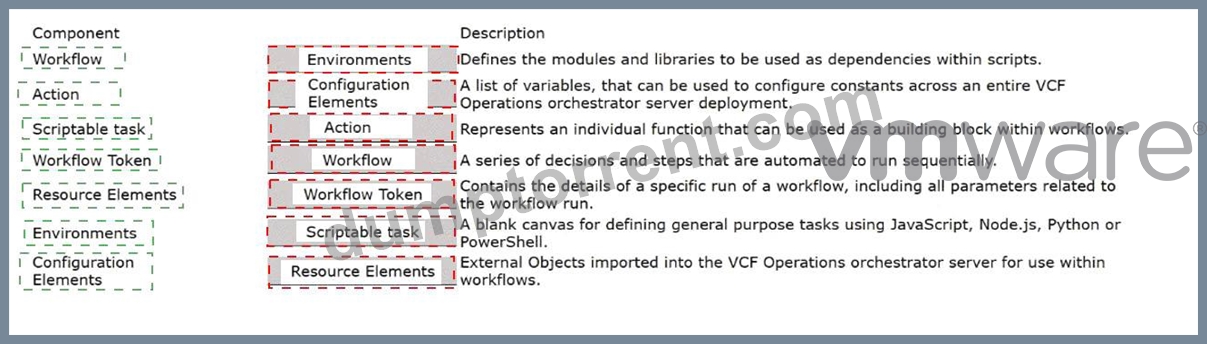
Explanation:
In VMware Cloud Foundation 9.0, the VCF Operations orchestrator (formerly vRealize Orchestrator) utilizes a specific object-oriented hierarchy to facilitate infrastructure automation. Workflows are the primary administrative unit, representing a logical sequence of automated steps. Within these, Actions serve as reusable, modular functions-often written in JavaScript-that act as building blocks across multiple workflows to reduce code duplication. For custom logic, Scriptable tasks provide a "blank canvas" allowing developers to execute polyglot scripts (Node.js, Python, or PowerShell) directly within a workflow's schema.
To manage environment-wide variables and reusable assets, the orchestrator uses Configuration Elements and Resource Elements. Configuration Elements store persistent constants (like API endpoints or global timeout values) shared across the server, while Resource Elements allow the import of external files (such as XML, text, or binary files) for use during execution. Modern scripting requirements are handled by Environments, which define the specific runtime dependencies and external libraries (like boto3 for Python) needed for complex integrations. Finally, the Workflow Token is a critical operational object created during every execution; it stores the specific state, inputs, and outputs of a single run, serving as the primary source for audit trails and troubleshooting failed automation tasks. Together, these components allow for the deep extensibility required to integrate VCF with third-party ITSM and CMDB platforms.
NEW QUESTION # 29
An administrator has been tasked with creating a provider content library. The following requirements must be satisfied:
* The content library must be configured as a local content library.
* The content library must be associated with the region called West.
Select the four steps involved in configuring the provider content library. (Choose four.)
Answer:
Explanation:
Explanation:
* Log into the Provider Management Portal.
* Click CREATE CONTENT LIBRARY.
* Specify the region called West.
* Ensure Subscribe to an external library is disabled.
In VMware Cloud Foundation (VCF) 9.0, the Provider Management Portal is the centralized interface used by cloud providers to manage global infrastructure and shared resources across the entire fleet.
To satisfy the requirements:
* Administrative Context: The task of creating global resources like a provider-level content library is a
"Day 0/1" infrastructure task, which must be performed in the Provider Management Portal rather than a tenant-specific Organization Portal.
* Regional Association: VCF 9.0 uses Regions to logically group underlying vSphere and NSX resources. Associating the library with the West region ensures that the templates and ISOs within that library are specifically available for workloads deployed into that regional infrastructure.
* Local vs. Subscribed: A Local Content Library is one where the provider directly uploads and manages the content. The requirement specifies a local configuration; therefore, the option to Subscribe to an external library must be disabled. If it were enabled, the library would instead attempt to synchronize content from a remote URL (such as a public VMware repository or another VCF instance).
Once created, this library acts as a "golden repository" that the provider can then share with multiple tenant organizations, ensuring consistency across the private cloud fleet.
NEW QUESTION # 30
An administrator needs to configure a connection between VMware Cloud Foundation (VCF) Automation and an external system to enable the exchange of data for extensibility purposes.
Which two integration types are supported for this purpose? (Choose two.)
- A. VMware Cloud Foundation SDDC Manager
- B. vSphere Lifecycle Manager
- C. VCF Operations Orchestrator
- D. Action-Based Extensibility (ABX)
- E. VMware Live Recovery
Answer: C,D
Explanation:
VCF 9.0 Automation provides two primary "engines" for extensibility and external system integration. VCF Operations Orchestrator is the robust, long-standing workflow engine designed for complex, multi-step orchestration across heterogeneous infrastructure. It supports extensive plugin libraries for third-party systems like ServiceNow, Infoblox, or custom REST/SOAP endpoints. Action-Based Extensibility (ABX) is the modern, serverless alternative that allows administrators to execute lightweight scripts (Python, Node.js, or PowerShell) directly within the VCF Automation framework. ABX is ideal for quick, specific tasks such as calling a web hook or performing a simple API transformation during the provisioning lifecycle. While SDDC Manager (Option D) and vSphere Lifecycle Manager (Option E) are core components of the VCF stack for management and patching, they are not used as extensibility "integrations" for data exchange in the context of automation workflows.
NEW QUESTION # 31
An administrator has been tasked to enable developers to utilize Terraform to configure resources within VMware Cloud Foundation (VCF) Automation. The solution must:
* enable developers to configure Content Libraries.
* enable developers to configure Cloud Zones.
* enable developers to create flavor and image mappings.
What solution satisfies the requirements?
- A. Organization Administrator role.
- B. Terraform provider for VCF Automation.
- C. Terraform configuration in VCF Automation.
- D. System Administrator role.
Answer: B
Explanation:
The Terraform provider for VCF Automation is the specific tool designed to allow Infrastructure-as-Code (IaC) workflows to interact with the VCF 9.0 API surface. In VCF 9.0, the provider has been expanded to support the newer Organization and Region-based architecture. By utilizing this provider, developers can declare Content Libraries, Cloud Zones, and Flavor/Image Mappings within their HCL (HashiCorp Configuration Language) files. While specific RBAC roles (like Organization Administrator) are necessary for the credentials used by the Terraform runner, the solution itself is the provider that translates Terraform commands into the correct REST API calls for the VCF Automation engine. This enables a consistent developer experience where infrastructure configuration is versioned in Git and applied programmatically, aligning with modern DevOps practices supported by the VCF 9.0 platform.
NEW QUESTION # 32
A VMware Cloud Foundation (VCF) Automation administrator has been tasked with ensuring that all newly- deployed virtual machines (VMs) provisioned in the Finance Organization are automatically configured for disaster recovery protection using VMware Live Recovery (VLR). Finance is an AIIApps Organization in VCFA.
Which statement meets this requirement?
- A. Create a catalog item that calls an ABX workflow to add the VMs to VLR.
- B. Create a Day 2 policy that adds the VMs to a VLR Protection Group. Attach the policy to all catalog items available in the Finance Organization.
- C. Create a Day 2 action, scoped to the Finance Organization, that assigns the appropriate VLR Protection Group to all deployments.
- D. Configure an Event Subscription that triggers an Orchestrator workflow to protect the VMs in VLR.
Answer: B
Explanation:
In VCF 9.0, Policies are the most scalable way to enforce compliance and operational standards across an organization without modifying individual blueprints. To ensure all VMs are automatically protected by VMware Live Recovery (VLR), the administrator should Create a Day 2 policy. This policy type can be configured to automatically apply a "VLR Protection Group" assignment as a post-provisioning step. By attaching the policy to all catalog items within the Finance Organization, the administrator guarantees that regardless of which blueprint a user chooses, the protection logic is consistently applied. This "Policy-as- Code" approach is superior to manual event subscriptions (Option A) or individual catalog items (Option B) because it centralizes governance; if the protection requirements change, the admin only needs to update the single policy rather than dozens of separate scripts or subscriptions. This ensures that the Finance team's workloads remain compliant with disaster recovery mandates from the moment they are deployed.
NEW QUESTION # 33
A company has deployed an new VMware Cloud Foundation (VCF) Fleet within their development environment. An administrator has been tasked with configuring the organization for VM Apps so that developers can start to create new cloud templates and catalog items.
When creating the organization for VM Apps, the administrator successfully configured access control and assigned Organization-level and Service-level roles to the correct users and groups.
Drag and drop the five steps the administrator must take from the Steps list into the Ordered Steps list and place them in the correct order so that the objective is completed.
(Choose five.)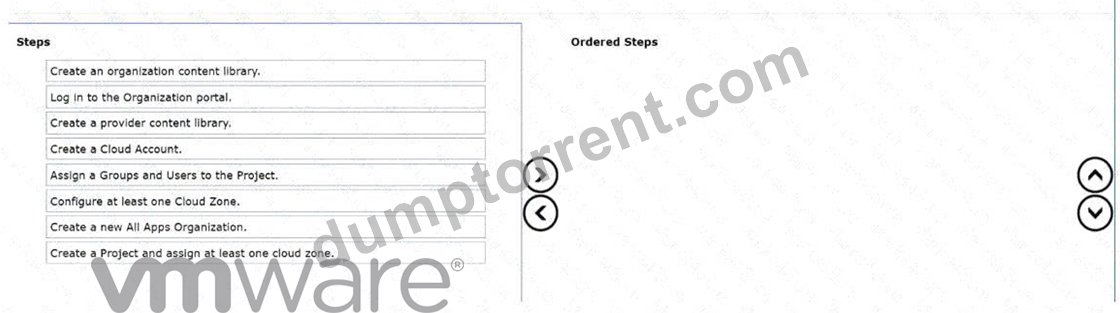
Answer:
Explanation:
Explanation:
VM Apps Organization Configuration
Verified answer:
* Log in to the Organization portal.
* Create a Cloud Account.
* Configure at least one Cloud Zone.
* Create a Project and assign at least one cloud zone.
* Assign a Groups and Users to the Project.
In VMware Cloud Foundation (VCF) 9.0, configuring a VMApps Organization for developer self-service follows a specific hierarchical workflow once the initial organization creation and role assignments are complete. The administrator must first Log in to the Organization portal to perform tenant-specific resource management.
The first technical requirement is to establish a connection to the underlying infrastructure by choosing to Create a Cloud Account. This account integrates the tenant's view with the vCenter and NSX Manager resources provided by the fleet administrator. Once connectivity is established, the admin must Configure at least one Cloud Zone. In the VMApps model, the Cloud Zone is the construct that defines which compute clusters, storage policies, and networks are available for workload placement.
To enable consumption, the administrator must Create a Project and assign at least one cloud zone.
The Project serves as the primary governance boundary where resource quotas and cloud templates are managed. Finally, the administrator must Assign Groups and Users to the Project. This entitlement step ensures that developers have the necessary permissions (e.g., Project Administrator or Member) to consume the infrastructure and create the required catalog items within their isolated environment.
NEW QUESTION # 34
An administrator must initiate the deployment of a new 3-tier application architecture using the VMware Cloud Foundation (VCF) Automation portal. This application includes:
* A web tier (stateless).
* A business logic tier (some local caching).
* A database tier (stateful, PostgreSQL).
* An NSX load balancer fronting the web tier.
* ~99.9% uptime requirement.
* Moderate performance requirements.
Which requirement represents a risk inherent to single-zone deployments?
- A. A higher network complexity.
- B. A shared failure domain for all application tiers.
- C. A higher latency between application tiers.
- D. A split-brain isolation.
Answer: B
Explanation:
The primary architectural risk in any single-zone deployment within VCF 9.0 is the existence of a shared failure domain. In a single-zone Supervisor cluster or workload domain, all components-including the web, application, and database tiers-reside within the same logical and often physical infrastructure boundary (such as a single rack or data center room). If the underlying zone experiences a critical failure, such as a localized power outage, cooling failure, or a total top-of-rack switch collapse, the entire 3-tier application stack will go offline simultaneously. For mission-critical applications requiring high availability, VCF 9.0 recommends a multi-zone or stretched cluster architecture. In such designs, the failure of one zone does not compromise the entire application because the tiers can be distributed across different fault domains, ensuring that the stateless web tier and stateful database remain operational elsewhere. In the context of the 99.9% uptime requirement mentioned, a single-zone design represents a significant risk because it lacks the redundancy needed to survive zone-level disruptions.
NEW QUESTION # 35
An administrator is designing a blueprint for a multi-tier application. The application requires that a specific shell script be executed on the virtual machine (VM) during the initial boot process to register the instance with an internal security dashboard.
Which construct should the administrator include in the blueprint to achieve this?
- A. A custom property named boot.script.exec.
- B. A cloudConfig stanza within the Cloud.Machine resource properties.
- C. An ABX action mapped to the compute.provision.pre event.
- D. A VCF Operations Orchestrator workflow mapped to the post.provision event.
Answer: B
Explanation:
In VCF 9.0 Automation, the standard and most reliable method for executing scripts inside a guest OS during the initial boot is using cloud-init via the cloudConfig stanza. By embedding the script within the cloudConfig section of the Cloud.Machine resource in the YAML blueprint, the automation engine passes this data to the vSphere metadata service. During the first boot, the cloud-init agent (which must be pre-installed on the VM template) retrieves and executes the script with root/administrator privileges. This occurs entirely within the guest OS, making it the ideal solution for registration tasks that require local OS context. While ABX (Option A) or Orchestrator (Option C) can perform "outside-in" management, they do not run scripts during the boot process as natively or as early as cloud-init, which is specifically designed for the "Day 0" configuration of cloud instances.
NEW QUESTION # 36
An administrator is tasked to implement a GitOps workflow to manage VMware Cloud Foundation (VCF) Automation blueprints and infrastructure deployment.
Which statement describes VCF Automation support for this use case?
- A. Provides native management of ArgoCD instances, GitOps pipelines, and triggering of GitOps deployments directly from the VCFA UI.
- B. Supports continuous monitoring of Git repositories and automatic application of changes to running deployments.
- C. Provides version synchronization from a Git repository, enabling declarative infrastructure management and version control.
- D. Supports export of YAML descriptions of deployed infrastructure and committing the results back to a Git repository for drift detection and rollback.
Answer: C
Explanation:
VCF 9.0 Automation natively supports GitOps methodologies by providing version synchronization with Git-based repositories (such as GitHub, GitLab, or Bitbucket). This integration allows administrators and developers to treat infrastructure as code (IaC) by storing blueprints (Cloud Templates) as YAML files in a version-controlled environment. The platform can be configured to periodically sync with the repository, ensuring that the latest "released" versions in Git are automatically available in the VCF Automation service catalog. This enables a declarative management model where changes to infrastructure are proposed via Pull Requests, peer-reviewed, and then synchronized to the private cloud environment. While it facilitates the lifecycle of the templates, it is primarily a synchronization engine (Option A) rather than a full-scale CD tool like ArgoCD or a real-time "auto-apply" engine for running instances, providing the necessary balance between developer flexibility and operational governance.
NEW QUESTION # 37
An administrator has been tasked with deploying an AllApps Organization within VMware Cloud Foundation (VCF) Automation.
During the regional networking creation step, which three NSX constructs will automatically be configured?
(Choose three.)
- A. A Virtual Distributed Switch (VDS).
- B. A Virtual Private Cloud (VPC) connectivity profile.
- C. A Default Virtual Private Cloud (VPC).
- D. A Provider Tier-0 Gateway.
- E. An NSX Transit Gateway.
Answer: B,C,E
Explanation:
When creating a Region for an AllApps Organization in VCF 9.0, the automation engine orchestrates several critical NSX networking components to enable multi-tenancy. The NSX Transit Gateway is deployed to provide the underlying routing backbone that connects different VPCs and external services within the region. Simultaneously, a Default VPC is instantiated for the organization, providing an out-of-the- box isolated environment where developers can immediately begin deploying workloads. To govern how this VPC and others interact with the broader network, a VPC Connectivity Profile is created. This profile defines the "Guardrails" for the organization, such as whether VPCs are strictly isolated (Private - TGW) or have external access. Unlike manual networking setups, these steps are automated during the Region-to- Organization mapping process, ensuring that the necessary multi-tenant infrastructure is consistent and ready for use without manual Tier-1 gateway or segment configuration by the administrator.
NEW QUESTION # 38
A customer created a workflow to execute during machine provisioning in a VMApps Organization within VMware Cloud Foundation (VCF) Automation 9. The workflow includes inputs that interact with the provisioning-payload data. When a machine is requested, provisioning completes successfully, but the workflow does not run. What is the cause of the workflow-execution failure?
- A. The Event Broker Subscription is set to blocking.
- B. The Event Broker Subscription is set to non-blocking.
- C. The workflow is signed.
- D. The workflow is not signed.
Answer: D
Explanation:
VCF 9.0 introduces enhanced security requirements for Operations Orchestrator integration, specifically regarding the execution of custom extensibility logic. A common cause for a workflow failing to trigger, even when the provisioning process itself is successful, is that the workflow is not signed. By default, VCF 9.0 Automation enforces a security policy that requires all custom workflows to be digitally signed by a trusted certificate before the Event Broker Service (EBS) will execute them. This prevents unauthorized or malicious scripts from running within the management plane of the private cloud. If the workflow is not signed, the EBS will silently ignore the trigger or log a security violation in the background, while the main VM provisioning-which is a separate process-continues to completion. The administrator must import the developer certificate into the Orchestrator and sign the workflow package to authorize its execution in the production environment.
NEW QUESTION # 39
A customer requires a backup of blueprints within VMware Cloud Foundation (VCF) Automation to a third- party solution each time the blueprint is released.
What construct will satisfy the requirement?
- A. ArgoCD service
- B. Velero service
- C. Event broker subscription
- D. CloudConfig
Answer: C
Explanation:
To automate the export or backup of Blueprints (Cloud Templates) in VCF 9.0, the Event Broker Service (EBS) is the required mechanism. While Velero (Option A) is used for backing up vSphere Pods and ArgoCD (Option C) is for continuous delivery, neither is designed to "listen" for internal automation metadata changes.
By creating an Event Broker Subscription mapped to the "Blueprint Released" or "Template Version Created" topic, the administrator can trigger an action every time a developer finalizes a new version of their infrastructure code. This triggered action (typically an ABX or Orchestrator task) can then programmatically retrieve the YAML definition of the blueprint via the VCF Automation API and push it to an external third- party storage solution or a secondary Git repository for long-term archival and backup. This ensures that the organization maintains a complete, off-appliance history of its infrastructure designs, satisfying auditing and disaster recovery requirements.
NEW QUESTION # 40
An administrator has been tasked with creating a region to provide resources to an Organization in VMware Cloud Foundation (VCF) Automation.
The following information has been provided to the administrator for this task:
* Two workload domains are configured and will integrate with the region.
* All workload domains are configured to share a VMware NSX Manager.
* All workload domains are configured with VMware vSAN storage.
* All workload domain VMware vCenter instances have a Supervisor enabled.
Before creating the region, what two additional configurations should the administrator validate? (Choose two.)
- A. All Supervisors are configured with the same services across all vCenter instances.
- B. All required storage classes are present and have the same names across all vCenter instances.
- C. All required virtual machine (VM) classes are present and have the same names across all vCenter instances.
- D. An AllApps Organization has been created.
- E. A Region Quota has been created and associated with the Organization.
Answer: B,C
Explanation:
In VCF 9.0, a Region is a logical grouping of resources (typically spanning multiple vCenter/Supervisor instances) that is presented to an Organization for consumption. For the automation engine to treat multiple clusters or vCenter instances as a single, unified pool of capacity, there must be absolute naming parity for resource types. If a blueprint requests a "Large-Memory" VM Class or a "Gold-Storage" Storage Class, that specific name must exist and be configured identically on every Supervisor instance within the region. If naming differs-for example, "Gold-Tier" on one and "Gold-Storage" on another-the provisioning engine will fail to find a consistent placement target, leading to deployment errors. Validating that VM Classes and Storage Classes are synchronized in name and availability across all participating workload domains is a mandatory "Day 0" task before the logical Region construct can be finalized in the Provider Management Portal.
NEW QUESTION # 41
A customer requires a backup of blueprints within VMware Cloud Foundation (VCF) Automation to a third- party solution each time the blueprint is released.
What construct will satisfy the requirement?
- A. ArgoCD service
- B. Velero service
- C. Event broker subscription
- D. CloudConfig
Answer: C
Explanation:
To automate the export or backup of Blueprints (Cloud Templates) in VCF 9.0, the Event Broker Service (EBS) is the required mechanism. While Velero (Option A) is used for backing up vSphere Pods and ArgoCD (Option C) is for continuous delivery, neither is designed to "listen" for internal automation metadata changes.
By creating an Event Broker Subscription mapped to the "Blueprint Released" or "Template Version Created" topic, the administrator can trigger an action every time a developer finalizes a new version of their infrastructure code. This triggered action (typically an ABX or Orchestrator task) can then programmatically retrieve the YAML definition of the blueprint via the VCF Automation API and push it to an external third- party storage solution or a secondary Git repository for long-term archival and backup. This ensures that the organization maintains a complete, off-appliance history of its infrastructure designs, satisfying auditing and disaster recovery requirements.
NEW QUESTION # 42
Which statement describes Virtual Private Clouds (VPCs)?
- A. Enables the provider administrator to create multiple VCF instances nested within public clouds (e.g., Amazon AWS, Microsoft Azure, Google GCP, etc.).
- B. Enables multiple organizations to share virtualized GPUs.
- C. Enables the provider administrator to create nested VCF instances with a private cloud.
- D. Enables multiple organizations to share the same physical Supervisor cluster while consuming logically isolated networks.
Answer: D
Explanation:
Virtual Private Clouds (VPCs) in VCF 9.0 represent a significant evolution in multi-tenant networking. A VPC is a logically isolated network partition that exists within a shared physical infrastructure, specifically a Supervisor cluster. This construct allows multiple distinct organizations to coexist on the same compute hardware while maintaining complete separation of their network traffic, IP address spaces, and security policies. Each VPC acts as a "mini-datacenter" for the tenant, providing automated services such as routing, DHCP, NAT, and distributed firewalls without the tenant ever needing to see or interact with the underlying NSX Tier-0 or Tier-1 gateway architecture. This "abstraction" is the key to scaling VCF 9.0 deployments, as it allows the provider to maximize host utilization across many small tenants while giving each tenant the
"look and feel" of a dedicated, private networking environment. It effectively removes the complexity of manual VLAN or segment management that characterized older private cloud architectures.
NEW QUESTION # 43
......
3V0-21.25 Questions Prepare with Learning Information: https://www.dumptorrent.com/3V0-21.25-braindumps-torrent.html
Practice Material for 3V0-21.25 Exam Question Preparation: https://drive.google.com/open?id=1XJqMwhmxl1A9zV4owLv0TMEJLEL0rne0