


2022 100% Free AWS-DevOps Daily Practice Exam With 275 Questions
AWS-DevOps exam torrent Amazon study guide
The AWS DevOps Engineer – Professional certification is intended for developers, DevOps engineers, or anyone who is already working in a team that handles AWS software infrastructure.
NEW QUESTION 103
You are having a web and worker role infrastructure defined in AWS using Amazon EC2 resources. You are
using SQS to manage the jobs being send by the web role. Which of the following is the right way to ensure
the worker processes are adequately setup to handle the number of jobs send by the web role
- A. Use ELB to ensure that the load is evenly distributed to the set of web and worker instances
- B. Use Route53 to ensure that the load is evenly distributed to the set of web and worker instances
- C. Use Cloudwatch monitoring to check the size of the queue and then scale out using Autoscaling to
ensure that it can handle the right number of jobs - D. Use Cloudwatch monitoring to check the size of the queue and then scale out SQS to ensure that it can
handle the right number of jobs
Answer: C
Explanation:
Explanation
The below diagram shows how SGS can be used to manage the communication between the Web and worker
roles. The number of messages in the SQS queue can
be used to determine the number of instances that should be there in the AutoScaling Group.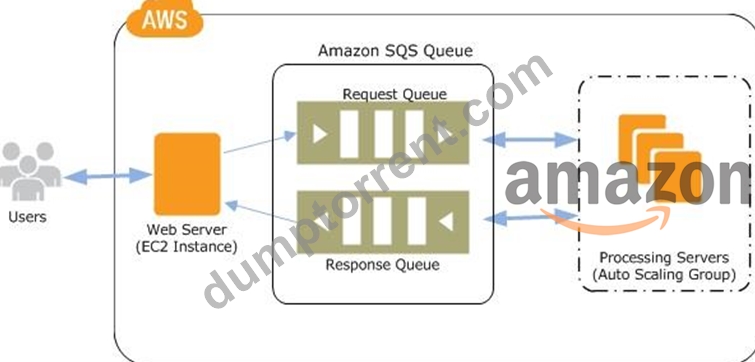
For more information on SQS and Autoscaling, please refer to the below U RL:
* http://docs.aws.amazon.com/autoscaling/latest/userguide/as-using-sqs-queue.html
NEW QUESTION 104
For auditing, analytics, and troubleshooting purposes, a DevOps Engineer for a data analytics application needs to collect all of the application and Linux system logs from the Amazon EC2 instances before termination. The company, on average, runs 10,000 instances in an Auto Scaling group. The company requires the ability to quickly find logs based on instance IDs and date ranges.
Which is the MOST cost-effective solution?
- A. Create an EC2 Instance-terminate Lifecycle Action on the group, create an Amazon CloudWatch Events rule based on it to trigger an AWS Lambda function for storing the logs in Amazon S3, and create a catalog of log files in an Amazon DynamoDB table with the primary key being Instance ID and sort key being Instance Termination Date.
- B. Create an EC2 Instance-terminate Lifecycle Action on the group, write a termination script for pushing logs into Amazon CloudWatch Logs, create a CloudWatch Events rule to trigger an AWS Lambda function to create a catalog of log files in an Amazon DynamoDB table with the primary key being Instance ID and sort key being Instance Termination Date.
- C. Create an EC2 Instance-terminate Lifecycle Action on the group, push the logs into Amazon Kinesis Data Firehouse, and select Amazon ES as the destination for providing storage and search capability.
- D. Create an EC2 Instance-terminate Lifecycle Action on the group, write a termination script for pushing logs into Amazon S3, and trigger an AWS Lambda function based on S3 PUT to create a catalog of log files in an Amazon DynamoDB table with the primary key being Instance ID and sort key being Instance Termination Date.
Answer: A
Explanation:
Because using Amazon CloudWatch Events rule is better than writing a script.
NEW QUESTION 105
As part of your deployment pipeline, you want to enable automated testing of your AWS CloudFormation template. What testing should be performed to enable faster feedback while minimizing costs and risk? Select three answers from the options given below
- A. Validatethe AWS CloudFormation template against the official XSD scheme definitionpublished by Amazon Web Services.
- B. Usethe AWS CloudFormation Validate Template to validate the properties ofresources defined in the template.
- C. When creating the stack, specify an Amazon SNS topic to which your testing system is subscribed. Your testing system runs tests when it receives notification that the stack is created or updated.
- D. Validatethe template's is syntax using a generalJSON parser.
- E. Updatethe stack with the template. If the template fails rollback will return thestack and its resources to exactly the same state.
- F. Usethe AWS CloudFormation Validate Template to validate the syntax of the template
Answer: C,E,F
Explanation:
Explanation
The AWS documentation mentions the following
The aws cloudformation validate-template command is designed to check only the syntax of your template. It does not ensure that the property values that you have specified for a resource are valid for that resource. Nor does it determine the number of resources that will exist when the stack is created.
To check the operational validity, you need to attempt to create the stack. There is no sandbox or test area for AWS Cloud Formation stacks, so you are charged for the resources you create during testing.
Option F is needed for notification.
For more information on Cloudformation template validation, please visit the link:
* http://docs.aws.amazon.com/AWSCIoudFormation/latest/UserGuide/using-cfn-vaIidate-template.htmI
NEW QUESTION 106
What does it mean if you have zero IOPS and a non-empty I/O queue for all EBS volumes attached to a running EC2 instance?
- A. You need to re-mount the EBS volume in the OS.
- B. The I/O queue is buffer flushing.
- C. Your EBS disk head(s) is/are seeking magnetic stripes.
- D. The EBS volume is unavailable.
Answer: D
Explanation:
This is the definition of Unavailable from the EC2 and EBS SLA. "Unavailable" and
"Unavailability" mean... For Amazon EBS, when all of your attached volumes perform zero read write IO, with pending IO in the queue.
https://aws.amazon.com/ec2/sla/
NEW QUESTION 107
A Solutions Architect is building an application on AWS that will require 20,000 IOPS on a particular volume
to support a media event. Once the event ends, the IOPS need is no longer required. The marketing team asks
the Architect to build the platform to optimize storage without incurring downtime.
How should the Architect design the platform to meet these requirements?
- A. Stop the Amazon EC2 instance and provision IOPS for the EBS volume.
- B. Change the Amazon EC2 instant types.
- C. Change the EBS volume type to Provisioned IOPS.
- D. Enable an API Gateway to change the endpoints for the Amazon EC2 instances.
Answer: C
NEW QUESTION 108
A gaming company adopted AWS Cloud Formation to automate load-testing of theirgames. They have created an AWS Cloud Formation template for each gaming environment and one for the load-testing stack. The load-testing stack creates an Amazon Relational Database Service (RDS) Postgres database and two web servers running on Amazon Elastic Compute Cloud (EC2) that send HTTP requests, measure response times, and write the results into the database. A test run usually takes between 15 and 30 minutes. Once the tests are done, the AWS Cloud Formation stacks are torn down immediately. The test results written to the Amazon RDS database must remain accessible for visualization and analysis.
Select possible solutions that allow access to the test results after the AWS Cloud Formation load -testing stack is deleted.
Choose 2 answers.
- A. Define a deletion policy of type Snapshotfor the Amazon RDS resource to assure that the RDS database can be restoredafter the AWS Cloud Formation stack is deleted.
- B. Define an update policy to prevent deletionof the Amazon RDS database after the AWS Cloud Formation stack is deleted.
- C. Defineautomated backups with a backup retention period of 30 days for the Amazon RDSdatabase and perform point-in-time recovery of the database after the AWS CloudFormation stack is deleted.
- D. Define a deletion policy of type Retain forthe Amazon RDS resource to assure that the RDS database is not deleted with theAWS Cloud Formation stack.
- E. Define an Amazon RDS Read-Replica in theload-testing AWS Cloud Formation stack and define a dependency relation betweenmaster and replica via the Depends On attribute.
Answer: A,D
Explanation:
Explanation
With the Deletion Policy attribute you can preserve or (in some cases) backup a resource when its stack is deleted. You specify a DeletionPolicy attribute for each resource that you want to control. If a resource has no DeletionPolicy attribute, AWS Cloud Formation deletes the resource by default.
To keep a resource when its stack is deleted, specify Retain for that resource. You can use retain for any resource. For example, you can retain a nested stack, S3 bucket, or CC2 instance so that you can continue to use or modify those resources after you delete their stacks.
For more information on Deletion policy, please visit the below url
* http://docs.aws.amazon.com/AWSCIoudFormation/latest/UserGuide/aws-attribute-deletionpolicy.html
NEW QUESTION 109
To access the AWS Security Token Service (STS) you can issue calls directly to the AWS STS Query API. This API is a web service interface that accepts ______ requests.
- A. HTTPS
- B. GET
- C. PUT
- D. POST
Answer: A
Explanation:
The Query API for IAM and AWS STS lets you call service actions. Query API requests are HTTPS requests that must contain an Action parameter to indicate the action to be performed.
IAM and AWS STS support GET and POST requests for all actions, that is, the API does not require you to use GET for some actions and POST for others.
Reference: http://docs.aws.amazon.com/IAM/latest/UserGuide/programming.html
NEW QUESTION 110
You are building out a layer in a software stack on AWS that needs to be able to scale out to react to increased
demand as fast as possible. You are running the code on EC2 instances in an Auto Scaling Group behind an
ELB. Which application code deployment method should you use?
- A. Create a Dockerfile when preparing to deploy a new version to production and publish it to S3. Use
UserData in the Auto Scaling Launch configuration to pull down the Dockerfile from S3 and run it when
new instances launch. - B. SSH into new instances that come online, and deploy new code onto the system by pulling it from an S3
bucket, which is populated by code that you refresh from source control on new pushes. - C. Create a new Auto Scaling Launch Configuration with UserData scripts configured to pull the latest
code at all times. - D. Bake an AMI when deploying new versions of code, and use that AMI for the Auto Scaling Launch
Configuration.
Answer: D
Explanation:
Explanation
Since the time required to spin up an instance is required to be fast, its better to create an AMI rather than use
User Data. When you use User Data, the script will be
run during boot up, and hence this will be slower.
An Amazon Machine Image (AMI) provides the information required to launch an instance, which is a virtual
server in the cloud. You specify an AM I when you launch
an instance, and you can launch as many instances from the AMI as you need. You can also launch instances
from as many different AMIs as you need.
For more information on the AMI, please refer to the below link:
* http://docs.aws.amazon.com/AWSCC2/latest/UserGuide/AMIs.html
NEW QUESTION 111
A company is running an application on Amazon EC2 instances behind an ELB Application Load Balancer. The instances run in an EC2 Auto Scaling group across multiple Availability Zones.
After a recent application update, users are getting HTTP 502 Bad Gateway errors from the application URL.
The DevOps Engineer cannot analyze the problem because Auto Scaling is terminating all EC2 instances shortly after launch for being unhealthy.
What steps will allow the DevOps Engineer access to one of the unhealthy instances to troubleshoot the deployed application?
- A. Create an image from the terminated instance and create a new instance from that image. The Application team can then log into the new instance.
- B. Edit the Auto Scaling group to enable termination protection as this will protect unhealthy instances from being terminated.
- C. As soon as a new instance is created by AutoScaling, put the instance into a Standbystate as this will prevent the instance from being terminated.
- D. Add a lifecycle hook to your Auto Scaling group to move instances in the Terminatingstate to the Terminating:Waitstate.
Answer: A
NEW QUESTION 112
Which of the following design strategies is ideal when designing loosely coupled systems. Choose 2 answers
from the options given below
- A. Having the web and worker roles running on separate EC2 Instances
- B. Having the web and worker roles running on the same set of EC2 Instances
- C. Using SNS to establish communication between the web and worker roles
- D. Using SQS to establish communication between the web and worker roles
Answer: A,D
Explanation:
Explanation
The below diagram shows the ideal design which uses SQS and separate environments for web and worker
processes. The SQS queue manages the communication
between the web and worker roles.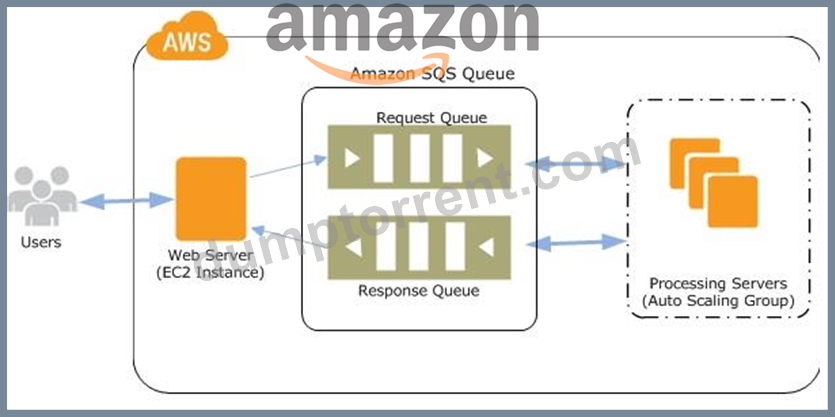
One example is the way Elastic beanstalk manages worker environments. For more information on this, please
visit the below URL:
http://docs.aws.a
mazon.com/elasticbeanstalk/latest/dg/using-features-managing-env-tiers.htm I
NEW QUESTION 113
A company has a web application that uses an Amazon DynamoDB table in a single AWS Region to store user information. To support an increasingly global user base, the application must run in a secondary Region and allow users to connect to their closest Region and fail over to the secondary Region.
Which approach should be used to ensure the deployment meets these requirements?
- A. Define DynamoDB cross-region backups to copy data to the secondary Region, deploy the web stack in both Regions, and configure Amazon Route 53 to use a latency-based routing policy with health checks.
- B. Convert the DynamoDB table to a global table, deploy the web stack in both Regions, and configure Amazon Route 53 to use a geoproximity routing policy with health checks.
- C. Configure DynamoDB streams to copy data between Regions, deploy the web stack in both Regions, and configure Amazon Route 53 to use a geoproximity routing policy with health checks.
- D. Use DynamoDB Accelerator to copy data to the secondary Region, deploy the web stack in both Regions, and configure Amazon Route 53 to use a failover routing policy.
Answer: B
Explanation:
Explanation/Reference: https://aws.amazon.com/blogs/database/how-to-use-amazon-dynamodb-global-tables-to-power- multiregion-architectures/
NEW QUESTION 114
You have a requirement to automate the creation of EBS Snapshots. Which of the following can be used to
achieve this in the best way possible.
- A. Use Cloudwatch Events to trigger the snapshots of EBS Volumes
- B. Use the AWS CodeDeploy service to create a snapshot of the AWS Volumes
- C. Create a powershell script which uses the AWS CLI to get the volumes and then run the script as a cron
job. - D. Use the AWSConfig service to create a snapshot of the AWS Volumes
Answer: A
Explanation:
Explanation
The best is to use the inbuilt service from Cloudwatch, as Cloud watch Events to automate the creation of CBS
Snapshots. With Option A, you would be restricted to
running the powrshell script on Windows machines and maintaining the script itself And then you have the
overhead of having a separate instance just to run that
script.
When you go to Cloudwatch events, you can use the Target as EC2 CreateSnapshot API call as shown below.
Create rules to invoke Targets based on Events happening in your AWS environment.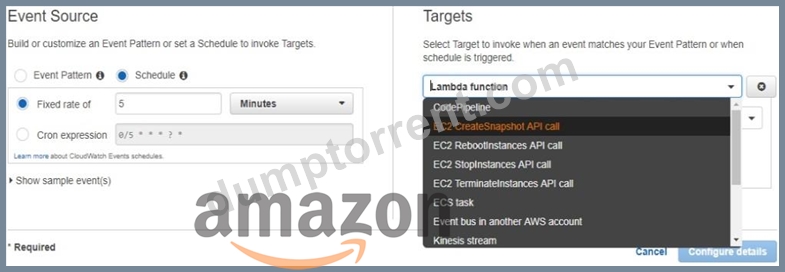
The AWS Documentation mentions
Amazon Cloud Watch Cvents delivers a near real-time stream of system events that describe changes in
Amazon Web Services (AWS) resources. Using simple rules
that you can quickly set up, you can match events and route them to one or more target functions or streams.
Cloud Watch Cvents becomes aware of operational
changes as they occur. Cloud Watch Cvents responds to these operational changes and takes corrective action
as necessary, by sending messages to respond to the
environment, activating functions, making changes, and capturing state information.
For more information on Cloud watch Cvents, please visit the below U RL:
* http://docs.aws.amazon.com/AmazonCloudWatch/latest/events/Whatl
sCloudWatchCvents.html
NEW QUESTION 115
A company using AWS CodeCommit for source control wants to automate its continuous integration and continuous deployment pipeline on AWS in its development environment. The company has three requirements:
1. There must be a legal and a security review of any code change to make sure sensitive information is not leaked through the source code.
2. Every change must go through unit testing.
3. Every change must go through a suite of functional testing to ensure functionality.
In addition, the company has the following requirements for automation:
1. Code changes should automatically trigger the CI/CD pipeline.
2. Any failure in the pipeline should notify [email protected].
3. There must be an approval to stage the assets to Amazon S3 after tests have been performed.
What should a DevOps Engineer do to meet all of these requirements while following CI/CD best practices?
- A. Commit to the development branch and trigger AWS CodePipeline from the development branch. Make an individual stage in CodePipeline for security review, unit tests, functional tests, and manual approval. Use Amazon CloudWatch metrics to detect changes in pipeline stages and Amazon SES for emailing devops- [email protected].
- B. Commit to the development branch and trigger AWS CodePipeline from the development branch. Make an individual stage in CodePipeline for security review, unit tests, functional tests, and manual approval. Use Amazon CloudWatch Events to detect changes in pipeline stages and Amazon SNS for emailing devops- [email protected].
- C. Commit to mainline and trigger AWS CodePipeline from mainline. Make an individual stage in CodePipeline for security review, unit tests, functional tests, and manual approval. Use AWS CloudTrail logs to detect changes in pipeline stages and Amazon SNS for emailing [email protected].
- D. Commit to mainline and trigger AWS CodePipeline from mainline. Make an individual stage in CodePipeline for security review, unit tests, functional tests, and manual approval. Use Amazon CloudWatch Events to detect changes in pipeline stages and Amazon SES for emailing [email protected].
Answer: B
NEW QUESTION 116
Which of the following CLI commands is used to spin up new EC2 Instances?
- A. awsec2 new-instances
D- awsec2 launch-instances - B. awsec2 run-instances
B- awsec2 create-instances
Answer: B
Explanation:
Explanation
The AWS Documentation mentions the following
Launches the specified number of instances using an AMI for which you have permissions.
You can specify a number of options, or leave the default options. The following rules apply:
* [EC2-VPC] If you don't specify a subnet ID. we choose a default subnet from your default VPC for you.
If you don't have a default VPC, you must specify a subnet ID in the request.
* [EC2-Classic] If don't specify an Availability Zone, we choose one for you.
* Some instance types must be launched into a VPC. if you do not have a default VPC. or if you do not specify a subnet ID. the request fails. For more information, see Instance Types Available Only in a VPC.
* [EC2-VPC] All instances have a network interface with a primary private IPv4 address. If you don't specify this address, we choose one from the IPv4 range of your subnet.
* Not all instance types support IPv6 addresses. For more information, see Instance Types.
* If you don't specify a security group ID, we use the default security group. For more information, see Security Groups.
* If any of the AMIs have a product code attached for which the user has not subscribed, the request fails.
For more information on the Cc2 run instance command please refer to the below link
* http://docs.aws.amazon.com/cli/latest/reference/ec2/run-instances.html
NEW QUESTION 117
A company is using AWS CodeBuild, AWS CodeDeploy, and AWS CodePipeline to deploy applications automatically to an Amazon EC2 instance. A DevOps Engineer needs to perform a security assessment scan of the operating system on every application deployment to the environment. How should this be automated?
- A. Use Amazon Inspector as a CodePipeline task after the successful use of CodeDeploy to deploy the code to the systems.
- B. Use Amazon CloudWatch Events to monitor for CodePipeline notifications of a successful code deployment and configure CloudWatch Events to trigger an AWS X-Ray scan.
- C. Use Amazon CloudWatch Events to monitor for AWS CodeDeploy notifications of a successful code deployment and configure CloudWatch Events to trigger an Amazon Inspector scan.
- D. Use Amazon CloudWatch Events to monitor for Auto Scaling event notifications of new instances and configure CloudWatch Events to trigger an Amazon Inspector scan.
Answer: D
NEW QUESTION 118
A DevOps Engineer must implement monitoring for a workload running on Amazon EC2 and Amazon RDS MySQL. The monitoring must include:
- Application logs and operating system metrics for the Amazon EC2
instances
- Database logs and operating system metrics for the Amazon RDS
database
Which steps should the Engineer take?
- A. Install an Amazon CloudWatch Logs agent on the EC2 instance and configure it to send application logs to CloudWatch.
- B. Install an Amazon CloudWatch agent on the EC2 instance, and configure the agent to send the application logs and operating system metrics to CloudWatch. Enable RDS Enhanced Monitoring, and modify the RDS instance to publish database logs to CloudWatch Logs.
- C. Set up scheduled tasks on the EC2 and RDS instances to put operating system metrics and application and database logs into an Amazon S3 bucket. Set up an event on the bucket to invoke an AWS Lambda function to monitor for errors each time an object is put into the bucket.
- D. Install an Amazon CloudWatch agent on the EC2 and RDS instances. Configure the agent to send the operating system metrics and application and database logs to CloudWatch.
Answer: B
NEW QUESTION 119
Your CTO has asked you to make sure that you know what all users of your AWS account are doing to
change resources at all times. She wants a report of who is doing what over time, reported to her once per
week, for as broad a resource type group as possible. How should you do this?
- A. Use CloudWatch Events Rules with an SNS topic subscribed to all AWS API calls. Subscribe the CTO
to an email type delivery on this SNS Topic. - B. Use AWS IAM credential reports to deliver a CSV of all uses of IAM User Tokens over time to the CTO.
- C. Use AWS Config with an SNS subscription on a Lambda, and insert these changes over time into a
DynamoDB table. Generate reports based on the contents of this table. - D. Create a global AWS CloudTrail Trail. Configure a script to aggregate the log data delivered to S3 once
per week and deliver this to the CTO.
Answer: D
Explanation:
This is the ideal use case for AWS CloudTrail.
CloudTrail provides visibility into user activity by recording API calls made on your account. CloudTrail
records important information about each API call, including the name of the API, the identity of the caller,
the time of the API call, the request parameters, and the response elements returned by the AWS service.
This information helps you to track changes made to your AWS resources and to troubleshoot operational
issues. CloudTrail makes it easier to ensure compliance with internal policies and regulatory standards.
Reference: https://aws.amazon.com/cloudtrail/faqs/
NEW QUESTION 120
A DevOps Engineer is launching a new application that will be deployed using Amazon Route 53, an Application Load Balancer, Auto Scaling, and Amazon DynamoDB. One of the key requirements of this launch is that the application must be able to scale to meet a sudden load increase. During periods of low usage, the infrastructure components must scale down to optimize cost.
What steps can the DevOps Engineer take to meet the requirements? (Select TWO.)
- A. Enable Auto Scaling for the DynamoDB tables that are used by the application.
- B. Configure the Application Load Balancer to automatically adjust the target group based on the current load.
- C. Determine which Amazon EC2 instance limits need to be raised by leveraging AWS Trusted Advisor, and submit a request to AWS Support to increase those limits.
- D. Create an Amazon CloudWatch Events scheduled rule that runs every 5 minutes to track the current use of the Auto Scaling group. If usage has changed, trigger a scale-up event to adjust the capacity. Do the same for DynamoDB read and write capacities.
- E. Use AWS Trusted Advisor to submit limit increase requests for the Amazon EC2 instances that will be used by the infrastructure.
Answer: A,B
Explanation:
Explanation/Reference: https://docs.aws.amazon.com/autoscaling/ec2/userguide/autoscaling-load-balancer.html
NEW QUESTION 121
You have been given a business requirement to retain log files for your application for 10 years.
You need to regularly retrieve the most recent logs for troubleshooting.
Your logging system must be cost-effective, given the large volume of logs.
What technique should you use to meet these requirements?
- A. Store your log in Amazon CloudWatch Logs.
- B. Store your logs in HDFS on an Amazon EMR cluster.
- C. Store your logs on Amazon EBS, and use Amazon EBS snapshots to archive them.
- D. Store your logs in Amazon Glacier.
- E. Store your logs in Amazon S3, and use lifecycle policies to archive to Amazon Glacier.
Answer: E
NEW QUESTION 122
What is the scope of an EBS snapshot?
- A. Region
- B. Placement Group
- C. VPC
- D. Availability Zone
Answer: A
Explanation:
An EBS snapshot is tied to its region and can only be used to create volumes in the same region.
You can copy a snapshot from one region to another. For more information, see Copying an Amazon EBS Snapshot.
http://docs.aws.amazon.com/AWSEC2/latest/UserGuide/resources.html
NEW QUESTION 123
Your company needs to automate 3 layers of a large cloud deployment. You want to be able to track this
deployment's evolution as it changes over time, and carefully control any alterations. What is a good way to
automate a stack to meet these requirements?
- A. Use AWS Config to declare a configuration set that AWS should roll out to your cloud.
- B. Use OpsWorks Stacks with three layers to model the layering in your stack.
- C. Use CloudFormation Nested Stack Templates, with three child stacks to represent the three logical
layers of your cloud. - D. Use Elastic Beanstalk Linked Applications, passing the important DNS entires between layers using the
metadata interface.
Answer: C
Explanation:
Explanation
As your infrastructure grows, common patterns can emerge in which you declare the same components in each
of your templates. You can separate out these common components and create dedicated templates for them.
That way, you can mix and match different templates but use nested stacks to create a single,
unified stack. Nested stacks are stacks that create other stacks. To create nested stacks, use the AWS:: Cloud
Form ation::Stackresource in your template to reference other templates.
For more information on nested stacks, please visit the below URL:
* http://docs^ws.amazon.com/AWSCIoudFormation/latest/UserGuide/best-practices.html#nested
Note:
The query is, how you can automate a stack over the period of time, when changes are required, with out
recreating the stack.
The function of Nested Stacks are to reuse Common Template Patterns.
For example, assume that you have a load balancer configuration that you use for most of your stacks. Instead
of copying and pasting the same configurations into your templates, you can create a dedicated template for
the load balancer. Then, you just use the resource to reference that template from within other templates.
Yet another example is if you have a launch configuration with certain specific configuration and you need to
change the instance size only in the production environment and to leave it as it is in the development
environment.
AWS also recommends that updates to nested stacks are run from the parent stack.
When you apply template changes to update a top-level stack, AWS CloudFormation updates the top-level
stack and initiates an update to its nested stacks. AWS
Cloud Formation updates the resources of modified nested stacks, but does not update the resources of
unmodified nested stacks.
NEW QUESTION 124
Which of the following services from AWS can be integrated with the Jenkins continuous integration tool.
- A. AmazonEC2
- B. AmazonElastic beanstalk
- C. AmazonECS
- D. Allof the above
Answer: D
Explanation:
Explanation
The following AWS sen/ices can be integrated with Jenkins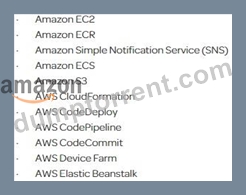
For more information on Jenkins in AWS, please refer to the below link:
* https://dOawsstatic.com/whitepapers/DevOps/Jenkins_on_AWS.pdf
NEW QUESTION 125
You are designing a cloudformation stack which involves the creation of a web server and a database server.
You need to ensure that the web server in the stack gets created after the database server is created. How can
you achieve this?
- A. Ensurethat the database server is defined as a child of the web server in thecloudformation template.
- B. Ensurethat the database server is defined first and before the web server in thecloudformation template.
The stack creation normally goes in order to create the resources. - C. Ensurethat the web server is defined as a child of the database server in thecloudformation template.
- D. Usethe DependsOn attribute to ensure that the database server is created before the web server.
Answer: D
Explanation:
Explanation
The AWS Documentation mentions
With the DependsOn attribute you can specify that the creation of a specific resource follows another. When
you add a DependsOn attribute to a resource, that resource is created only after the creation of the resource
specified in the DependsOn attribute.
For more information on the DependsOn attribute, please visit the below url
http://docs.aws.amazon.com/AWSCIoudFormation/latest/UserGuide/aws-attribute-dependson.html
NEW QUESTION 126
A company used AWS CloudFormation to deploy a three-tier web application that stores data in an Amazon RDS MySOL Multi-AZ DB instance. A DevOps Engineer must upgrade the RDS instance to the latest major version of MySQL while incurring minimal downtime.
How should the Engineer upgrade the instance while minimizing downtime?
- A. Update the DBEngineVersion property of the AWS: :RDS: :DB:Instance resource type in the CloudFormation template to the latest desired version. Create a new RDS Read Replicas resource with the same properties as the instance to be upgraded. Perform an Update Stack operation.
- B. Update the DBEngineVersion property of the AWS: : RDS : :DBInstance resource type in the CloudFormation template to the latest desired version. Perform an Update Stack operation. Create a new RDS Read Replicas resource with the same properties as the instance to be upgraded. Perform a second Update Stack operation.
- C. Update the EngineVersion property of the AWS::RDS:: DBInstance resource type in the CloudFormation template to the latest desired version. Launch a second stack and make the new RDS instance a read replica.
- D. Update the EngineVersion property of the AWS :: RDS :: DBInstance resource type in the CloudFormation template to the latest version, and perform an Update Stack operation.
Answer: C
NEW QUESTION 127
......
Use Valid New AWS-DevOps Test Notes & AWS-DevOps Valid Exam Guide: https://www.dumptorrent.com/AWS-DevOps-braindumps-torrent.html
AWS-DevOps Actual Questions Answers PDF 100% Cover Real Exam Questions: https://drive.google.com/open?id=1kAH5b6SyUEaPb23pmWHlJvwN4GiAbLrO