


Prepare Top CyberArk PAM-DEF Exam Study Guide Practice Questions Edition
Go to PAM-DEF Questions - Try PAM-DEF dumps pdf
NEW QUESTION # 70
When a DR Vault Server becomes an active vault, it will automatically revert back to DR mode once the Primary Vault comes back online.
- A. False, the Vault administrator must manually set the DR Vault to DR mode by setting "FailoverMode=no" in the padr.ini file
- B. True, if the AllowFailback setting is set to "yes" in the padr.ini file
- C. False, the Vault administrator must manually set the DR Vault to DR mode by setting "FailoverMode=no" in the dbparm.ini file
- D. True; this is the default behavior
Answer: A
NEW QUESTION # 71
It is possible to leverage DNA to provide discovery functions that are not available with auto-detection.
- A. TRUE
- B. FALSE
Answer: A
Explanation:
Explanation
It is possible to leverage DNA to provide discovery functions that are not available with auto-detection.
Auto-detection is a feature that enables the CPM to automatically discover and onboard accounts on target systems that are associated with a specific platform. Auto-detection can be configured in the Platform Management settings for each platform that supports this functionality. However, auto-detection has some limitations, such as requiring the CPM to have access to the target system, not supporting all platforms, and not providing comprehensive information about the accounts and their security risks1. DNA, on the other hand, is a standalone scanning tool that can discover and audit privileged accounts across the network, regardless of the platform or the CPM access. DNA can provide additional discovery functions, such as identifying machines vulnerable to Pass-the-Hash attacks, collecting reliable and comprehensive audit information, and generating reports and visual maps that evaluate the privileged account security status in the organization2. DNA can also be used before or independently of the CyberArk PAM solution, as it does not require agents to be installed on target systems2. References:
* 1: Auto-detection
* 2: CyberArk DNA Overview
NEW QUESTION # 72
Which report could show all accounts that are past their expiration dates?
- A. Privileged Account Inventory report
- B. Application Inventory report
- C. Privileged Account Compliance Status report
- D. Activity log
Answer: C
NEW QUESTION # 73
What is the name of the Platform parameters that controls how long a password will stay valid when One Time Passwords are enabled via the Master Policy?
- A. Min Validity Period
- B. Interval
- C. Timeout
- D. Immediate Interval
Answer: A
Explanation:
Explanation
The name of the Platform parameter that controls how long a password will stay valid when One Time Passwords are enabled via the Master Policy is Min Validity Period. This parameter defines the number of minutes to wait from the last retrieval of the account until it is replaced. This gives the user a minimum period to be able to use the password before it is changed by the CPM. The Min Validity Period parameter can be configured in the Platform Management settings for each platform that supports One Time Passwords. The default value is 60 minutes, but it can be modified according to the organization's security policy1. The Min Validity Period parameter is also used to release exclusive accounts automatically1. References:
* 1: Privileged Account Management, Min Validity Period subsection
NEW QUESTION # 74
When should vault keys be rotated?
- A. whenever a CyberArk user leaves the organization
- B. annually
- C. when migrating to a new data center
- D. when it is copied to file systems outside the vault
Answer: B
NEW QUESTION # 75
Match each permission to where it can be found.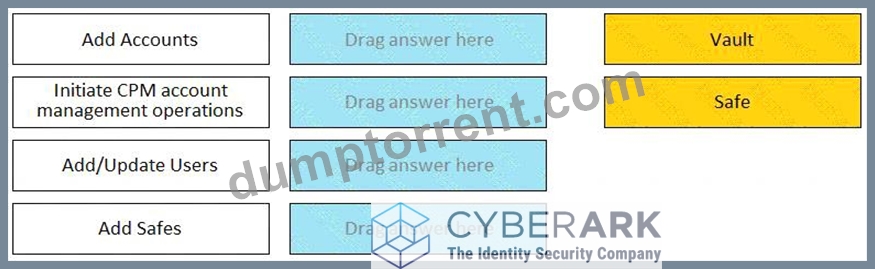
Answer:
Explanation: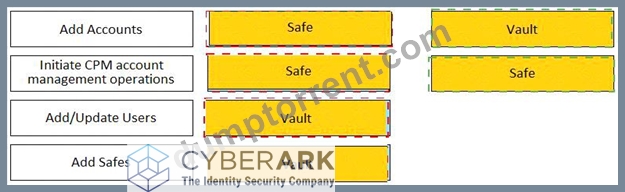
Explanation
* Add Accounts --> Safe
* Initiate CPM account management operations -> Safe
* Add/Update Users -> Vault
* Add Safes -> Vault
Comprehensive Explanation:
* Add Accounts: This permission is associated with the ability to add new accounts to the CyberArk Vault. It is typically found in the Vault's administrative settings where account management is handled.
* Initiate CPM account management operations: This permission allows users to initiate operations related to the Central Policy Manager (CPM) for account management within a Safe. It is found in the Safe's permissions settings.
* Add/Update Users: This permission enables the addition or updating of user information in the Vault. It is found in the Vault's user management settings.
* Add Safes: This permission is related to the creation of new Safes in the Vault. It is found in the Vault's administrative settings where Safe management is conducted.
References:
* The permissions and their locations can be referenced in the CyberArk Defender PAM course materials and official documentation, which provide detailed information on the management of permissions within the CyberArk solution.
NEW QUESTION # 76
Ad-Hoc Access (formerly Secure Connect) provides the following features. Choose all that apply.
- A. PSM connections from a terminal without the need to login to the PVWA.
- B. Session Recording.
- C. PSM connections to target devices that are not managed by CyberArk.
- D. Real-time live session monitoring.
Answer: B,C,D
Explanation:
Explanation
Ad-Hoc Access (formerly Secure Connect) is a feature that allows users to connect to target devices that are not managed by CyberArk through the PSM. Users can specify the address, username, and password of the target device, and select a client to launch the connection. Ad-Hoc Access sessions benefit from the standard PSM features, such as session recording, detailed auditing, and real-time live session monitoring. However, Ad-Hoc Access does not allow users to connect from a terminal without logging in to the PVWA, as this would bypass the authentication and authorization mechanisms of CyberArk. References:
* Configure ad hoc connections
* Ad Hoc Connections
* Privileged Remote Access Management - PAM Remote Access
NEW QUESTION # 77
Where can PTA be configured to send alerts? (Choose two.)
- A. Email
- B. PAReplicate
- C. Google Analytics
- D. SIEM
- E. EVD
Answer: A,D
NEW QUESTION # 78
Arrange the steps to restore a Vault using PARestore for a Backup in the correct sequence.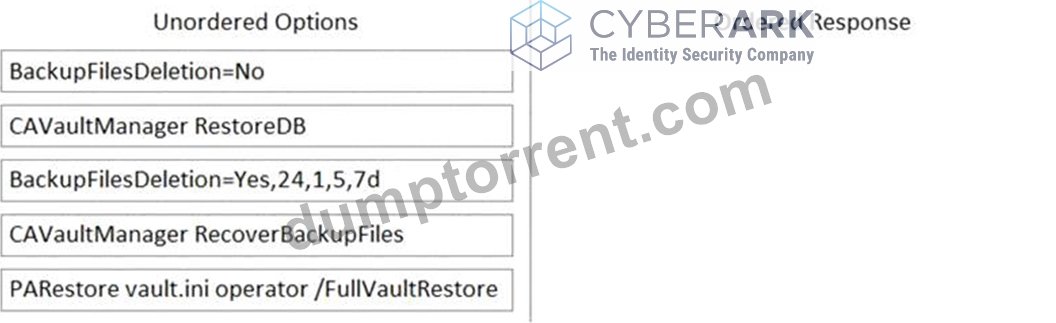
Answer:
Explanation: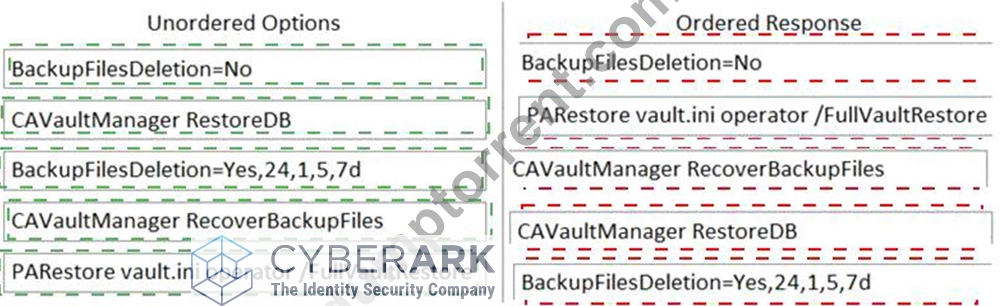
Explanation
BackupFilesDeletion=No
PARestore vault.ini operator /FullVaultRestore
CAVaultManager RecoverBackupFiles
CAVaultManager RestoreDB
BackupFilesDeletion=Yes,24,1,5,7d
https://docs.cyberark.com/Product-Doc/OnlineHelp/PAS/Latest/en/Content/PASIMP/Restoring-Safes-or-the-Vau
NEW QUESTION # 79
Where can reconcile and/or logon accounts be linked to an account? (Choose two.)
- A. service account settings
- B. safe settings
- C. platform settings
- D. master policy
- E. account settings
Answer: B,C
Explanation:
Explanation
Reconcile and logon accounts can be linked to an account within the platform settings and safe settings. The platform settings define the parameters for its linked accounts in either the Target Account or Service Account that requires them. When linked accounts are specified in the Target Account platform, they appear in the CPM pane of the Account Details page. Similarly, when they are specified in the Service Account platform, they appear in the CPM pane of the Service Account Details page1. Safe settings are also involved in the process of linking accounts, as they determine where the accounts are stored and managed within the CyberArk Vault.
References:
* CyberArk Docs - Linked Accounts1
* CyberArk REST API documentation on adding Reconcile and Login Accounts to an Account
NEW QUESTION # 80
When running a "Privileged Accounts Inventory" Report through the Reports page in PVWA on a specific safe, which permission/s are required on that safe to show complete account inventory information?
- A. List Accounts, Access Safe without confirmation
- B. Manage Safe, View Audit
- C. List Accounts, View Safe Members
- D. Manage Safe Owners
Answer: C
NEW QUESTION # 81
CyberArk recommends implementing object level access control on all Safes.
- A. True
- B. False
Answer: B
Explanation:
Explanation
CyberArk does not recommend implementing object level access control on all Safes. According to the CyberArk documentation1, enabling object level access control impacts Vault performance. Therefore, it should be used only when necessary and with caution. Object level access control is useful when you need to give granular permissions to specific passwords or files in a Safe, regardless of the Safe level member authorizations. For example, you can use it to grant access to an external vendor or technician for a specific password only, without exposing any other passwords or files in the Safe. However, if you do not need this level of granularity, you can use the regular Safe member authorizations to control user access to the Safe and its contents.
NEW QUESTION # 82
Which one the following reports is NOT generated by using the PVWA?
- A. Convince Status
- B. Sales List
- C. Accounts Inventory
- D. Application Inventory
Answer: B
NEW QUESTION # 83
A user has successfully conducted a short PSM session and logged off. However, the user cannot access the Monitoring tab to view the recordings.
What is the issue?
- A. The user is not a member of the PVWAMonitor group
- B. The PSM service is not running
- C. The user is not a member of the Auditors group
- D. The user must login as PSMAdminConnect
Answer: C
NEW QUESTION # 84
You are concerned about the Windows Domain password changes occurring during business hours.
Which settings must be updated to ensure passwords are only rotated outside of business hours?
- A. in the Master Policy
Account Change Window > ToHour & From Hour - B. In the platform policy -
Automatic Password Management > Password Change > ToHour & FromHour - C. On each individual account -
Edit > Advanced > ToHour & FromHour - D. Administration Settings -
CPM Settings > ToHour & FromHour
Answer: B
NEW QUESTION # 85
A Logon Account can be specified in the Master Policy.
- A. FALSE
- B. TRUE
Answer: A
Explanation:
Explanation
A Logon Account cannot be specified in the Master Policy. The Master Policy is a set of rules that define the security and compliance policy of privileged accounts in the organization, such as access workflows, password management, session monitoring, and auditing1. The Master Policy does not include any technical settings that determine how the system manages accounts on various platforms1. A Logon Account is a technical setting that defines the account that the CPM uses to log on to a target system and perform password management tasks, such as changing, verifying, or reconciling passwords2. A Logon Account can be specified in the Platform Management settings, which are configured by the IT administrator for each platform2. The Platform Management settings are independent of the Master Policy and can be customized according to the organization's environment and security policies1. References:
* The Master Policy
* [Platform Management]
NEW QUESTION # 86
You have been asked to secure a set of shared accounts in CyberArk whose passwords will need to be used by end users. The account owner wants to be able to track who was using an account at any given moment.
Which security configuration should you recommend?
- A. Configure both one-time passwords and exclusive access for the appropriate platform in Master Policy.
- B. Configure shared account mode on the appropriate safe.
- C. Configure one-time passwords for the appropriate platform in Master Policy.
- D. Configure object level access control on the appropriate safe.
Answer: A
NEW QUESTION # 87
Ad-Hoc Access (formerly Secure Connect) provides the following features. Choose all that apply.
- A. PSM connections from a terminal without the need to login to the PVWA.
- B. Session Recording.
- C. PSM connections to target devices that are not managed by CyberArk.
- D. Real-time live session monitoring.
Answer: B,C,D
NEW QUESTION # 88
What is the purpose of the HeadStartlnterval setting m a platform?
- A. It determines how far in advance audit data is collected tor reports
- B. It alerts users of upcoming password changes x number of days before expiration.
- C. It instructs the AIM Provider to 'skip the cache' during the defined time period
- D. It instructs the CPM to initiate the password change process X number of days before expiration.
Answer: D
NEW QUESTION # 89
......
CyberArk PAM-DEF exam covers a wide range of topics related to privileged access security, including password management, session isolation, credential rotation, and monitoring and auditing. It also covers best practices for securing privileged accounts and protecting against cyber threats. By passing the exam, individuals can demonstrate that they have a deep understanding of CyberArk PAS solutions and can effectively manage and secure privileged accounts in their organization.
CyberArk PAM-DEF (CyberArk Defender - PAM) Certification Exam is a comprehensive exam designed to test the knowledge and skills of cybersecurity professionals in implementing and managing privileged access management (PAM) solutions using CyberArk technology. Privileged access management is a critical component of any organization's cybersecurity strategy, as it ensures that only authorized personnel have access to sensitive systems and data. CyberArk is a leading provider of PAM solutions, and their Defender - PAM certification is widely recognized in the industry as a mark of expertise in this field.
Free CyberArk Defender PAM-DEF Exam Question: https://www.dumptorrent.com/PAM-DEF-braindumps-torrent.html
Dumps Practice Exam Questions Study Guide for the PAM-DEF Exam: https://drive.google.com/open?id=1hrV1u9k_tkkDF5PkEdJSVWUU3m3qo_69