


Validate your Skills with Updated QSDA2024 Exam Questions & Answers and Test Engine
Tested & Approved QSDA2024 Study Materials Download Free Updated 52 Questions
NEW QUESTION # 30
Sales managers need to see an overview of historical performance and highlight the current year's metrics.
The app has the following requirements:
* Display the current year's total sales
* Total sales displayed must respond to the user's selections
Which variables should a data architect create to meet these requirements?
- A.

- B.

- C.

- D.

Answer: B
Explanation:
To meet the requirements of displaying the current year's total sales in a way that responds to user selections, the correct approach involves using both SET and LET statements to define the necessary variables in the data load editor.
Explanation of Option C:
* SET vCurrentYear = Year(Today());
* The SET statement is used here to assign the current year to the variable vCurrentYear. The SET statement treats the variable as a text string without evaluation. This is appropriate for a variable that will be used as part of an expression, ensuring the correct year is dynamically set based on the current date.
* LET vCurrentYTDSales = '=SUM({$<Year={'$(vCurrentYear)'}>} [Sales Amount])';
* The LET statement is used here to assign an evaluated expression to the variable vCurrentYTDSales. This expression calculates the Year-to-Date (YTD) sales for the current year by filtering the Year field to match vCurrentYear. The LET statement ensures that the expression inside the variable is evaluated, meaning that when vCurrentYTDSales is called in a chart or KPI, it dynamically calculates the YTD sales based on the current year and any user selections.
Key Points:
* Dynamic Year Calculation: Year(Today()) dynamically calculates the current year every time the script runs.
* Responsive to Selections: The set analysis syntax {$<Year={'$(vCurrentYear)'}>} ensures that the sales totals respond to user selections while still focusing on the current year's data.
* Appropriate Use of SET and LET: The combination of SET for storing the year and LET for storing the evaluated sum expression ensures that the variables are used effectively in the application.
NEW QUESTION # 31
Exhibit.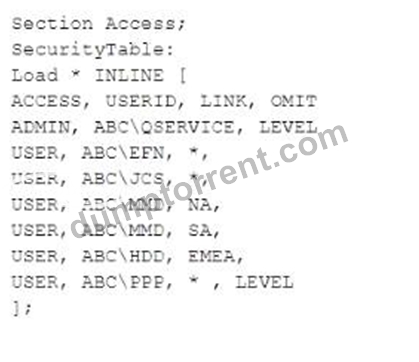
The Section Access security table for an app is shown. User ABC\PPP opens a Qlik Sense app with a table using the field called LEVEL on one of the table columns.
Which is the result?
- A. The table is removed from the user interface.
- B. The user gets a 'Field not found' error.
- C. The table is displayed without the LEVEL column.
- D. The user gets an 'Incomplete visualization' error.
Answer: C
Explanation:
In this scenario, the Section Access security table controls user access to data within the Qlik Sense app. The user in question, ABC\PPP, has a specific entry in the security table that determines their access rights to the LEVEL field.
Understanding Section Access:
* Section Accessis used to enforce security by restricting access to certain data based on the user's credentials.
* In the security table provided, the USER role for ABC\PPP is set to have access to all data (* in the LINK field), but the OMIT field is set to LEVEL. The OMIT field in Section Access specifies fields that should be omitted from the user's view.
Outcome:
* Since the OMIT field for user ABC\PPP is set to LEVEL, this user will not have access to the LEVEL field in the Qlik Sense application.
Option D: The table is displayed without the LEVEL columnis the correct outcome.
* Explanation: When user ABC\PPP opens the app, the LEVEL field is omitted from their view. Any table or visualization that uses the LEVEL field will have that field excluded from display. The rest of the data and columns in the table will be visible, but the LEVEL column will not be shown.
References:
* Qlik Sense Security and Section Access Documentation: The OMIT functionality in Section Access is specifically designed to remove fields from the user's access, ensuring that sensitive or unnecessary data is not exposed.
NEW QUESTION # 32
Exhibit.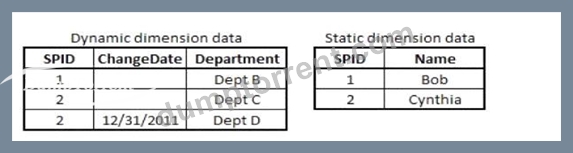
A large electronics company re-assigns sales people once per year from one Department to another.
SPID is the Salesperson ID; the SPID for each individual sales person Name remains constant. The Department for a SPID may change; each change is stored in the Dynamic Dimension data.
Four tables need to be linked correctly: a transaction table, a dynamic salesperson dimension, a static salesperson dimension, and a department dimension.
Which script prefix should the data architect use?
- A. Semantic
- B. IntervalMatch
- C. Merge
- D. Partial Reload
Answer: B
Explanation:
In the scenario described, the Dynamic Dimension data tracks changes in department assignments for salespeople over time. To correctly link the transaction data with the salesperson data and ensure that sales are associated with the correct department based on the date, an IntervalMatch function should be used.
IntervalMatchis designed to match discrete data (like transaction dates) with a range of dates. In this case, each salesperson's department assignment is valid over a period of time, and the IntervalMatch function can be used to link the transaction data with the correct department for each salesperson based on the transaction date.
* Option A (Merge):This option is incorrect as it refers to combining data sets, which doesn't address the need to handle the dynamic, date-based department assignments.
* Option B (IntervalMatch):This is the correct choice because it allows you to match each transaction with the correct department assignment based on the ChangeDate in the Dynamic Dimension data.
* Option C (Partial Reload):This refers to reloading only part of the data, which is not relevant to linking tables based on date ranges.
* Option D (Semantic):This option is not applicable as it refers to a broader approach to data modeling and interpretation rather than specifically linking data based on time intervals.
Thus,IntervalMatchis the correct method for linking the transaction data with the dynamic salesperson dimension, ensuring that each transaction is associated with the correct department based on the historical assignment data.
NEW QUESTION # 33
Refer to the exhibit.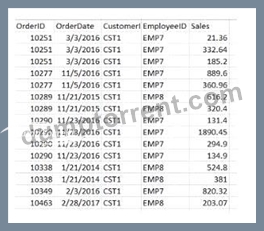
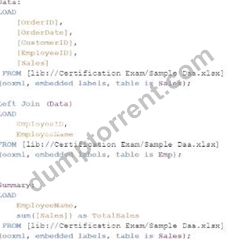
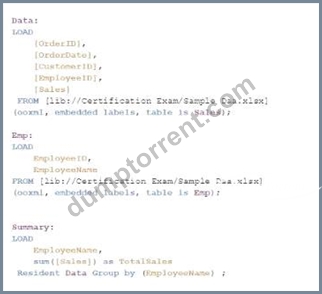
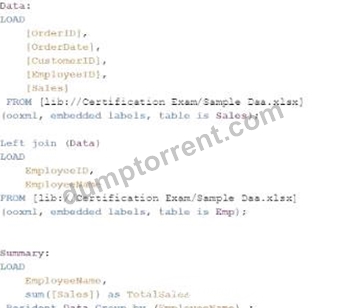
A data architect needs to build a dashboard that displays the aggregated sates for each sales representative. All aggregations on the data must be performed in the script.
Which script should the data architect use to meet these requirements?
- A.
- B.
- C.
- D.
Answer: C
Explanation:
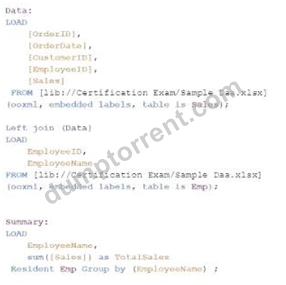
The goal is to display the aggregated sales for each sales representative, with all aggregations being performed in the script. Option C is the correct choice because it performs the aggregation correctly using a Group by clause, ensuring that the sum of sales for each employee is calculated within the script.
* Data Load:
* The Data table is loaded first from the Sales table. This includes the OrderID, OrderDate, CustomerID, EmployeeID, and Sales.
* Next, the Emp table is loaded containing EmployeeID and EmployeeName.
* Joining Data:
* A Left Join is performed between the Data table and the Emp table on EmployeeID, enriching the data with EmployeeName.
* Aggregation:
* The Summary table is created by loading the EmployeeName and calculating the total sales using the sum([Sales]) function.
* The Resident keyword indicates that the data is pulled from the existing tables in memory, specifically the Data table.
* The Group by clause ensures that the aggregation is performed correctly for each EmployeeName, summarizing the total sales for each employee.
Key Qlik Sense Data Architect References:
* Resident Load: This is a method to reuse data that is already loaded into the app's memory. By using a Resident load, you can create new tables or perform calculations like aggregation on the existing data.
* Group by Clause: The Group by clause is essential when performing aggregations in the script. It groups the data by specified fields and performs the desired aggregation function (e.g., sum, count).
* Left Join: Used to combine data from two tables. In this case, Left Join is used to enrich the sales data with employee names, ensuring that the sales data is associated correctly with the respective employee.
Conclusion:Option C is the most appropriate script for this task because it correctly performs the necessary joins and aggregations in the script. This ensures that the dashboard will display the correct aggregated sales per employee, meeting the data architect's requirements.
NEW QUESTION # 34
A data architect needs to retrieve data from a REST API. The data architect needs to loop over a series of items that are being read using the REST connection.
What should the data architect do?
- A. Use the REST Connector with pagination mechanism
- B. Use With Connection to pass a parameter to the REST URL
- C. Use pagination of the REST Connector to create a template of the desired data
- D. Recreate the SQL Statement with the correct parameters
Answer: A
Explanation:
When retrieving data from a REST API, particularly when the dataset is large or the data is segmented across multiple pages (which is common in REST APIs), the REST Connector in Qlik Sense needs to be configured to handle pagination.
Pagination is the process of dividing the data retrieved from the API into pages that can be loaded sequentially or as required. Qlik Sense's REST Connector supports pagination by allowing the dataarchitect to set parameters that will sequentially retrieve each page of data, ensuring that the complete dataset is retrieved.
Key Steps:
* REST Connector Setup: Configure the REST connector in Qlik Sense and specify the necessary API endpoint.
* Pagination Mechanism: Use the built-in pagination mechanism to define how the connector should retrieve the subsequent pages (e.g., by using query parameters like page or offset).
NEW QUESTION # 35
Exhibit.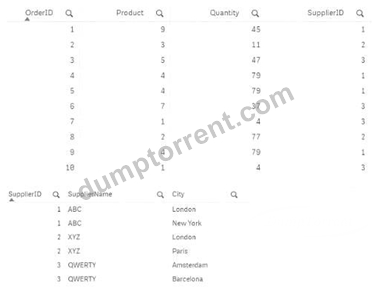
Refer to the exhibits.
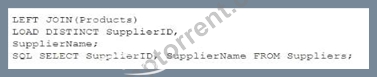
The Orders table contains a list of orders and associated details. A data architect needs to replace the SupplierlD with the SupplierName using the second table as the source.
The output must be a single table.
Which script should the data architect use?
- A.

- B.

- C.
- D.

Answer: C
Explanation:
In this scenario, the data architect needs to replace the SupplierID in the Orders table with the corresponding SupplierName from the Suppliers table, and the desired output should be a single table that includes all the order details along with the SupplierName instead of the SupplierID.
Analyzing the Options:
* Option A:
* Uses a MAPPING LOAD followed by an APPLYMAP to replace SupplierID with SupplierName in the Orders table. However, the table is dropped afterward, which means it won't produce the required output.
* The MAPPING LOAD approach is generally used to map values but is not necessary in this context as we are combining data from two tables directly.
* Option B:
* This option attempts to LEFT JOIN the Products table with the Suppliers table, but it does not directly address replacing SupplierID with SupplierName in the Orders table.
* Additionally, it does not remove the SupplierID after the join, which is essential for the correct output.
* Option C:
* This option uses a LEFT JOIN with the DISTINCT keyword on the SupplierID field to avoid duplicates. The SupplierName is correctly joined to the Orders table, replacing the SupplierID.
* This approach is the most appropriate because it results in a single table containing all order details with the SupplierName instead of the SupplierID.
* Option D:
* Similar to Option A, but it also introduces an unnecessary renaming step with MAPPING LOAD.
It's redundant and does not improve the solution over Option C.
Correct Script Choice:
Option Cis the correct script because:
* It ensures that SupplierName replaces SupplierID in the Orders table using a LEFT JOIN.
* The DISTINCT keyword is applied to the SupplierID field to prevent duplicate rows during the join.
* The result is a single table containing the required information with SupplierName in place of SupplierID.
References:
* Qlik Sense Join Operations: Using the correct JOIN type and ensuring proper deduplication (with DISTINCT if necessary) is key to merging tables in Qlik Sense.
NEW QUESTION # 36 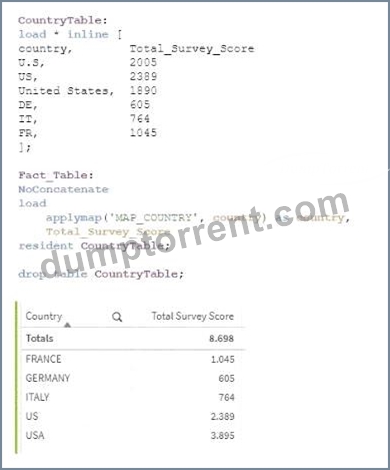
Refer to the exhibits.
On executing a load script of an app, the country field needs to be normalized. The developer uses a mapping table to address the issue. The script runs successfully but the resulting table is not correct.
What should the data architect do?
- A. Create two different mapping tables
- B. Use a LEFT JOIN Instead of the APPLYMAP
- C. Review the values of the source mapping table
- D. Use LOAD DISTINCT on the mapping table
Answer: C
Explanation:
In this scenario, the issue arises from using the applymap() function to normalize the country field values, but the result is incorrect. The reason is most likely related to the values in the source mapping table not matching the values in the Fact_Table properly.
The applymap() function in Qlik Sense is designed to map one field to another using a mapping table. If the source values in the mapping table are inconsistent or incorrect, the applymap() will not function as expected, leading to incorrect results.
Steps to resolve:
* Review the mapping table (MAP_COUNTRY): The country field in the CountryTable contains values such as "U.S.", "US", and "United States" for the same country. To correctly normalize the country names, you need to ensure that all variations of a country's name are consistently mapped to a single value (e.g., "USA").
* Apply Mapping: Review and clean up the mapping table so that all possible variants of a country are correctly mapped to the desired normalized value.
Key References:
* Mapping Tables in Qlik Sense: Mapping tables allow you to substitute field values with mapped values. Any mismatches or variations in source values should be thoroughly reviewed.
* Applymap() Function: This function takes a mapping table and applies it to substitute a field value with its mapped equivalent. If the mapped values are not correct or incomplete, the output will not be as expected.
NEW QUESTION # 37
A startup company is about have its Initial Public Offering (IPO) on the New York Stock Exchange.
This startup company has used Qlik Sense for many years for data-based decision making for Sales and Marketing efforts, as well as for input into Financial Reporting. The startup's Qlik Sense applications use variables that have different values at different points in time.
Due to the increased rigor required in record keeping for public companies, these variables must be clearly recorded in the script reload logs of the Qlik Sense applications. These logs are refreshed daily.
The data architect wants to have the variables names, with their current values,writteninto the script reload logs. Which script statement should the data architect use?
- A. Trace
- B. LogDetail
- C. Tag
- D. REM
Answer: A
Explanation:
In the scenario where the startup company is preparing for an IPO, there is an increased need for meticulous record-keeping, including the recording of variable values used in Qlik Sense applications. The TRACE statement is the most suitable option for logging variable values during script execution.
* TRACE: This statement writes custom messages, including variable values, to the script execution log.
By using TRACE, you can ensure that every reload log contains the names and current values of all relevant variables, providing the necessary transparency and traceability.
For example, the script could include:
TRACE $(VariableName);
This command will output the variable's value in the script log, ensuring it is recorded for audit purposes.
NEW QUESTION # 38
Exhibit.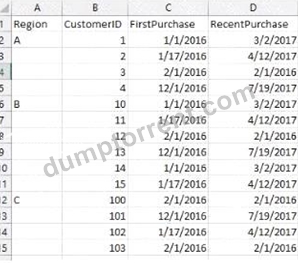
One of the data sources a data architect must add for a newly developed app is an Excel spreadsheet. The Region field only has values for the first record for the region. The data architect must perform a transformation so that each row contains the correct Region.
Which function should the data architect implement to resolve this issue?
- A. Above
- B. Previous
- C. IntervalMatch
- D. CrossTable
Answer: B
Explanation:
The given Excel spreadsheet has a Region field where the region value is only specified for the first record within each region. The data architect needs to fill in the missing region values for subsequent rows.
* Previous() Function: The Previous() function in Qlik Sense returns the value of the expression from the previous row. In this case, it can be used to fill down the Region values so that each row contains the correct region information.
* Implementation: The script can be designed to check if the current row's Region value is missing (null). If it is missing, the script can assign the value from the previous row using the Previous() function.
LOAD
If(IsNull(Region), Previous(Region), Region) AS Region,
This logic fills in the missing Region values with the value from the preceding row, which effectively resolves the issue shown in the spreadsheet.
NEW QUESTION # 39 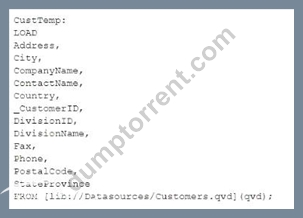
Refer to the exhibit.
A data architect needs to load data from Customers.qvd and sort the Country field in ascending order. Which method should be used?
- A. Insert an Order By clause after the FROM clause in the CustTemp table
- B. Perform a Resident LOAD of the CustTemp table and insert an Order By clause in this table
- C. Move the Country field to the first position in the field list in the LOAD statement
- D. Insert a Group By clause into the LOAD statement for the CustTemp table after the FROM clause
Answer: B
Explanation:
When loading data from a QVD file into a Qlik Sense application, if you need to sort the data by a specific field (in this case, the Country field), the Order By clause can be used. However, the Order By clause cannot be directly applied during the initial load from the QVD. Instead, the data should first be loaded into a temporary table and then sorted in a subsequent resident load.
* Initial Load from QVD:The data is first loaded into a temporary table (CustTemp) without any sorting.
* Resident Load with Order By:After the initial load, you perform a Resident Load from the CustTemp table and apply the Order By clause to sort the data by the Country field in ascending order.
LOAD
Address,
City,
CompanyName,
ContactName,
Country,
_CustomerID,
DivisionID,
DivisionName,
Fax,
Phone,
PostalCode,
StateProvince
RESIDENT CustTemp
ORDER BY Country;
This method ensures that the data is sorted correctly without violating Qlik Sense's loading rules.
NEW QUESTION # 40
Refer to the exhibit.
A company stores the employee data within a key composed of Country, UserlD, and Department. These fields are separated by a blank space. The UserlD field is composed of two characters that indicate the country followed by a unique code of two or three digits. A data architect wants to retrieve only that unique code.
Which function should the data architect use?
- A.

- B.

- C.

- D.

Answer: A
Explanation:
In this scenario, the key is composed of three components: Country, UserID, and Department, separated by spaces. The UserID itself consists of a two-character country code followed by a unique code of two or three digits. The objective is to extract only this unique numeric code from the UserID field.
Explanation of the Correct Function:
* Option A: RIGHT(SUBFIELD(Key, ' ', 2), 3)
* SUBFIELD(Key, ' ', 2):This function extracts the second part of the key (i.e., the UserID) by splitting the string using spaces as delimiters.
* RIGHT(..., 3):After extracting the UserID, the RIGHT() function takes the last three characters of the string. This works because the unique code is either two or three digits, and the RIGHT() function will retrieve these digits from the UserID.
This combination ensures that the data architect extracts the unique code from the UserID field correctly.
NEW QUESTION # 41
A data architect receives an error while running script.
What will happen to the existing data model?
- A. Newly loaded tables will be merged with the existing data model until the error is resolved.
- B. The data model will be removed from the application.
- C. The latest error-free data model will be maintained.
- D. The data model will be replaced with the tables that were successfully loaded before the error.
Answer: C
Explanation:
In Qlik Sense, when a data load script is executed and an error occurs, the script execution is halted immediately, and any tables that were being loaded at the time of the error are discarded. However, the existing data model-i.e., the last successfully loaded data model-remains intact and is not affected by the failed script. This ensures that the application retains the last known good state of the data, avoiding any partial or inconsistent data loads that could occur due to an error.
When the script encounters an error:
* The tables that were successfully loaded prior to the error are retained in the session, but these tables are not merged with the existing data model.
* The existing data model before the script was executed remains unchanged and is maintained.
* No partial or incomplete data is loaded into the application; hence, the data model remains consistent and reliable.
Qlik Sense Data Architect ReferencesThis behavior is designed to protect the integrity of the data model. In scenarios where script execution fails, the user can debug and fix the script without risking the data integrity of the existing application. The key references include:
* Qlik Help Documentation: Provides detailed information on how Qlik Sense handles script errors, highlighting that the existing data model remains unchanged after an error.
* Data Load Editor Practices: Best practices dictate ensuring that the script is fully functional before executing it to avoid data inconsistency. In cases where an error occurs, understanding that the current data model is maintained helps in strategic debugging and script correction.
NEW QUESTION # 42
exhibit.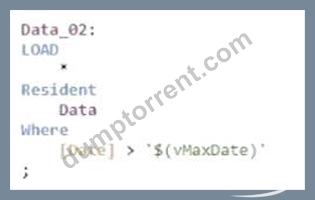
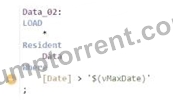
A data architect is validating that the script section, as shown in the exhibit, is working properly. They need to stop the script with a preview of the value used with the Load statement.
Where should the data architect put the debugger breakpoint?
- A.
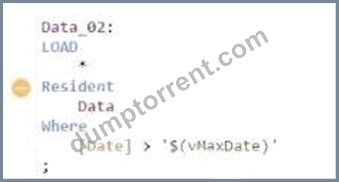
- B.
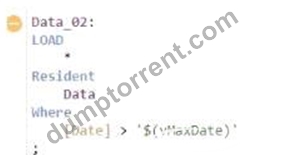
- C.
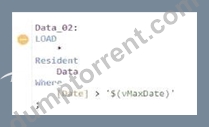
- D.
Answer: D
Explanation:
In this scenario, the data architect needs to validate the script and specifically ensure that the vMaxDate variable is being correctly utilized in the LOAD statement. The goal is to stop the script execution at a point where the variable's value can be previewed.
Understanding the Options:
* Option Aplaces the breakpoint just after the assignment of the variable vMaxDate in the Where clause but before any data is loaded.
* Option B, C, and Drepresent placements of the breakpoint after the LOAD statement begins processing the Resident table, which means that the variable vMaxDate would have already been utilized.
Correct Breakpoint Placement:
* Option Ais the correct choice because placing the breakpoint at this point allows you to preview the value of vMaxDate right before it is used in the Where clause. This placement ensures that the script execution halts before loading the data, allowing you to validate whether vMaxDate is correctly defined and whether it correctly filters the data based on the [Date] field.
* If the breakpoint were placed after the LOAD statement (as in Options B, C, or D), the script would have already attempted to load the data, making it too late to inspect the variable's value before it's used.
References:
* Qlik Sense Debugging Best Practices: When debugging, it is crucial to set breakpoints before the execution of a critical operation where the values of variables or fields are used to ensure that they hold the expected data.
NEW QUESTION # 43
Exhibit.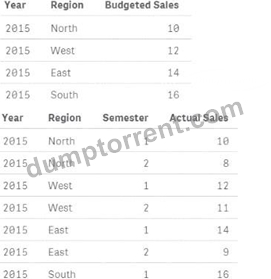
A data architect must load the two tables without creating a synthetic key. The data architect also must make sure expressions like Sum([Budgeted Sales]) are calculated correctly.
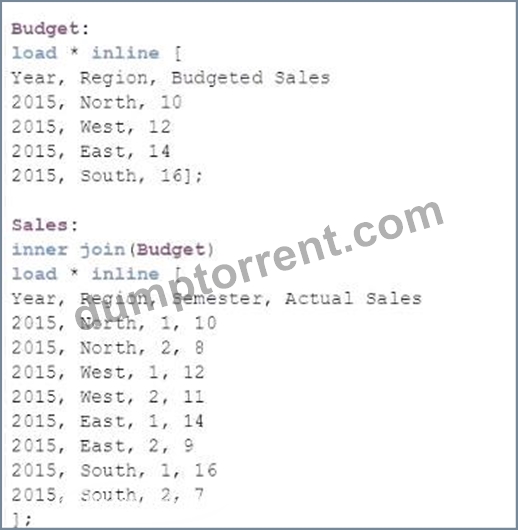
Which load script meets these requirements?
- A.
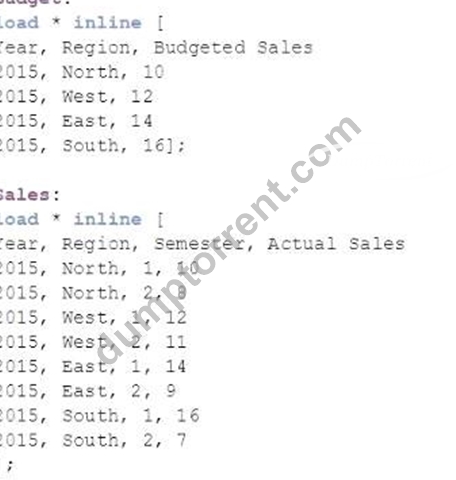
- B.
- C.
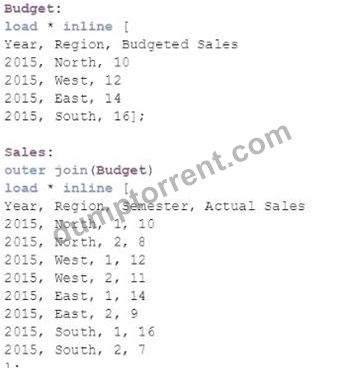
- D.
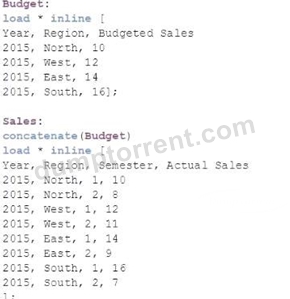
Answer: C
Explanation:
In the scenario provided, the data architect needs to load two tables (Budget and Sales) without creating a synthetic key, while ensuring that expressions like Sum([Budgeted Sales]) are calculated correctly.
Here is a breakdown of the options:
* Option A (Outer Join):This option uses an outer join between the Sales table and the Budget table.
While this approach will combine the tables based on the common fields (Year and Region), it will result in a single table that contains all fields from both tables. This approach prevents the creation of a synthetic key and retains all records from both tables, ensuring that all budgeted and actual sales data is available. As a result, calculations like Sum([Budgeted Sales]) will work correctly.This is the correct solution.
* Option B (Concatenate):This option uses concatenate, which combines the tables by stacking them on top of each other as if they were one table. This approach will not prevent synthetic keys and could cause issues with calculations since Budgeted Sales and Actual Sales would be in the same column, leading to incorrect aggregation results.
* Option C (Separate Load):This option simply loads the tables separately without any join or concatenation. While this will not create a synthetic key, it will result in two separate tables in the data model. Without any connection between these tables, calculations involving both Budgeted Sales and Actual Sales will not work correctly.
* Option D (Inner Join):This option uses an inner join, which will combine only the records that match in both tables based on Year and Region. While this approach avoids synthetic keys, it may exclude records that do not have a corresponding match in both tables, potentially leading to incomplete data.
Given the requirements to avoid synthetic keys and ensure correct calculations,Option A (Outer Join)is the most appropriate approach. It ensures all relevant data is included and that the data model remains free from synthetic keys, while also allowing accurate calculations.
NEW QUESTION # 44
Exhibit.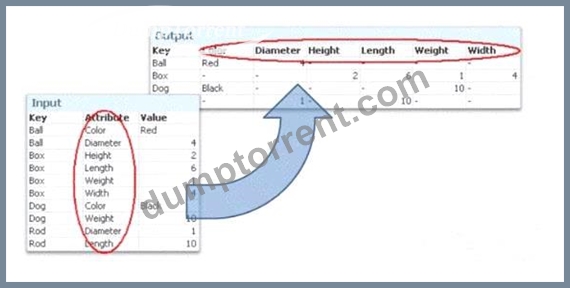
Refer to the exhibit.
A data architect wants to transform the input data set to the output data set. Which prefix to the Qlik Sense LOAD command should the data architect use?
- A. Hierarchy Be longsTo
- B. Peek
- C. PivotTable
- D. Generic
Answer: D
Explanation:
In this scenario, the data architect wants to transform the input dataset, which is in a key-value pair structure, into a table where each attribute becomes a column with its corresponding value under the relevant key.
Understanding the Requirement:
* Theinputdata consists of three fields: Key, Attribute, and Value.
* The desiredoutputstructure has the Key as a primary identifier, and the Attributes (like Color, Diameter, Height, etc.) are spread across the columns, with corresponding values filled in each row.
Best Method to Achieve this Transformation:
* The appropriate method to convert key-value pairs into a structured table where each unique attribute becomes a separate column is theGeneric Loadfunction in Qlik Sense.
Why Generic?
* Generic Loadis specifically designed for situations where data is stored in a key-value format (like the one provided) and needs to be converted into a more traditional tabular format, with attributes as columns.
* It creates a separate table for each combination of Key and Attribute, effectively "pivoting" the attribute values into columns in the output table.
How it Works:
* When applying a GENERIC LOAD to the input dataset, Qlik Sense will generate multiple tables, one for each Attribute. However, in the final data model, Qlik Sense automatically joins these tables by the Key field, effectively producing the desired output structure.
References:
* Qlik Sense Documentation on Generic Load: The documentation outlines how to use the Generic Load to handle key-value pairs and pivot them into a more traditional table format.
NEW QUESTION # 45
Exhibit.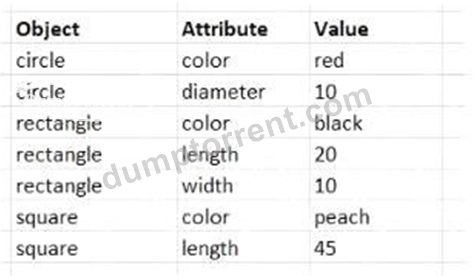
While performing a data load from the source shown, the data architect notices it is NOT appropriate for the required analysis.
The data architect runs the following script to resolve this issue: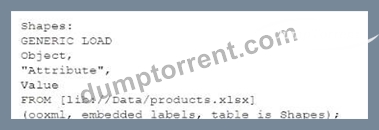
How many tables will this script create?
- A. 0
- B. 1
- C. 2
- D. 3
Answer: B
Explanation:
In this scenario, the data architect is using a GENERIC LOAD statement in the script to handle the data structure provided. A GENERIC LOAD is used in Qlik Sense when you have data in a key-value pair structure and you want to transform it into a more traditional table structure, where each attribute becomes a column.
Given the input data table with three columns (Object, Attribute, Value), and the attributes in the Attribute field being either color, diameter, length, or width, the GENERIC LOAD will create separate tables based on the combinations of Object and each Attribute.
Here's how the GENERIC LOAD works:
* For each unique object(circle, rectangle, square), the GENERIC LOAD creates separate tables based on the distinct values of the Attribute field.
* Each of these tableswill contain two fields: Object and the specific attribute (e.g., color, diameter, length, width).
Breakdown:
* Table for circle:
* Fields: Object, color, diameter
* Table for rectangle:
* Fields: Object, color, length, width
* Table for square:
* Fields: Object, color, length
Each distinct attribute (color, diameter, length, width) and object combination generates a separate table.
Final Count of Tables:
* The script will create6 separate tables: one for each unique combination of Object and Attribute.
References:
* Qlik Sense Documentation on Generic Load: Generic loads are used to pivot key-value pair data structures into multiple tables, where each key (in this case, the Attribute field values) forms a new column in its own table.
NEW QUESTION # 46 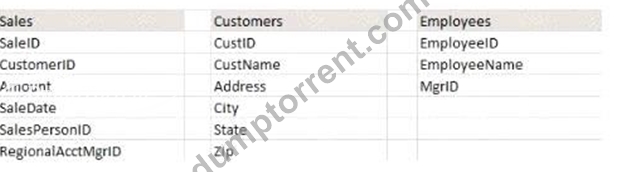
Refer to the exhibit.
A data architect needs to create a data model for a new app. Users must be able to see:
* Total sales for each customer
* Total sales for a given state
* Customers that have not had any sales
* Names of salesperson and regional account managers
* Total number of sales by date
Which steps should the data architect perform to meet these requirements?
Which steps should the data architect perform to meet these requirements?
- A. 1. Load the Sales table
2. Load the Customers table
3. Load the Employees table twice; name it and alias the EmployeelD field appropriately each time - B. 1. Load the Customers table and alias the CustID field as CustomerlD
2. Load the Employees table
3. Load the Sales table and alias the SalesPersonID and RegionalAcctMgrlD fields as EmployeelD - C. 1. Use a Mapping Load for the Employees table
2. Load the Sales table and use ApplyMap to get the names for SalesPersonID and RegionalAcctMgrlD
3. Use a Left Join Load to add the customer details for the Sales table - D. 1. Load the Customers table and alias the CustID field as CustomerlD
2. Use a Mapping Load for the Employees table
3. Load the Sales table and use ApplyMap to get the names for SalesPersonID and RegionalAcctMgrlD
Answer: A
Explanation:
In the provided scenario, the data architect needs to create a data model that supports various analyses, including total sales for each customer, total sales by state, identifying customers with no sales, and displaying the names of salespersons and regional account managers.
Here's whyOption Cis the correct choice:
* Loading the Sales Table:The Sales table contains key information related to sales transactions, including SaleID, CustomerID, Amount, SaleDate, SalesPersonID, and RegionalAcctMgrID. This table must be loaded first as it will be central to the analysis.
* Loading the Customers Table:The Customers table includes customer details such as CustID, CustName, Address, City, State, and Zip. Loading this table and linking it to the Sales table via the CustomerID field allows you to perform analyses such as total sales per customer and total sales by state. Importantly, loading the customers separately will also allow the identification of customers without any sales.
* Loading the Employees Table Twice:The Employees table must be loaded twice because it is used to look up two different roles in the sales process: the SalesPersonID and the RegionalAcctMgrID. When loading the table twice:
* The first instance of the Employees table will be used to map the SalesPersonID to EmployeeName.
* The second instance will be used to map the RegionalAcctMgrID to EmployeeName.
* Aliasing the EmployeeID field appropriately in each instance is crucial to prevent creating synthetic keys and to ensure the correct association with the roles in the sales process.
This approach ensures that the data model will correctly support all the required analyses, including identifying customers without sales, which is crucial for meeting the business requirements.
* Option AandOption Bpropose using a mapping load and ApplyMap, which can complicate the model and does not directly address all the business requirements.
* Option Dinvolves aliasing fields in a way that could create unnecessary complexity and might not accurately reflect the relationships in the data.
Thus,Option Cis the correct answer as it best meets the requirements while maintaining a clear and functional data model.
NEW QUESTION # 47
......
Qlik QSDA2024 Exam Syllabus Topics:
| Topic | Details |
|---|---|
| Topic 1 |
|
| Topic 2 |
|
| Topic 3 |
|
| Topic 4 |
|
| Topic 5 |
|
Regular Free Updates QSDA2024 Dumps Real Exam Questions Test Engine: https://www.dumptorrent.com/QSDA2024-braindumps-torrent.html