


Organizational-Behavior Exam Info and Free Practice Test All-in-One Exam Guide Mar-2026
Pass WGU Organizational-Behavior Actual Free Exam Q&As Updated Dump Mar 04, 2026
NEW QUESTION # 10
What is a personal view of how one is supposed to act in a given group situation?
- A. Role identity
- B. Role perception
- C. Role expectation
- D. Role conflict
Answer: B
Explanation:
In the context of group dynamics, "roles" refer to a set of expected behavior patterns attributed to someone occupying a given position in a social unit. Within this framework,Role Perceptionis defined as an individual' s own view of how he or she is supposed to act in a given situation. We get these perceptions from various stimuli around us-friends, books, movies, or observing how successful colleagues behave.
It is important to distinguish Role Perception fromRole Expectations, which are howothersbelieve a person should act in a given situation. For example, a manager might have a role expectation that a supervisor should be stern, but the supervisor's own role perception might be that they should be a supportive mentor. When role perception and role expectation do not align, it can lead to confusion or poor performance.Role Identityrefers to the certain attitudes and behaviors consistent with a role, whileRole Conflictoccurs when an individual finds that compliance with one role requirement may make it difficult to comply with another. Because the question specifically asks for thepersonal viewof behavior, "Role Perception" is the correct technical term.
NEW QUESTION # 11
Which statement is true about groupshift?
- A. It is a side-stepping technique.
- B. It can be toward caution or toward risk.
- C. It is not a real-world phenomenon.
- D. It cannot be toward greater risk.
Answer: B
Explanation:
Groupshift is a phenomenon related to groupthink, specifically describing the way group members tend to exaggerate their initial positions when discussing a given set of alternatives. In a group setting, the collective decision often shows a shift toward a more extreme version of the position held by members before the discussion began. While many people assume groups always lead to more conservative decisions, groupshift demonstrates that the shift can move in either direction: toward greater caution or toward greater risk.
The shift toward risk is more common in many organizational settings. This occurs for several reasons: first, the shared responsibility of a group diffuses the accountability for any single individual, making them feel bolder. Second, members who are more willing to take risks may be perceived as more confident and thus exert more influence over the group's final decision. Conversely, if the initial atmosphere of the group is conservative, the discussion tends to reinforce that caution, leading to a "shift" toward even more extreme avoidance of risk. Understanding groupshift is vital for managers because it highlights that group decisions are not necessarily "average" or "moderate" versions of individual opinions; rather, the social dynamics within a group can drive the collective toward extremes that no single member might have chosen independently.
Recognizing this allows leaders to implement checks and balances, such as appointing a devil's advocate, to ensure that the group does not drift into a dangerous or overly timid position due to the social reinforcement of the shift phenomenon.
NEW QUESTION # 12
What is a characteristic employed by transactional leaders?
- A. Provides vision and sense of mission
- B. Promises rewards for good performance
- C. Instills pride and gains trust
- D. Promotes intelligence and rationality
Answer: B
Explanation:
Organizational Behavior distinguishes between transformational andtransactional leaders. Transactional leaders guide or motivate their followers in the direction of established goals by clarifying role and task requirements. They function primarily through a series of "transactions" or exchanges where the leader provides something the followers want in return for their performance.
One of the primary characteristics of transactional leadership iscontingent reward, which involvespromising rewards for good performanceand recognizing accomplishments. Other characteristics include management by exception (active or passive), where the leader intervenes only when standards are not met. Options A, B, and C describe transformational leaders, who inspire followers to transcend their own self-interests for the good of the organization and are capable of having a profound and extraordinary effect on followers. While transformational leadership is often celebrated for driving innovation and change, transactional leadership remains essential for maintaining the day-to-day stability and efficiency of an organization by ensuring that employees are rewarded for meeting specific, tangible targets.
NEW QUESTION # 13
What is a purpose of employee evaluations?
- A. To measure the psychological symptoms of organizational dysfunctionality
- B. To educate employees on the personalities of supervisors and help them adjust to management styles
- C. To serve as a screening device for hiring new employees
- D. To assist management in making human resource decisions
Answer: D
Explanation:
Performance evaluations serve several vital functions within an organization's management system. The primary purpose isto assist management in making human resource decisions. These decisions include identifying who should receive promotions, who is eligible for salary increases, and who might need to be transferred or even terminated.
Beyond administrative decisions, evaluations provide essential feedback to employees about how the organization views their performance. This feedback acts as a basis for personal development and career planning. Furthermore, evaluations help identify training and development needs by pinpointing specific skill deficiencies that an employee may have. They also provide a criterion against which the organization can validate its selection and development programs; for instance, if employees who scored high on a hiring test perform poorly on their evaluations, the hiring process may need to be adjusted. Therefore, rather than being a psychological diagnostic tool (Option B) or a pre-hiring screen (Option C), the performance evaluation is a retrospective and developmental tool used to manage the existing workforce effectively.
NEW QUESTION # 14
What is one of the six primary characteristics that define an organization's culture?
- A. Team orientation
- B. Competitor benchmarking
- C. Political orientation
- D. Aggressiveness
Answer: D
Explanation:
Research suggests that seven (often grouped into six or seven in various texts) primary characteristics capture the essence of an organization's culture. One of these key characteristics isAggressiveness, which describes the degree to which people are aggressive and competitive rather than easygoing.
Other characteristics include:
* Innovation and Risk Taking:The degree to which employees are encouraged to be innovative and take risks.
* Attention to Detail:The degree to which employees are expected to exhibit precision and analysis.
* Outcome Orientation:The degree to which management focuses on results rather than techniques and processes.
* People Orientation:The degree to which management decisions take into account the effect of outcomes on people within the organization.
* Team Orientation:The degree to which work activities are organized around teams rather than individuals.
* Stability:The degree to which organizational activities emphasize maintaining the status quo in contrast to growth.
By assessing an organization on these dimensions, a complete picture of its culture emerges, providing a basis for shared understanding among members.
NEW QUESTION # 15
A company switched from assembly lines to self-managed work teams. What can team members do to improve the synergy and success of their teams?
- A. Exercise collective control over the pace of work
- B. Change work group roles at random
- C. Share information but not engage in collective performance goals
- D. Assign individual roles rather than mutual team roles
Answer: A
Explanation:
A self-managed work team is characterized by its high level of autonomy and collective responsibility. To improve synergy and success, these teams must move beyond simply sharing information (which is characteristic of a work group) and engage in collective actions. One of the primary hallmarks of a successful self-managed team is the ability toexercise collective control over the pace of work.
In a traditional assembly line, the pace is dictated by the machinery or a supervisor. In a self-managed team, members decide how to schedule work, assign tasks, and monitor their own progress. This collective control fosters a sense of ownership and accountability. Options A and C describe traditional "work group" behaviors rather than team behaviors; teams require mutual accountability rather than just individual roles. By controlling their own pace and methods, team members can synchronize their efforts more effectively, leading to the positive synergy where the team's output is greater than the sum of individual inputs.
NEW QUESTION # 16
What is an advantage of a strong organizational culture?
- A. There is ambiguity in what employees perceive as expectations.
- B. Core values are not intensely held and widely shared.
- C. The internal climate exhibits low behavioral control.
- D. There is a formation of strong employee commitment.
Answer: D
Explanation:
Astrong organizational cultureis one in which the core values are both intensely held and widely shared by the members. One of the primary advantages of such a culture is theformation of strong employee commitment. When employees believe in and identify with the organization's values, they are more likely to be dedicated to its goals and more willing to put in extra effort to see the organization succeed.
A strong culture also serves to reduce turnover because it creates a high level of agreement among members about what the organization stands for. This unanimity of purpose builds cohesiveness and loyalty.
Furthermore, a strong culture acts as a substitute for formalization; it tells employees how they are expected to behave without the need for thick manuals or rigid rules. While it can have liabilities (as noted in Q32), the immediate organizational benefit is a motivated, committed workforce that shares a common sense of direction.
NEW QUESTION # 17
A team is struggling to resolve procedural issues that govern their performance. What should the team leader do to resolve the problem?
- A. Research the problem and impose a solution
- B. Rearrange roles within the team by adding members
- C. Ask questions and help team members talk through the problem
- D. Appoint an assistant team leader to track the struggles and report back
Answer: C
Explanation:
When a team struggles with procedural issues-the "how" of their work-the most effective leadership approach is often facilitative rather than directive. Instead of imposing a solution (Option A), which can lead to resistance or a lack of "buy-in," the leader shouldask questions and help team members talk through the problem. This technique is rooted in the concept ofteam coachingand process consultation.
By facilitating a dialogue, the leader encourages the team to take ownership of their own processes. This collaborative problem-solving approach helps identify the root cause of the procedural friction, whether it be ambiguous roles, inefficient workflows, or conflicting expectations. Furthermore, helping the team talk through the issue strengthens their internal communication and conflict-resolution skills, making them more resilient in the future. A leader who acts as a facilitator helps the team move from the "storming" phase of development-where procedural conflicts are common-into the "norming" phase, where clear, agreed-upon standards of behavior and performance are established by the group itself.
Organizational Culture
NEW QUESTION # 18
In organizing a team to develop a new product for entry into the electronics market, management wanted to assign team members having characteristics common to effective teams. Which list specifies common characteristics of effective teams?
- A. A climate of trust, members who score low on the personality characteristic of extroversion, and effective leadership
- B. Members who are emotionally stable, members who fill role demands, and a manageable level of conflict
- C. A climate of trust, members who fill role demands, and an absence of conflict
- D. Effective leadership, members who score low on the personality characteristic of extroversion, and members who fill role demands
Answer: B
Explanation:
The effectiveness of a team is generally categorized by its composition, context, and process. According to the Big Five Personality Model and team research, effective teams are typically composed of individuals who score high onemotional stability, agreeableness, and conscientiousness. These traits help maintain a positive working environment and reduce interpersonal friction. Furthermore, teams must ensure that they have people to fill variousrole demands-meaning that all necessary tasks and social-maintenance functions are being performed by someone within the group.
Crucially, effective teams do not necessarily have an "absence of conflict" (which refutes option C). Instead, they maintain amanageable level of conflict. Specifically, "task conflict"-disagreements over the content of the work-can actually stimulate discussion and lead to better decisions, provided that "relationship conflict" (interpersonal animosity) remains low. Therefore, a team that is emotionally stable, fulfills its role requirements, and handles conflict constructively is much more likely to succeed in a high-pressure environment like the electronics market than one that simply tries to avoid all disagreement.
NEW QUESTION # 19
Management has noticed that the accounting work group is having difficulty because group members seem to be working in different directions. Which suggested action can the company take to increase group cohesiveness?
- A. Establish more rigid role definition for group members
- B. Give group rewards rather than individual rewards
- C. Have the group avoid competition with other groups
- D. Give individual rewards rather than group rewards
Answer: B
Explanation:
Group cohesiveness refers to the degree to which members are attracted to one another and are motivated to remain part of the group. When members are "working in different directions," it indicates a lack of alignment and shared purpose. One of the most effective structural methods to foster unity is togive group rewards rather than individual rewards. When rewards are tied to the collective output of the team, members are incentivized to collaborate, share information, and support one another to ensure the entire group succeeds.
Individual rewards often foster internal competition, which can further fragment a group that is already struggling with alignment.
In addition to group-based rewards, other strategies to increase cohesiveness include making the group smaller, increasing the time members spend together, and stimulating competition withothergroups (rather than avoiding it). By shifting the focus from individual achievement to collective success, the organization encourages members to coordinate their efforts, thereby increasing the "we-feeling" necessary for high- performing teams.
NEW QUESTION # 20
A is ambitious and cheerful at work. Which type of values are these?
- A. Terminal values
- B. Determinate values
- C. Intermediate values
- D. Instrumental values
Answer: D
Explanation:
Values represent basic convictions that a specific mode of conduct or end-state of existence is personally or socially preferable to an opposite mode. In Organizational Behavior, Milton Rokeach created the Rokeach Value Survey (RVS), which classifies values into two distinct sets: Terminal values and Instrumental values.
Terminal valuesrefer to desirable end-states of existence. These are the goals a person would like to achieve during their lifetime, such as world peace, prosperity, or a sense of accomplishment.Instrumental values, on the other hand, refer to preferable modes of behavior or means of achieving the terminal values. Being
"ambitious" and "cheerful" are behavioral traits or methods that an individual employs to reach their ultimate goals. For instance, being ambitious (an instrumental value) is the "means" an employee uses to achieve the
"end" of financial success or career status (a terminal value). Similarly, being cheerful is a mode of conduct that might help an individual achieve the terminal goal of social recognition or happiness. Therefore, because these descriptions focus on thehowof behavior rather than thewhatof ultimate life goals, they are strictly categorized as instrumental values. Understanding these values is crucial for managers because they influence motivation and how employees perceive organizational rewards and culture.
NEW QUESTION # 21
How can an organization transmit its culture to its employees?
- A. By studying employee gripes and complaints
- B. By influencing the balance of cultural backgrounds of employees
- C. By creating and repeating ritualistic activities
- D. By requiring employees to memorize the mission statement
Answer: C
Explanation:
Culture is transmitted to employees in several ways, most notably through stories, rituals, material symbols, and language.Ritualsare repetitive sequences of activities that express and reinforce the key values of the organization-what goals are most important, which people are important, and which are expendable. For example, a company might hold an annual awards ceremony that celebrates "risk-taking," thereby reinforcing a culture of innovation more effectively than a written document could.
These ritualistic activities serve as a physical manifestation of the organization's underlying values. While mission statements (Option A) provide a formal overview, they often fail to capture the "lived experience" of the culture. Similarly, while the selection process influences who enters the organization, the transmission of culture happens after hiring through consistent, repeated social practices. By engaging in these rituals, employees internalize the organization's norms and expectations, transforming them from "outsiders" to
"insiders" who understand the shared organizational meaning.
NEW QUESTION # 22
A coach encourages a person to run two miles in ten minutes and provides the person a stopwatch to check periodically. The person completes the run in 9.8 minutes. Considering the goal-setting theory of motivation, which two factors explain why the person achieved the goal?
- A. Specificity and encouragement
- B. Specificity and feedback
- C. Direction and challenge
- D. Challenge and encouragement
Answer: B
Explanation:
Edwin Locke'sGoal-Setting Theorysuggests that specific and difficult goals, with feedback, lead to higher performance. The theory identifies several key components that drive motivation. First isSpecificity. In this case, the coach did not just say "run fast"; they set a specific target of "two miles in ten minutes". Specific goals act as an internal stimulus, providing a clear sense of what needs to be done and how much effort is required.
Image of Goal-Setting Theory of Motivation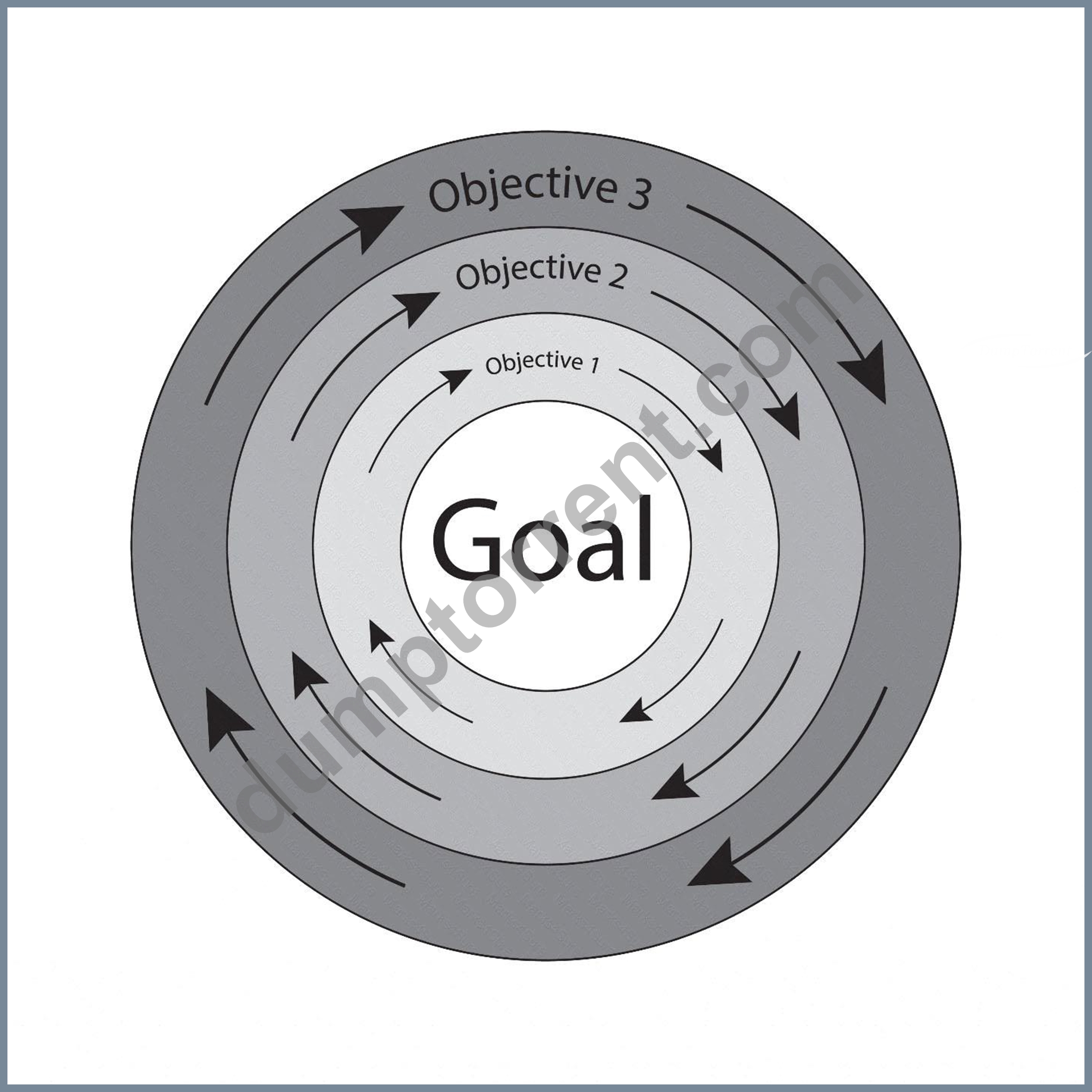
The second critical factor isFeedback. By providing a stopwatch, the coach allowed the runner to monitor their own progress. Feedback helps individuals identify discrepancies between what they have done and what they want to do; it guides behavior and motivates the individual to adjust their effort level to meet the goal.
While "challenge" is also a part of the theory (as difficult goals lead to higher performance), the presence of the stopwatch specifically addresses the feedback mechanism, and the clear time-distance parameters address specificity. Therefore, the combination of a clearly defined target (specificity) and the ability to track progress (feedback) are the primary drivers for the runner achieving the 9.8-minute result.
NEW QUESTION # 23
A project team was formed to complete a specific project. At the end of the first 6 months, the team was unable to deliver the results. The main cause was several team members spending significant time mistakenly working on the same tasks. Which role of a team lead is most useful in the given case?
- A. Coordinator
- B. Planner
- C. Motivator
- D. Controller
Answer: A
Explanation:
In group dynamics, the failure described-redundant efforts and a lack of task synchronization-points to a failure incoordination. TheCoordinatorrole is responsible for clarifying goals, delegating tasks, and ensuring that the efforts of individual team members are integrated rather than duplicated. Without effective coordination, even highly motivated and skilled teams can fail because their energy is dissipated through
"working in different directions".
While a "Planner" (Option B) sets the initial schedule and a "Controller" (Option C) monitors outcomes, the Coordinator acts as the glue during the execution phase. The Coordinator ensures that every member knows their specific contribution and how it fits into the whole. In this case, because the members were "mistakenly working on the same tasks," a Coordinator would have intervened to clarify boundaries and manage the interdependencies of the work. Effective coordination is the primary antidote to the "process losses" that occur when team members overlap in their efforts.
NEW QUESTION # 24
Which option defines organizational culture?
- A. A method of stratifying the organization's target market
- B. A system of unique physical parameters that describes the organization
- C. A unique system of shared organizational meaning
- D. A human resources department program for recognizing diversity
Answer: C
Explanation:
Organizational culture is defined as aunique system of shared meaningheld by members that distinguishes the organization from other organizations. This system of shared meaning is a set of key characteristics that the organization values. It represents the "common perception" held by the organization's members; even though individuals may have different backgrounds or occupy different levels in the hierarchy, they tend to describe the organization's culture in similar terms.
Culture is the social glue that helps hold the organization together by providing appropriate standards for what employees should say and do. It acts as a boundary-defining element, creates a sense of identity for employees, facilitates commitment to something larger than individual self-interest, and enhances the stability of the social system. While physical parameters (Option A) or HR programs (Option B) may reflect or support the culture, the culture itself is the underlying shared cognitive framework-the "way we do things around here"-that guides employee behavior and shapes their organizational experience.
NEW QUESTION # 25
An employee is motivated by economic success, well-being, world peace, and autonomy and self-reliance in the workplace. Which of the employee's motives is an instrumental value?
- A. Autonomy and self-reliance
- B. Economic
- C. World peace
- D. Prosperity
Answer: A
Explanation:
In Organizational Behavior, values are often classified using the Rokeach Value Survey, which distinguishes betweenTerminal ValuesandInstrumental Values. Terminal values represent the ultimate goals or "end- states" an individual hopes to achieve, such as prosperity (economic success), well-being, and world peace.
These are the destinations toward which a person works. In contrast, instrumental values are the "modes of conduct" or the means by which one achieves those terminal goals.
In this specific scenario, "autonomy and self-reliance" are categorized as instrumental values because they describe the behavioral methods an employee uses to navigate the workplace and eventually reach their terminal goals, such as economic success or personal well-being. For example, an employee might use autonomy (an instrumental value) as a tool to gain the efficiency required to achieve prosperity (a terminal value). Understanding this distinction is vital for managers because while terminal values tell us what the employee wants to achieve, instrumental values tell us how they prefer to behave in order to get there.
Autonomy and self-reliance are practical approaches to work life rather than the final life-goals themselves, thus fitting the definition of instrumental values perfectly.
NEW QUESTION # 26
What is the impact of high group cohesiveness and well-defined performance norms on the productivity of a team?
- A. The productivity of the team will remain low
- B. The productivity of the team will remain as is
- C. The productivity of the team will improve significantly
- D. The productivity of the team will improve slightly
Answer: C
Explanation:
The interaction between cohesiveness and performance norms is a critical concept in Organizational Behavior. As shown in the research regarding group dynamics,the productivity of the team will improve significantlywhen both cohesiveness and performance norms are high. Cohesiveness provides the social
"glue" that keeps the team together, while performance norms provide the "direction" by establishing clear expectations for effort, output, and quality.
When these two factors coincide, the group becomes a powerful force; members motivate one another to meet the high standards they have collectively accepted. This is the "ideal" state for any work team. If cohesiveness is high but performance norms are low, the group is unified but unproductive. If cohesiveness is low but norms are high, productivity improves only slightly because members lack the social bond to sustain high- level collaboration. Therefore, the combination of a strong bond and high standards yields the most significant productivity gains.
NEW QUESTION # 27
......
Online Questions - Valid Practice Organizational-Behavior Exam Dumps Test Questions: https://www.dumptorrent.com/Organizational-Behavior-braindumps-torrent.html
Latest Organizational-Behavior Actual Free Exam Updated 42 Questions: https://drive.google.com/open?id=1E3fKCPCwv-otCkMqSSqaEwH9TDVeBtgZ