


Practice CCNP Enterprise 300-410 exam. Online Exam Practice Tests with detailed explanations! Pass 300-410 with confidence!
300-410 - Implementing Cisco Enterprise Advanced Routing and Services Practice Tests 2023 | DumpTorrent
NEW QUESTION # 287
Refer to the exhibit.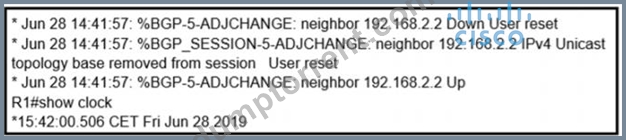
An engineer is troubleshooting BGP on a device but discovers that the clock on the device does not correspond to the time stamp of the log entries.
Which action ensures consistency between the two times?
- A. Make sure that the clock on the device is synchronized with an NTP server
- B. Configure the service timestamps log uptime command in global configuration mode
- C. Configure the logging clock synchronize command in global configuration mode
- D. Configure the service timestamps log datetime localtime command in global configuration mode
Answer: B
NEW QUESTION # 288
Refer to the exhibit.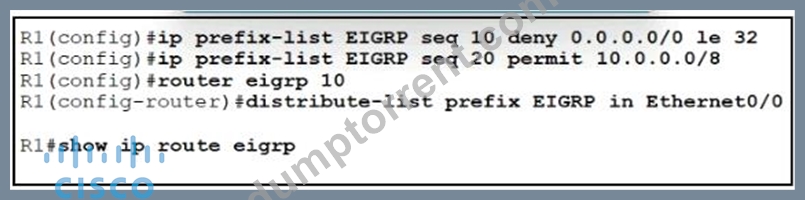
A prefix list is created to filter routes inbound to an EIGRP process except for network 10 prefixes After the prefix list is applied no network 10 prefixes are visible in the routing table from EIGRP. Which configuration resolves the issue?
- A. ip prefix-list EIGRP seq 20 permit 10.0.0.0/8 ge 9.
- B. ip prefix-list EIGRP seq 20 permit 10.0.0.0/8 ge 9 ip prefix-list EIGRP seq 10 permit 0.0.0.0/0 le 32
- C. ip prefix-list EIGRP seq 10 permit 0.0.0.0/0 le 32
- D. ip prefix-list EIGRP seq 5 permit 10.0.0.0/8 ge 9 no ip prefix-list EIGRP seq 20 permit 10.0.0.0/8
Answer: D
NEW QUESTION # 289
Exhibit: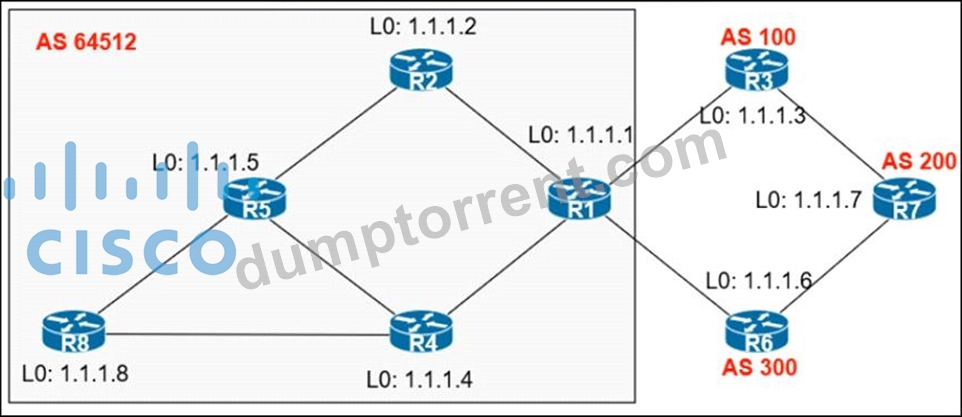
An engineer configured R2 and R5 as route reflectors and noticed that not all routes are sent to R1 to advertise to the eBGP peers. Which iBGP routers must be configured as route reflectors to advertise all routes to restore reachability across all networks?
- A. R1 and R4
- B. R1 and R5
- C. R2 and R5
- D. R4 and R5
Answer: A
NEW QUESTION # 290
Refer to the exhibit.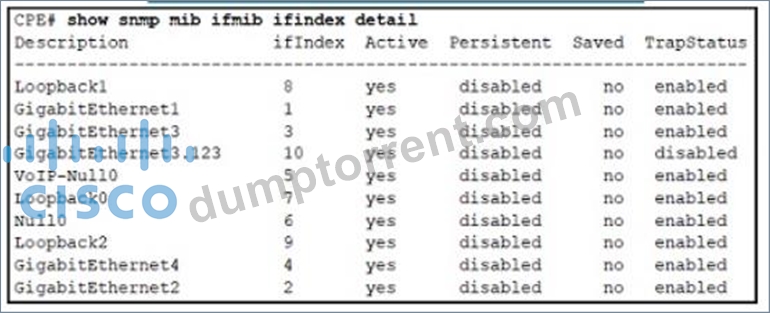
Refer to the exhibit. After reloading the router an administrator discovered that the interface utilization graphs displayed inconsistencies with their previous history in the NMS. Which action prevents this issue from occurring after another router reload in the future?
- A. Configure SNMP interface index persistence on the router
- B. Configure SNMP to use static OlDs referring to individual router interfaces
- C. Save the router configuration to startup-config before reloading the router
- D. Rediscover all the router interfaces through SNMP after the router is reloaded
Answer: A
NEW QUESTION # 291
Which statement about IPv6 RA Guard is true?
- A. It does not offer protection in environments where IPv6 traffic is tunneled.
- B. Packets that are dropped by IPv6 RA Guard cannot be spanned.
- C. It is not supported in hardware when TCAM is programmed.
- D. It cannot be configured on a switch port interface in the ingress direction.
Answer: A
Explanation:
Explanation
https://www.cisco.com/c/en/us/td/docs/ios-xml/ios/ipv6_fhsec/configuration/xe-3s/ip6f-xe-3s-book/ip6-ra-guard The IPv6 RA Guard feature does not offer protection in environments where IPv6 traffic is tunneled.
NEW QUESTION # 292
Refer to the exhibit.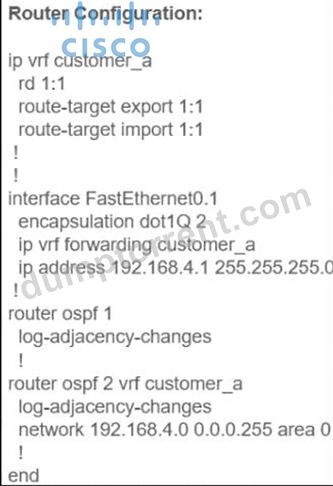
The network administrator configured VRF lite for customer A. The technician at the remote site misconfigured VRF on the router. Which configuration will resolve connectivity for both sites of customer a?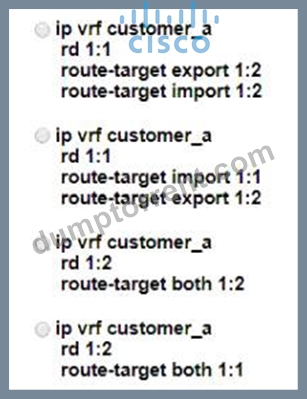
- A. Option A
- B. Option C
- C. Option B
- D. Option D
Answer: D
Explanation:
Explanation
From the exhibit, we learned:
+ VRF customer_a was exported with Route target (RT) of 1:1 so at the remote site it must be imported with the same RT 1:1.
+ VRF customer_a was imported with Route target (RT) of 1:1 so at the remote site it must be exported with the same RT 1:1.
Therefore at the remote site we must configure the command "route-target both 1:1" (which is equivalent to two commands "route-target import 1:1" & "route-target export 1:1".
NEW QUESTION # 293
Refer to Exhibit.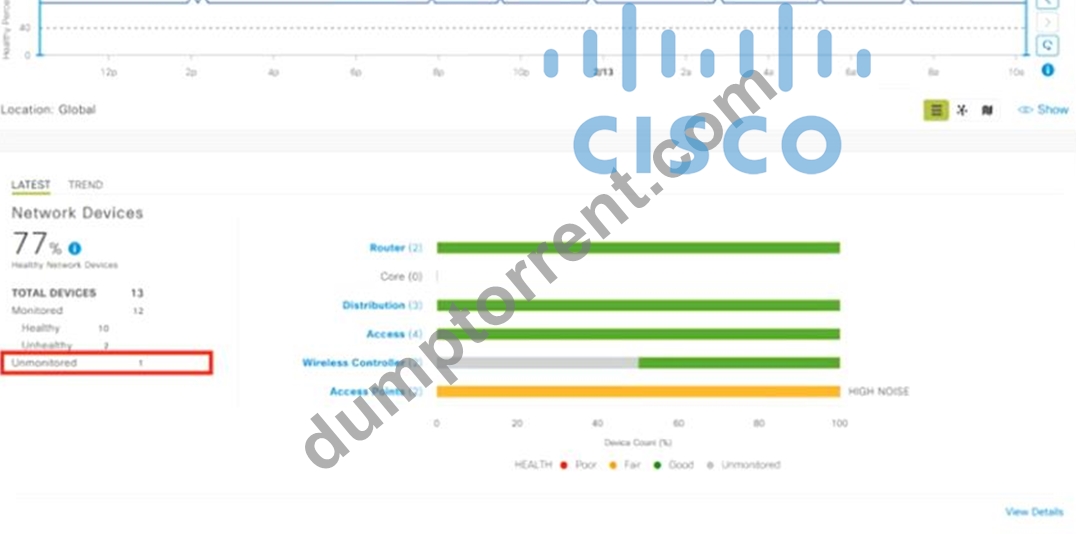
A network administrator added one router in the Cisco DNA Center and checked its discovery and health from the Network Health Dashboard. The network administratorobserved that the router is still showing up as unmonitored. What must be configured on the router to mount it in the Cisco DNA Center?
- A. Configure router with NetFlow data
- B. Configure router with routing to reach Cisco DNA Center
- C. Configure router with the telemetry data
- D. Configure router with SNMPv2c or SNMPv3 traps
Answer: C
Explanation:
Unmonitored: Unmonitored devices are devices for which Assurance did not receive any telemetry data during the specified time range.
NEW QUESTION # 294 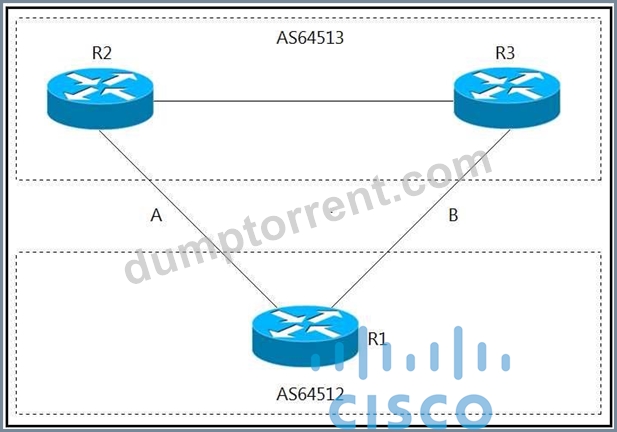
Refer to the exhibit. A network engineer for AS64512 must remove the inbound and outbound traffic from link A during maintenance without closing the BGP session so that there is still a backup link over link A toward the ASN.
Which BGP configuration on R1 accomplishes this goal?
- A.
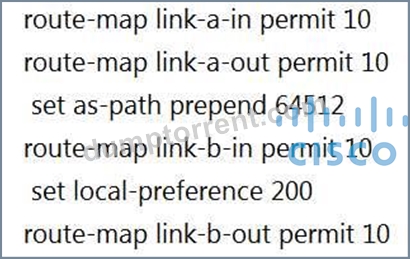
- B.
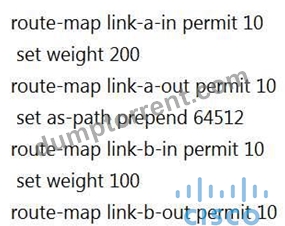
- C.
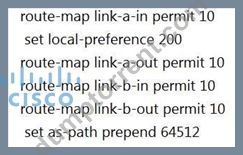
- D.
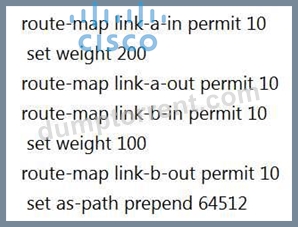
Answer: A
Explanation:
Section: Mixed Questions
NEW QUESTION # 295
Which function does LDP provide in an MPLS topology?
- A. It enables a MPLS topology to connect multiple VPNs to P routers.
- B. It provides a means for LSRs to exchange IP routes.
- C. It exchanges routes for MPLS VPNs across different VRFs.
- D. It provides hop-by-hop forwarding in an MPLS topology for LSRs.
Answer: D
Explanation:
Explanation
LDP provides a standard methodology for hop-by-hop, or dynamic label, distribution in an MPLS network by assigning labels to routes that have been chosen by the underlying Interior Gateway Protocol (IGP) routing protocols. The resulting labeled paths, called label switch paths (LSPs), forward label traffic across an MPLS backbone to particular destinations.
NEW QUESTION # 296
Refer to the exhibit.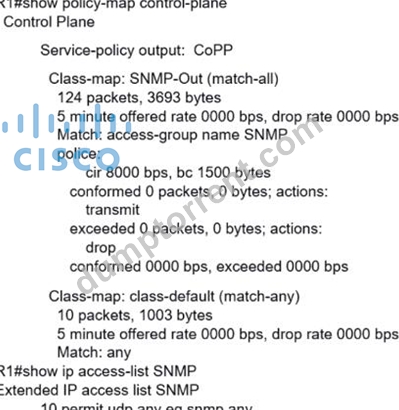
R1 is being monitored using SNMP and monitoring devices are getting only partial information. What action should be taken to resolve this issue?
- A. Modify the CoPP policy to increase the configured CIR limit for SNMP.
- B. Modify the access list to add a second line to allow udp any any eq snmp
- C. Modify the access list to include snmptrap.
- D. Modify the CoPP policy to increase the configured exceeded limit for SNMP.
Answer: C
NEW QUESTION # 297
Drag and drop the OSPF adjacency states from the left onto the correct descriptions on the right.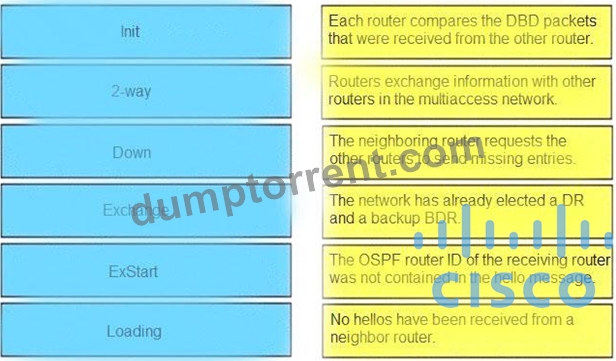
Answer:
Explanation: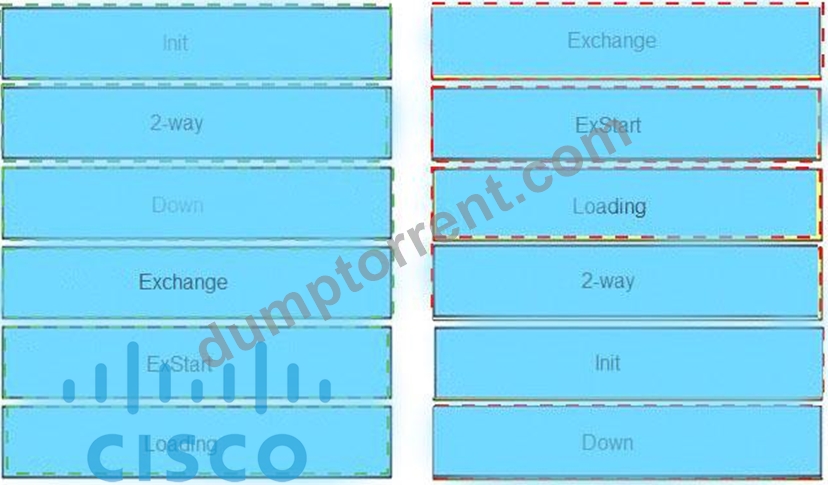
Explanation
Down
This is the first OSPF neighbor state. It means that no information (hellos) has been received from this neighbor, but hello packets can still be sent to the neighbor in this state.
During the fully adjacent neighbor state, if a router doesn't receive hello packet from a neighbor within the Router Dead Interval time (RouterDeadInterval = 4*HelloInterval by default) or if the manually configured neighbor is being removed from the configuration, then the neighbor state changes from Full to Down.
Attempt
This state is only valid for manually configured neighbors in an NBMA environment. In Attempt state, the router sends unicast hello packets every poll interval to the neighbor, from which hellos have not been received within the dead interval.
Init
This state specifies that the router has received a hello packet from its neighbor, but the receiving router's ID was not included in the hello packet. When a router receives a hello packet from a neighbor, it should list the sender's router ID in its hello packet as an acknowledgment that it received a valid hello packet.
2-Way
This state designates that bi-directional communication has been established between two routers.
Bi-directional means that each router has seen the other's hello packet. This state is attained when the router receiving the hello packet sees its own Router ID within the received hello packet's neighbor field. At this state, a router decides whether to become adjacent with this neighbor. On broadcast media and non-broadcast multiaccess networks, a router becomes full only with the designated router (DR) and the backup designated router (BDR); it stays in the 2-way state with all other neighbors. On Point-to-point and Point-to-multipoint networks, a router becomes full with all connected routers.
At the end of this stage, the DR and BDR for broadcast and non-broadcast multiacess networks are elected.
For more information on the DR election process, refer to DR Election.
Note: Receiving a Database Descriptor (DBD) packet from a neighbor in the init state will also a cause a transition to 2-way state.
Exstart
Once the DR and BDR are elected, the actual process of exchanging link state information can start between the routers and their DR and BDR. (ie. Shared or NBMA networks).
In this state, the routers and their DR and BDR establish a master-slave relationship and choose the initial sequence number for adjacency formation. The router with the higher router ID becomes the master and starts the exchange, and as such, is the only router that can increment the sequence number. Note that one would logically conclude that the DR/BDR with the highest router ID will become the master during this process of master-slave relation. Remember that the DR/BDR election might be purely by virtue of a higher priority configured on the router instead of highest router ID. Thus, it is possible that a DR plays the role of slave. And also note that master/slave election is on a per-neighbor basis.
Exchange
In the exchange state, OSPF routers exchange database descriptor (DBD) packets. Database descriptors contain link-state advertisement (LSA) headers only and describe the contents of the entire link-state database.
Each DBD packet has a sequence number which can be incremented only by master which is explicitly acknowledged by slave. Routers also send link-state request packets and link-state update packets (which contain the entire LSA) in this state. The contents of the DBD received are compared to the information contained in the routers link-state database to check if new or more current link-state information is available with the neighbor.
Loading
In this state, the actual exchange of link state information occurs. Based on the information provided by the DBDs, routers send link-state request packets. The neighbor then provides the requested link-state information in link-state update packets. During the adjacency, if a router receives an outdated or missing LSA, it requests that LSA by sending a link-state request packet. All link-state update packets are acknowledged.
Full
In this state, routers are fully adjacent with each other. All the router and network LSAs are exchanged and the routers' databases are fully synchronized.
Full is the normal state for an OSPF router. If a router is stuck in another state, it is an indication that there are problems in forming adjacencies. The only exception to this is the 2-way state, which is normal in a broadcast network. Routers achieve the FULL state with their DR and BDR in NBMA/broadcast media and FULL state with every neighbor in the remaining media such as point-to-point and point-to-multipoint.
Note: The DR and BDR that achieve FULL state with every router on the segment will display FULL/DROTHER when you enter the show ip ospf neighbor command on either a DR or BDR. This simply means that the neighbor is not a DR or BDR, but since the router on which the command was entered is either a DR or BDR, this shows the neighbor as FULL/DROTHER.
NEW QUESTION # 298
Refer to the exhibit.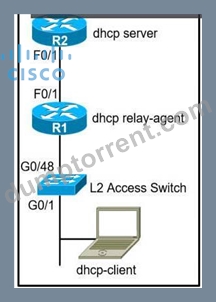
The network administrator can see the DHCP discovery packet in R1. but R2 is not replying to the DHCP request. The R1 related interface is configured with the DHCP helper address. If the PC is directly connected to the FaO/1 interface on R2, the DHCP server assigns as IP address from the DHCP pool to the PC. Which two commands resolve this issue? (Choose two.)
- A. ip dhcp relay information enable command on R1
- B. service dhcp command on R1
- C. ip dhcp option 82 command on R2
- D. service dhcp-relay command on R1
- E. ip dhcp relay information trust-all command on R2
Answer: A,D
NEW QUESTION # 299
Refer to the exhibit.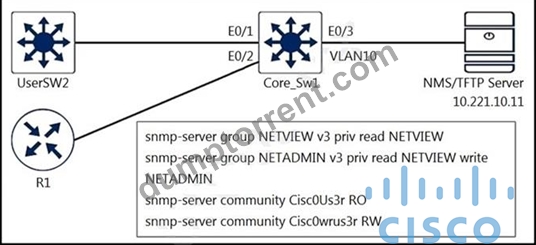
A junior engineer configured SNMP to network devices. Malicious users have uploaded different configurations to the network devices using SNMP and TFTP servers.
Which configuration prevents changes from unauthorized NMS and TFTP servers?
- A. access-list 20 permit 10.221.10.11
access-list 20 deny any log
!
snmp-server group NETVIEW v3 priv read NETVIEW access 20
snmp-server group NETADMIN v3 priv read NETVIEW write NETADMIN access 20 snmp-server community Cisc0wrus3r RO 20 snmp-server community Cisc0Us3r RW 20 snmp-server tftp-server-list 20 - B. access-list 20 permit 10.221.10.11
access-list 20 deny any log
!
snmp-server group NETVIEW v3 priv read NETVIEW access 20
snmp-server group NETADMIN v3 priv read NETVIEW write NETADMIN access 20 snmp-server community Cisc0Us3r RO 20 snmp-server community Cisc0wrus3r RW 20 snmp-server tftp-server-list 20 - C. access-list 20 permit 10.221.10.11
access-list 20 deny any log - D. access-list 20 permit 10.221.10.11
Answer: B
NEW QUESTION # 300
Refer to the exhibit.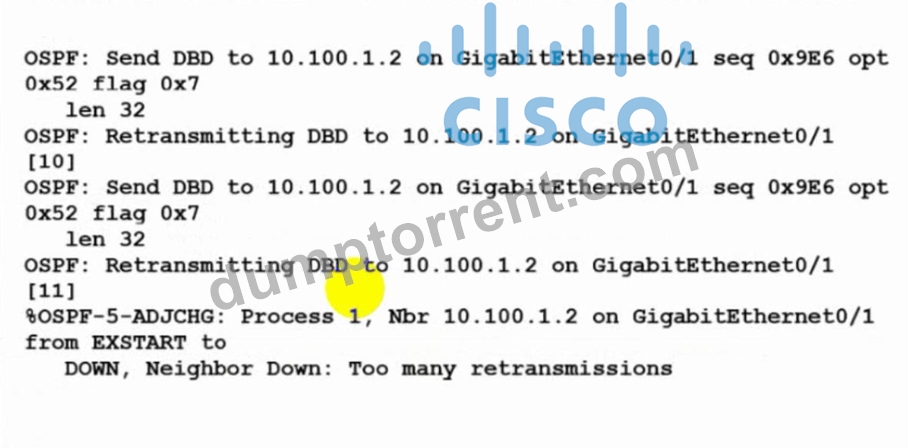
Refer to the exhibit. The OSPF neighbor relationship is not coming up What must be configured to restore OSPF neighbor adjacency?
- A. matching MTU values
- B. use router ID
- C. matching hello timers
- D. OSPF on the remote router
Answer: A
NEW QUESTION # 301
What does IPv6 Source Guard utilize to determine if IPv6 source addresses should be forwarded?
- A. Binding Table
- B. ACE
- C. DHCP
- D. ACLS
Answer: A
Explanation:
NEW QUESTION # 302
Refer to the exhibit.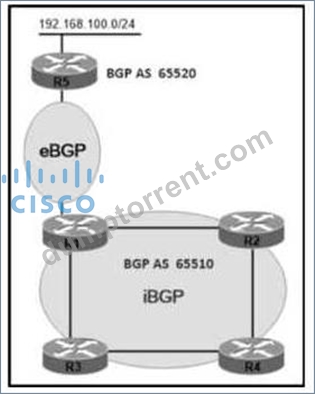
AS65510 iBGP is configured for directly connected neighbors. R4 cannot ping or traceroute network 192
168.100.0/24 Which action resolves this issue?
- A. Configure R1 as a route reflector server and configure R4 as a route reflector client
- B. Configure R4 as a route reflector server and configure R2 and R3 as route reflector clients.
- C. Configure R4 as a route reflector server and configure R1 as a route reflector client
- D. Configure R1 as a route reflector server and configure R2 and R3 as route reflector clients
Answer: C
NEW QUESTION # 303
Refer to the exhibit.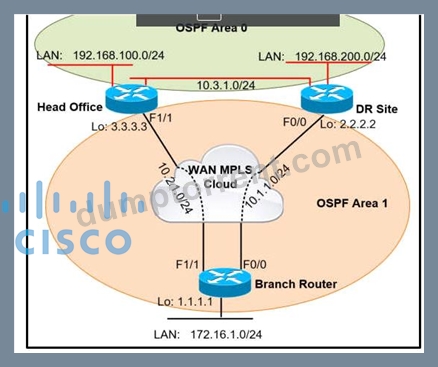
A network administrator reviews the branch router console log to troubleshoot the OSPF adjacency issue with the DR router. Which action resolves this issue?
- A. Configure the WAN interface for DR site in the related OSPF area.
- B. Stabilize the DR site flapping link to establish OSPF adjacency.
- C. Configure matching hello and dead intervals between sites.
- D. Advertise the branch WAN interface matching subnet for the DR site.
Answer: C
NEW QUESTION # 304
Refer to the exhibit.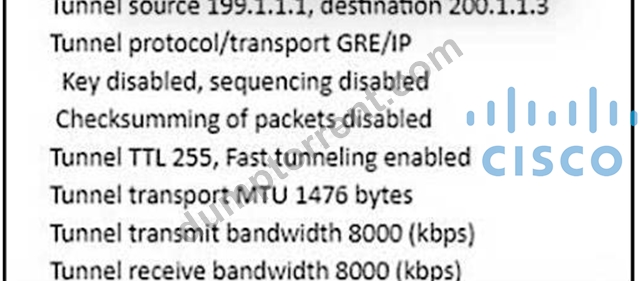
An engineer must establish a point-to-point GRE VPN between R1 and the remote site. Which configuration accomplishes the task for the remote site?
- A. Interface Tunnel1
tunnel source 200.1.1.3
tunnel destination 199.1.1.1
ip address 192.168.1.1.255.255.255.0 - B. Interface Tunnel
lunnel source 199.1.1.1
tunnel destination 200.1.1.3
ip address 192.168.1.1.255.255.255.0 - C. Interface Tunnel1
tunnel source 199.1.1.1
tunnel destination 200.1.1.3
ip address 192.168.1.3 255.255.255.0 - D. Interface Tunnel1
tunnel source 200.1.1.3
tunnel destination 199.1.1.1
ip address 192.168.1.3.255.255.255.0
Answer: D
NEW QUESTION # 305
Drag and drop the ICMPv6 neighbor discovery messages from the left onto the correct packet types on the right.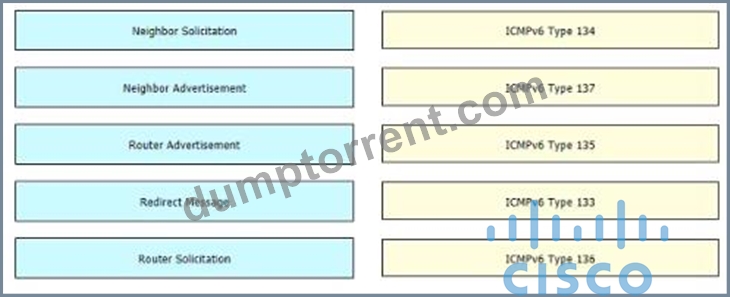
Answer:
Explanation: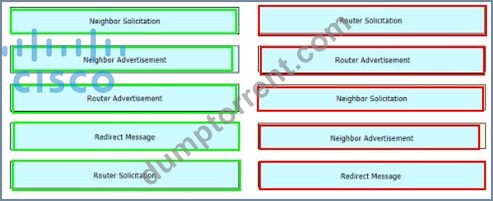
NEW QUESTION # 306
What is an MPLS LDP targeted session?
- A. session between neighbors that are connected no more than one hop away
- B. LDP session established between LSRs by exchanging TCP hello packets
- C. LDP session established by exchanging multicast hello packets
- D. label distribution session between non-directly connected neighbors
Answer: D
NEW QUESTION # 307
Refer to the exhibit.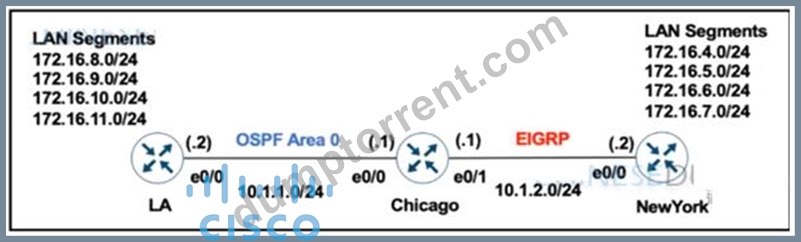
The network administrator configured the Chicago router to mutually redistribute the LA and NewYork routes with OSPF routes to be summarized as a single route in EIGRP using the longest summary mask: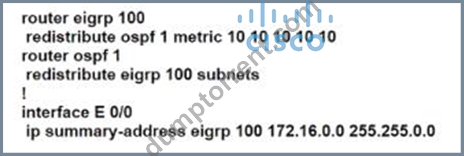
After the configuration, the New York router receives all the specific LA routes but the summary route. Which set of configurations resolves the issue on the Chicago router?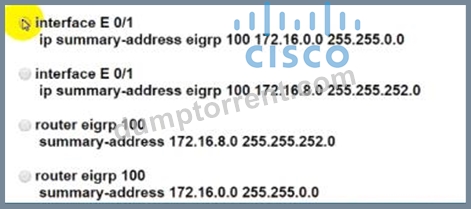
- A. Option A
- B. Option C
- C. Option B
- D. Option D
Answer: C
NEW QUESTION # 308
What does IPv6 Source Guard utilize to determine if IPv6 source addresses should be forwarded?
- A. Binding Table
- B. ACE
- C. DHCP
- D. ACLS
Answer: A
Explanation:
NEW QUESTION # 309 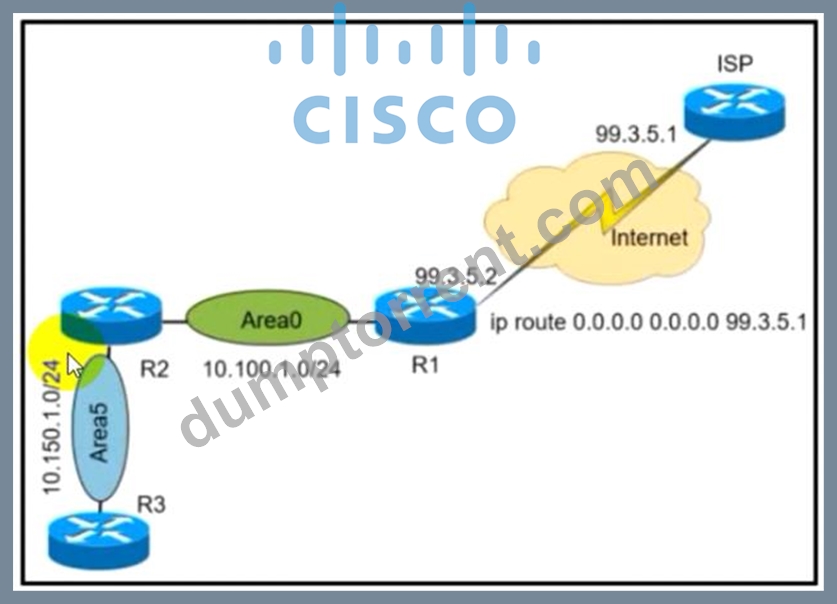
Refer to the exhibit. A network administrator redistributed the default static route into OSPF toward all internal routers to reach to Internet. Which set of commands restores reachability to the Internet by internal routers?
- A. router ospf 1
default-information originate - B. router ospf 1
redistribute connected 0.0.0.0 - C. router ospf 1
network 0.0.0.0 0.0.0.0 area 0 - D. router ospf 1
redistribute static subnets
Answer: A
NEW QUESTION # 310
Drag and drop the addresses from the left onto the correct IPv6 filter purposes on the right.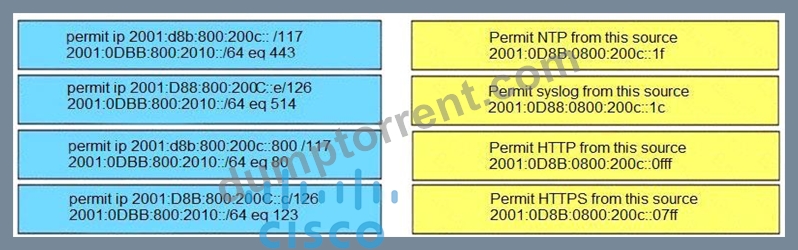
Answer:
Explanation: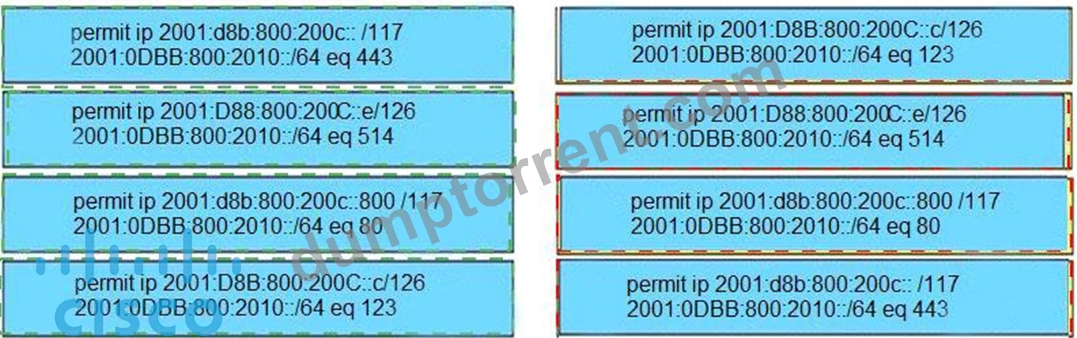
Explanation
Same Answer is already updated below: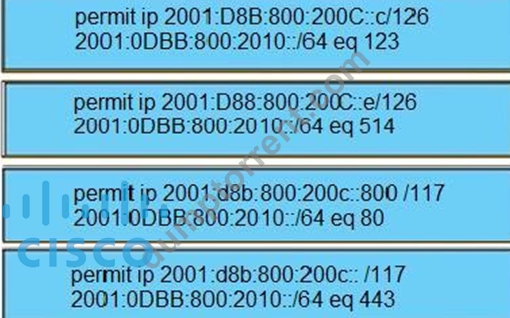
HTTP and HTTPs run on TCP port 80 and 443, respectively and we have to remember them.
Syslog runs on UDP port 514 while NTP runs on UDP port 123 so if we remember them we can find out the matching answers easily. But maybe there is some typos in this question as 2001:d88:800:200c::c/126 only ranges from 2001:d88:800:200c:0:0:0:c to 2001:d88:800:200c:0:0:0:f (4 hosts in total). It does not cover host 2001:0D88:0800:200c::1f. Same for 2001:D88:800:200c::e/126, which also ranges from
2001:d88:800:200c:0:0:0:c to 2001:d88:800:200c:0:0:0:f and does not cover host 2001:0D88:0800:200c::1c
.
NEW QUESTION # 311
......
Get instant access to 300-410 practice exam questions: https://drive.google.com/open?id=1ybFNYssZzQckJ_p_UA_m0pa2W2DX13fD
The best 300-410 exam study material and preparation tool is here: https://www.dumptorrent.com/300-410-braindumps-torrent.html